
Best Enterprise CMS Comparison 2026: Drupal, Contentful, and Sitecore Compared
Enterprise CMS decisions are made in months but lived with for years. Drupal, Contentful, and Sitecore each carry different cost trajectories, lock-in risks, and architectural trade-offs that only become visible at year three and year five. This enterprise CMS comparison 2026 cuts through the vendor positioning to give technical leaders an honest read on all three.
The enterprise CMS comparison 2026 looks very different from what it did three years ago. Contentful has evolved from a developer's tool into a robust enterprise platform. Sitecore has completely overhauled its architecture with XM Cloud.
At the same time, Drupal, the top open source enterprise CMS, has subtly become the go-to platform for many intricate digital projects around the world, such as those for the White House, the European Commission, and the Australian Government.
That makes 2026 a harder landscape to navigate than the one that existed three years ago, when the platforms were more clearly differentiated. For CTOs, tech leads, and architects facing a platform decision, the vendor comparison matrices and analyst quadrants are useful starting points. Still, they rarely answer the questions that actually determine whether an implementation succeeds at year three and year five.
This enterprise CMS comparison 2026 profiles each platform on its own terms, what it genuinely does well, where it hits structural limits at enterprise scale, and which kind of organisation belongs on it. We are not neutral observers. OpenSense Labs builds enterprise digital infrastructure on Drupal. But the analysis below is grounded in real TCO data, migration experience, and an honest account of where Contentful and Sitecore win.
Drupal, Enterprise CMS Comparison 2026: A Case for Open-Source Infrastructure
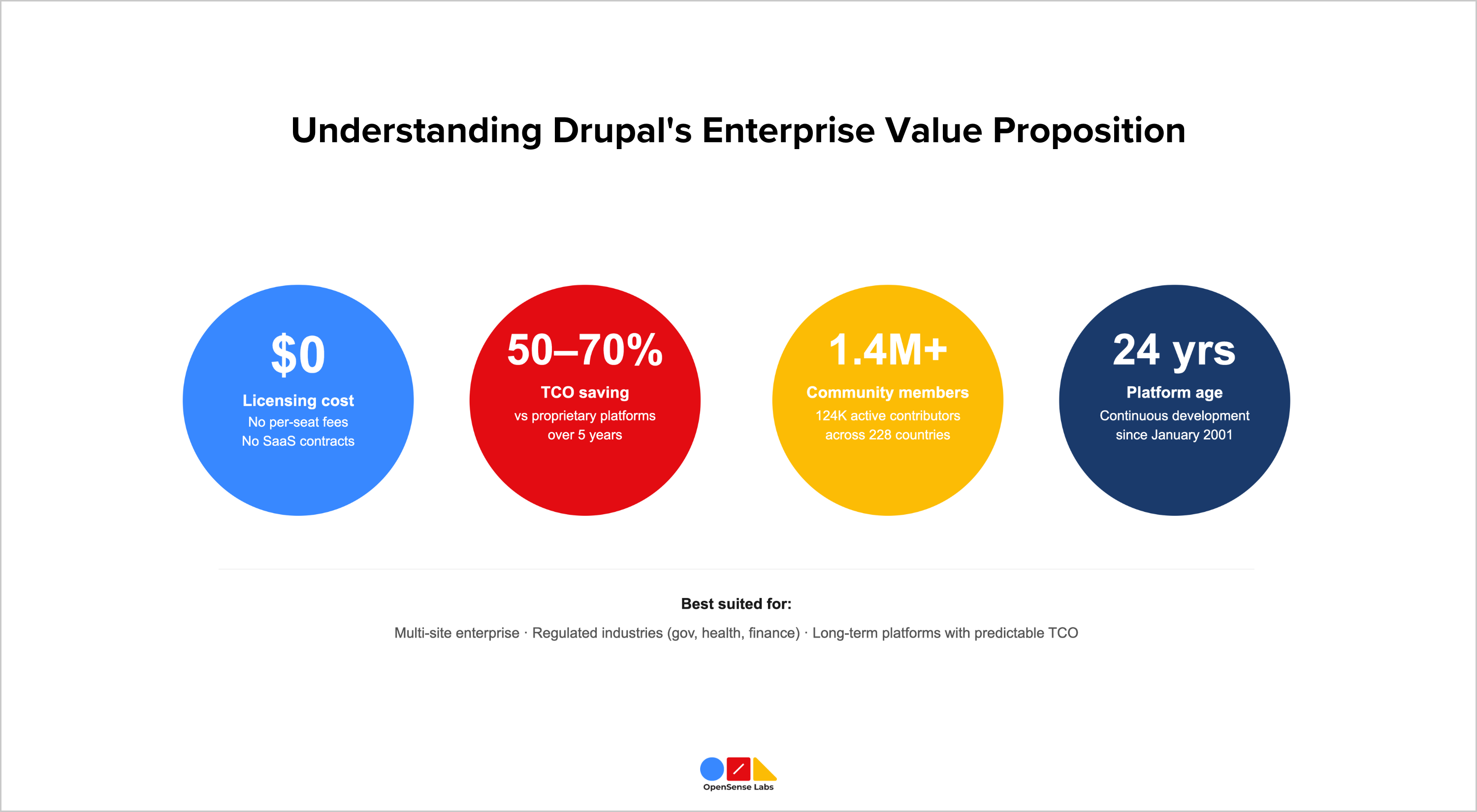
Drupal has been around for 24 years, led by technical experts who have managed extensive digital programs through various budget cycles, showcasing proven longevity rather than legacy risk.
The community governance has survived many commercial rivals. Its track record of backward compatibility is unmatched by any proprietary platform.
As an open source enterprise CMS, Drupal 10 and 11 are not the Drupal of 2008. Native JSON: API, contributed GraphQL, a modern configuration management system, and a layout builder that gives editorial teams genuine page-building capability without developer involvement.
The 2024 release of Drupal CMS, formerly Drupal Starshot, signals a decisive move toward marketer accessibility, narrowing the editorial UX gap that was Drupal's most legitimate historical weakness.
- Drupal Total Cost of Ownership: What the Numbers Say
No, licensing fee; it creates a fundamentally different total cost of ownership (TCO) path from the start. Enterprise Drupal setups are expensive; they require significant investment in design, development, and continuous support.
However, these expenses are mostly one-time. There are no per-user charges, no fees based on usage, and no SaaS agreements that increase each year.
Organizations that have switched from proprietary platforms often report a cost reduction of 50–70% over five years.
According to Gartner's TCO framework, the yearly costs of software ownership can be 3–4 times the original purchase price when considering personnel, maintenance, and infrastructure. This multiplier affects proprietary platforms more significantly since their ongoing fees are controlled by the vendor rather than managed internally.
2. The Lock-In Question
All information is stored in standard database formats, while all custom code remains fully owned by your organization. The platform also supports open standards such as REST and JSON, making integrations and future enhancements straightforward.
Changing hosting providers, switching frontend frameworks, or migrating to an enterprise CMS are separate choices that do not involve altering the CMS. The cost of leaving Drupal involves data migration. The cost of exiting a proprietary SaaS or .NET platform entails a re-platforming project.
In a Drupal vs Sitecore comparison in 2026, this distinction alone is often the deciding factor for organisations planning beyond a three-year horizon.
3. Community as a Long-Term Hedge
Over 24 years, Drupal has accumulated more than 1.4 million contributors across 228 countries. The Drupal Security Team maintains a proactive advisory programme with a 20-year documented CVE response history, the kind of audit trail enterprise security teams and regulators can actually evaluate.
Selecting Drupal means joining an ecosystem governed by the Drupal Association, a GPL licence, and a public roadmap that has held for two decades. No acquisition, no pivot, no funding round changes that.
4. Architecture: Headless Without Sacrifice
As a headless CMS for enterprise, Drupal runs as both a traditional coupled CMS and a fully decoupled headless backend, simultaneously, in the same installation. One content repository can serve a React marketing site, a native mobile app, a voice assistant, and a legacy web property, with no additional licensing and no per-channel fees.
Every capability is a module, every module is swappable, and the core is intentionally minimal. You build what you need without paying for what you don't.
Contentful, Enterprise CMS Comparison 2026: Headless Architecture at Enterprise Scale
Contentful built its reputation on a genuine insight; enterprise content management was too hard for developers to work with quickly, and the coupling of content storage with presentation was the primary reason. The headless CMS architecture Contentful pioneered for enterprise use in 2013 addressed that directly. It is clean, well-documented, and genuinely fast to deploy for teams that know what they are doing.
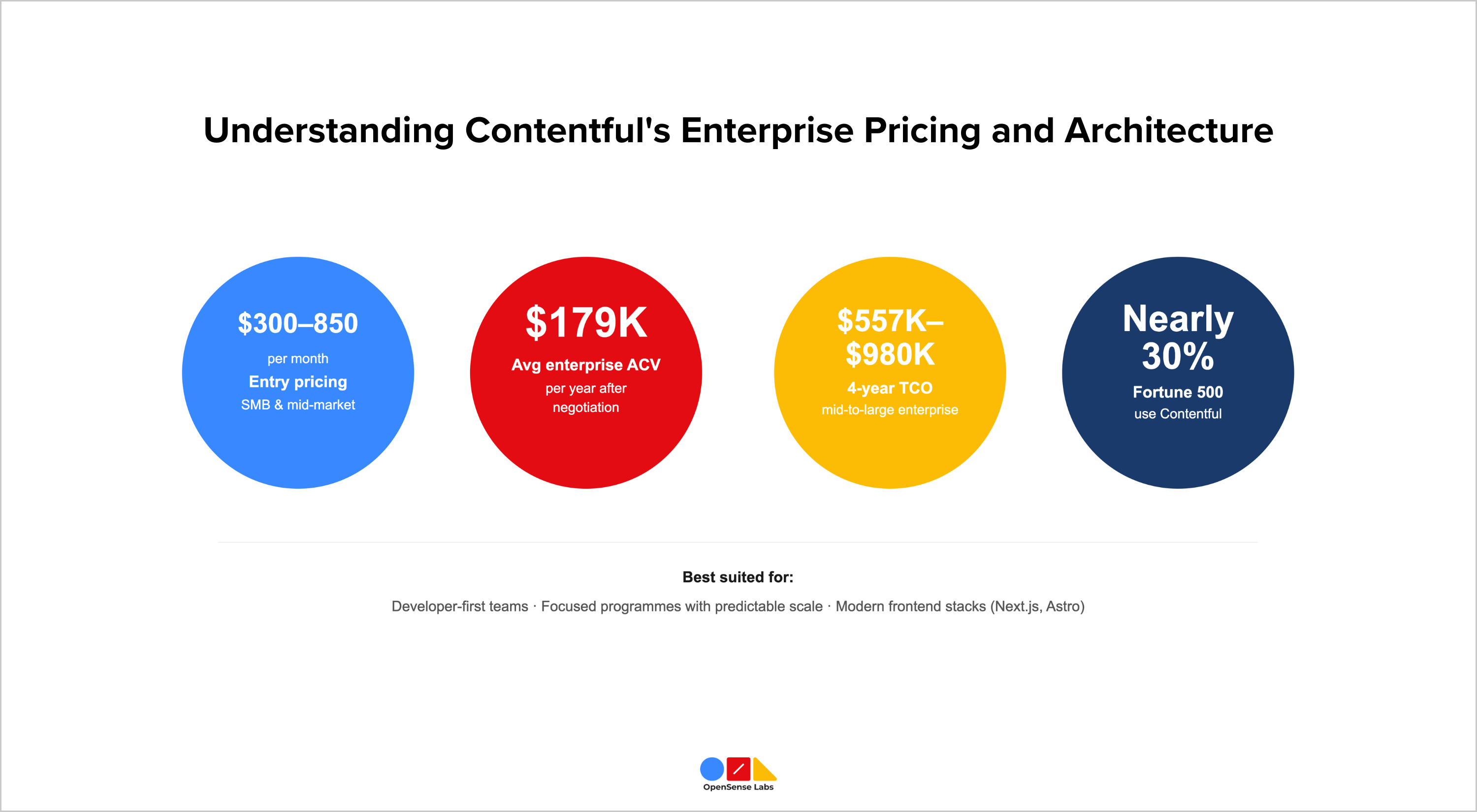
In 2026, Contentful leads the headless CMS market. Its Content Delivery API is efficient and highly trusted. The content modeling is organized and easy for developers to use. It serves almost 30% of Fortune 500 companies in various ways. For organizations that prioritize quick deployment, have a small to medium content team, and are at ease with SaaS solutions, it is an excellent option.
The complications emerge at enterprise scale, and they are structural rather than incidental.
- The Pricing Trajectory Problem
Contentful's listed pricing does not fully reflect the actual total cost of ownership for its enterprise CMS. Plans start at $300–$850 per month, but enterprise buyers negotiate custom contracts, and actual procurement data tells a different story.
Average annual contract values for enterprise deployments run around $179,000, with large organisations paying $80,000 to $200,000 or more, depending on traffic, locales, and support tier. A four-year TCO for a typical mid-to-large enterprise lands between $557,000 and $980,000 when subscription, implementation, and developer time are all included.
The compounding factor is usage-based pricing. API calls, content records, locales, and environments meter independently, so as a programme grows in markets and channels, the invoice grows non-linearly. Organisations that didn't model this at contract signature regularly find the gap between year-one and year-three costs is significant.
2. SaaS Dependency and the Lack of an Exit Strategy
Contentful is SaaS-only, no self-hosting, no data residency control. For organisations evaluating the best CMS for regulated industries, the absence of self-hosting alone is frequently disqualifying.
For others, the dependency is subtler: migration via API is technically feasible, but the organisational inertia of deep integration with Contentful's content model, workflows, and CDN makes switching non-trivial at scale. The growing ecosystem of Contentful alternatives exists largely because enterprises are already feeling this pressure.
3. The Editorial UX Gap at Volume
Contentful's editorial experience was designed for developers, not for large non-technical content teams. Without a native presentation layer, teams accustomed to page builders and live preview face a real usability gap. Content Studio and recent AI features are narrowing this, but organisations with dozens of contributors across multiple markets still typically need custom tooling or additional integrations to close it.
4. Where Contentful Genuinely Wins
Developer velocity. Martech integrations move faster on Contentful's API-first architecture than on platforms requiring custom backend work. For teams building in Next.js or Astro, time-to-deployment is shorter. Contentful is the right call for focused programmes with a modern frontend stack, a manageable content operation, and a team comfortable with SaaS infrastructure, as long as the programme doesn't outgrow those parameters.
Sitecore, Enterprise CMS Comparison 2026: Full Digital Experience Platform
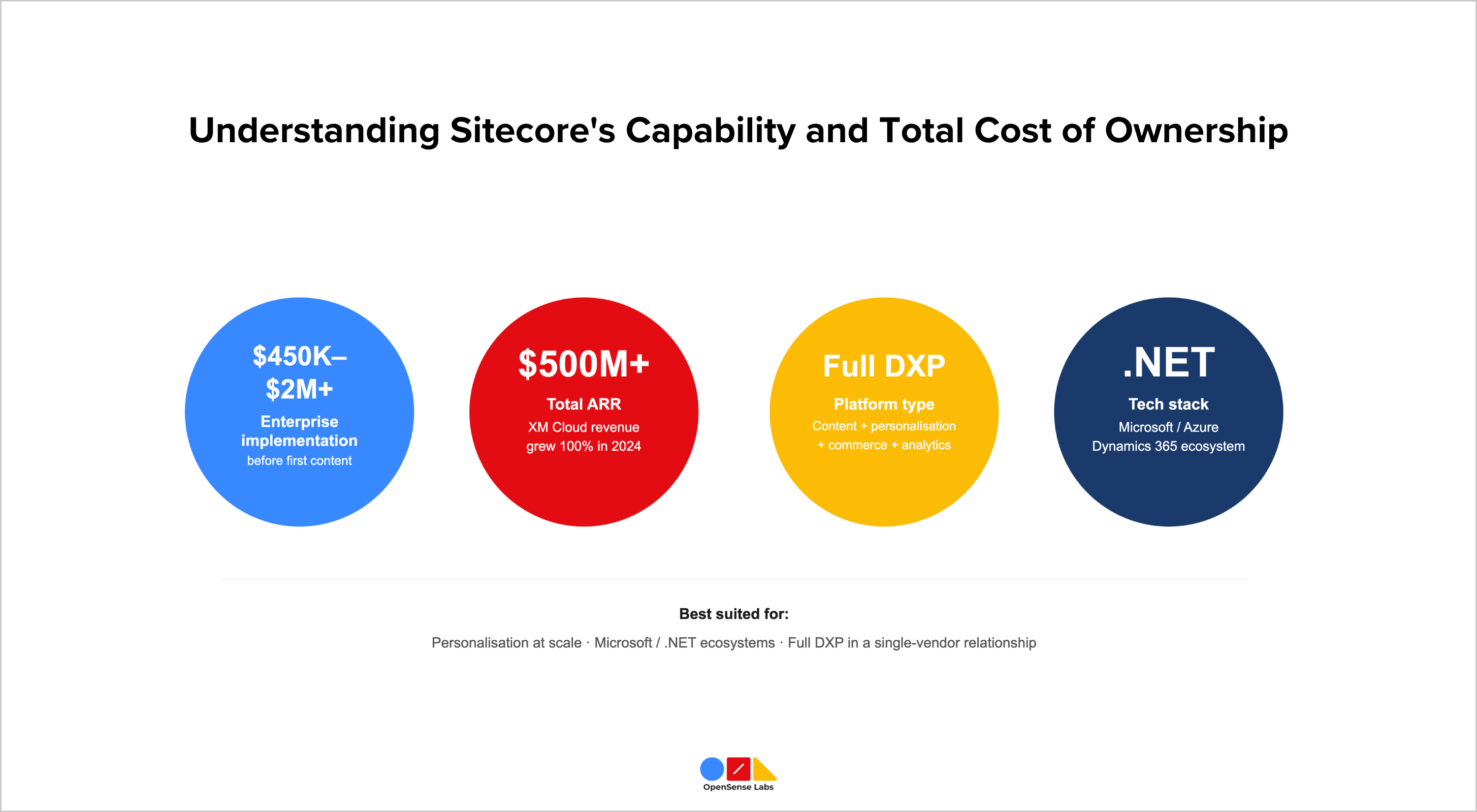
Sitecore is not a CMS in the same sense as Drupal or Contentful. It is a full digital experience platform, content management, personalisation, marketing automation, commerce, and analytics in a single vendor relationship. XM Cloud, with its cloud-native headless design, marks a true advancement from the on-premise .NET period. The platform is modernising, and the current generation is meaningfully better than what most legacy Sitecore critics are evaluating.
The honest framing; in any enterprise CMS comparison 2026, Sitecore is the most capable platform for specific use cases, and the most expensive and complex to operate across nearly all of them.
- Implementation: Complexity as the Entry Fee
Enterprise Sitecore deployments typically run $500,000 to $5 million before the first piece of content is published, covering licensing, customisation, integrations, infrastructure, and training. Timelines regularly extend across multiple quarters. Extracting value from the personalisation engine, marketing automation suite, and analytics infrastructure requires sustained investment in configuration and data integration long after go-live. This isn't a platform you stand up and walk away from.
2. Vendor Dependency at Platform Depth
Sitecore's lock-in is qualitatively deeper than Contentful's. Custom code doesn't port, templates and workflows are proprietary, and migrating away is a re-platforming project, equivalent in cost and risk to a greenfield build, not a content migration.
Sitecore has also seen significant ownership changes and product consolidations; the capabilities organisations built roadmaps around have been sunset or repositioned.
That history is worth factoring into any long-term commitment, and is one reason the Drupal vs Sitecore conversation in 2026 increasingly favours open-source for organisations prioritising platform stability.
3. Talent: A Narrower, Pricier Pool
Sitecore expertise is concentrated among .NET specialists who command a significant market premium. For organisations without an established .NET ecosystem or an existing Sitecore partner relationship, the talent supply chain is a real operational constraint, not a dealbreaker, but a cost that belongs in the overall CMS total cost of ownership model.
4. Where Sitecore Genuinely Wins
Personalisation at scale is Sitecore's real differentiator. A/B testing, behavioural segmentation, and cross-channel campaign orchestration are built natively into the same system, with no integrations required. For organisations already in the Microsoft ecosystem, with Azure infrastructure and Dynamics 365 in place, Sitecore fits in ways other platforms don't; integration investment is lower, and team expertise is closer.
If the primary investment is in delivering personalised experiences, not in content infrastructure, and the budget reflects that, Sitecore is a serious answer.
Organisations evaluating Sitecore XM Cloud alternatives consistently encounter Drupal as the strongest open-source counterpart for complex enterprise requirements.
Enterprise CMS Comparison 2026: Which Platform Fits Which Requirement
Most enterprise CMS evaluations stall because teams try to compare platforms feature-by-feature rather than requirement-by-requirement. The cleaner question is what a programme actually needs to succeed. The table below maps the most common enterprise requirements to the platform best positioned to meet them:
| If your primary requirement is… | Consider |
| Multi-site, multi-language at scale | Drupal |
| Regulated industries (gov, health, finance) | Drupal |
| Long-term platform with predictable TCO | Drupal |
| Rapid content MVP, small developer team | Contentful |
| Developer-first, modern frontend stack | Contentful |
| Deep personalisation + marketing automation | Sitecore |
| Full DXP in a single-vendor relationship | Sitecore |
| Budget-constrained enterprise | Drupal |
| Complex commerce + content integration | Drupal / Sitecore |
Three Fatal Selection Mistakes to Avoid
Most enterprise CMS implementations that underdeliver were not let down by the technology. They were let down by the selection process that preceded it. The three mistakes below account for the majority of avoidable platform failures:
- Feature overload: Vendors showcase hundreds of capabilities. Enterprises use 20–30%. Evaluate what you will actually use, not what the platform theoretically supports.
- Integration blindness: Selection is often driven by content creation UX, with API quality treated as secondary until it becomes a bottleneck.
- Ignoring content teams: Technically sound platforms regularly fail in practice because the people who use them daily were not consulted during selection.
Why We Build on Drupal
We have helped organisations navigate enterprise CMS migration to Drupal from their legacy platforms. We have run architecture consultations where the honest answer was that neither a re-platform nor a migration served the organisation's actual constraints, and the right move was to optimise what was already in place.
The organisations that get the most from Drupal treat their CMS as infrastructure, not as a product purchase. They invest in architecture before they invest in features. They think in five-year TCO horizons rather than annual contract renewals. And they choose implementation partners based on depth of Drupal expertise.
If you are navigating a CMS evaluation, or if an approaching contract renewal is forcing a reassessment, we are happy to share what we have seen work across industries, including what makes Drupal the best CMS for regulated industries like healthcare, finance, and government. That conversation does not require a sales process.
Ready to see what Drupal can do for your organisation?

Join Our Newsletter
Love open-source tech? Stay updated with projects that make a difference.