
DrupalCon Chicago: Key Product & AI Updates
“The DrupalCon Chicago keynote looks back at Drupal’s 25-year journey while outlining how the platform is evolving. It covers key updates such as Drupal CMS 2.1, AI-driven content workflows, and more efficient ways to build sites. Together, these updates point to the direction Drupal is moving next."
Over the years, we at OpenSense Labs have attended several DrupalCons, including DrupalCon Chicago, and each one has offered a different experience. What has remained consistent, however, is Dries’ keynote.
It continues to be a moment where the community comes together to reflect on Drupal’s progress, its challenges, and where it is headed.
This year felt more significant than usual, as Drupal celebrates its 25th anniversary. As the first DrupalCon Chicago after this milestone, the keynote carried a different weight. It was not just about current updates, but about setting the tone for what lies ahead.
Naturally, this is when the community leans in, paying close attention to how ideas are taking shape and how the platform is evolving.
Here are the key highlights from the DrupalCon Chicago, Driesnote, and what they signal for Drupal’s future.
Drupal’s Ecosystem Triangle: The Three-Part System
For over 25 years, Drupal has been built on a strong and balanced foundation, often described as a triangle. At the top sits Drupal as a platform, followed by agencies and organizations that bring it to life for businesses, and finally, the open-source community that continuously contributes to its growth.
This three-part ecosystem has remained resilient through multiple waves of technological change, proving its strength and adaptability over time.
However, with the rapid rise of AI, all three pillars of this ecosystem are being disrupted simultaneously, raising important questions about how Drupal will evolve in this shifting landscape.
“What happens when all three sides of this triangle are disrupted at the same time?” - Dries Buytaert
This very concern sets the stage for the latest product updates, as the focus now shifts toward adapting and strengthening Drupal for the AI-driven future.
Major Announcement Made During DrupalCon Chicago
DrupalCon Chicago set the stage for what’s next, introducing major updates to Drupal CMS and signaling the rapid growth of its marketplace ecosystem.
1. Drupal CMS 2.1 & Marketplace
At the product level, Dries revealed Drupal CMS 2.1, which is based on Drupal Core 11.3, and emphasized the continuous efforts to enhance its adoption. This update further strengthens Drupal CMS as a tailored platform with many built-in features, where ease of use remains a key priority.
Alongside usability, performance has also seen significant improvements. Over the past 18 months, Drupal has achieved a 50% reduction in database queries for uncached pages, one of the most notable performance gains in recent years.
These improvements directly benefit Drupal CMS, ensuring better performance for sites upgrading to the latest version.
“At DrupalCon Vienna, maybe six months ago, we had one site template. Well, I’m excited to announce that today we have 11 site templates and a marketplace.” - Dries Buytaert
At DrupalCon Chicago, the marketplace is positioned as an early but meaningful step forward, focused on providing ready-to-use solutions with well-designed themes to support broader adoption of Drupal. It also creates opportunities for agencies to build and distribute reusable solutions, improving their visibility and potential lead generation.
As part of this growing ecosystem, OpenSense Labs contributed CareSphere, the first non-profit-focused template on the Drupal marketplace, designed to help organizations launch mission-driven digital experiences more efficiently.

2. Content Control Center
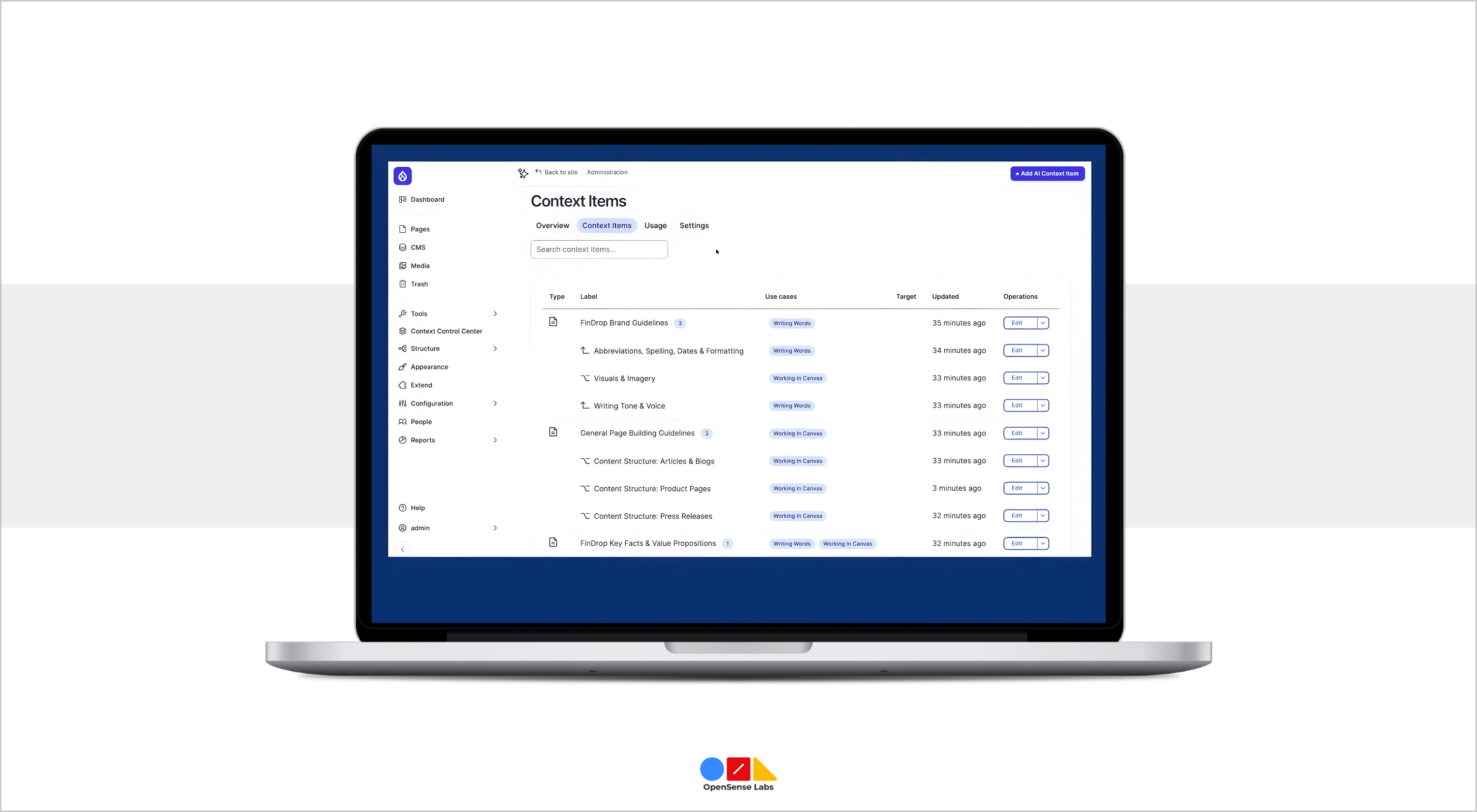
The Context Control Center was another important focus area in the keynote. First introduced as a rough prototype at an earlier DrupalCon, it has since evolved significantly and is now nearing production readiness.
At DrupalCon Chicago, Dries explained how it structures organizational knowledge into different layers, such as:
- Brand guidelines (including formatting rules and abbreviations)
- Tone, voice, and visual direction
- Content strategies for different page types
- Key value propositions and supporting materials
- Personas and customer profiles
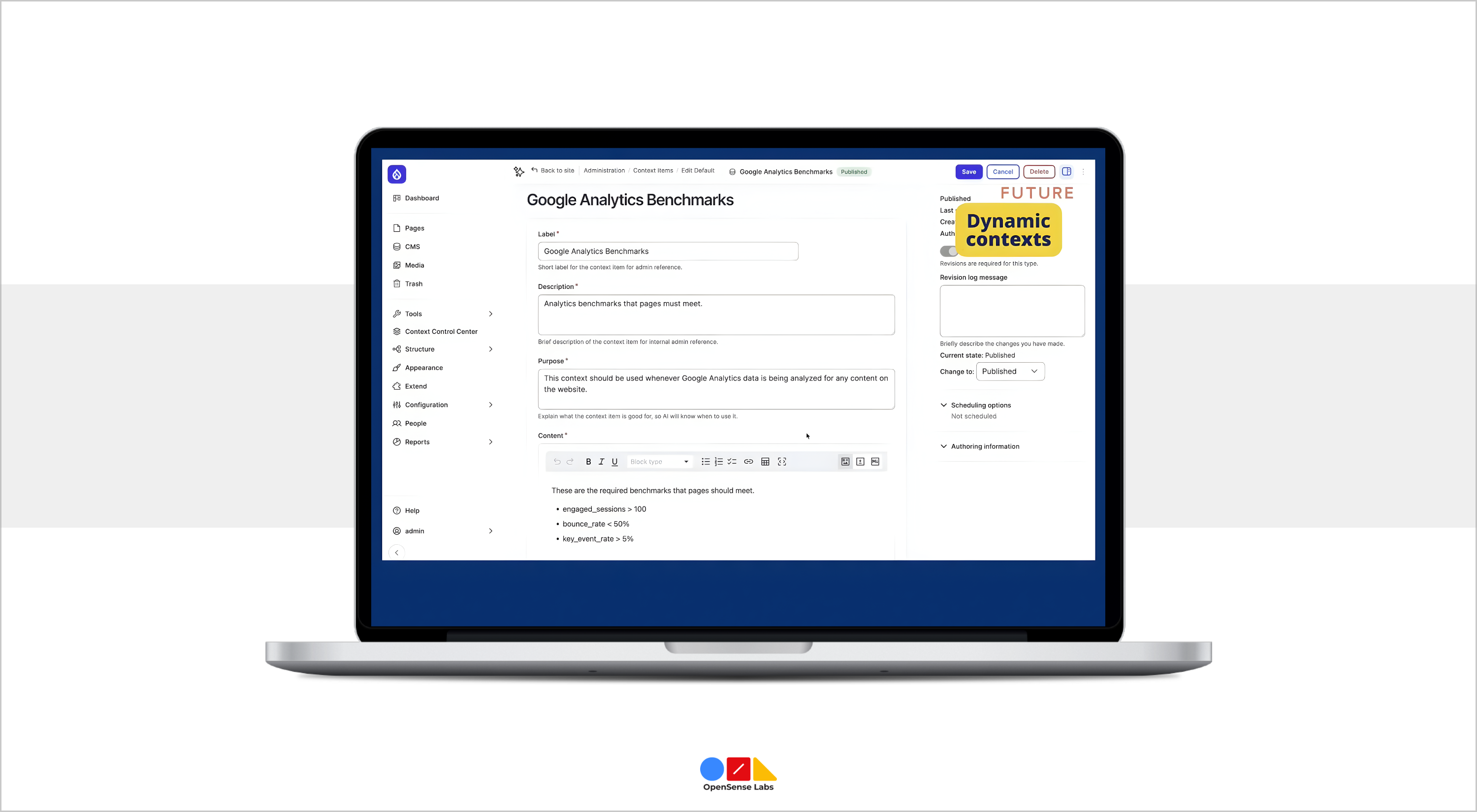
- Metrics and analytics, including live data integrations
An important direction for this system is its ability to go beyond static content. It is designed to connect with external tools like analytics platforms and CRM systems, ensuring that AI works with up-to-date and relevant information.
It also selectively loads context based on the task, for example, using product-related context when building a product page, rather than unrelated content structures.
3. Drupal Canvas & AI Integration
Another major announcement at DrupalCon Chicago was the release of the Drupal Canvas CLI & AI Integrations, a tool that bridges the gap between design outputs and production-ready Drupal builds.
At its core, the Canvas CLI takes a finished design (often created using tools like Lovable) and converts it into a structured Drupal implementation. It uses a set of predefined skill files to map visual elements into Drupal components, content types, and configurations.
Here’s how it works:
- The design input is fed into the CLI
- Skill files interpret the layout, sections, and elements
- These are translated into Drupal-compatible structures such as components and content models
- The system generates the required code and configuration within Drupal
The outcome is a structured setup with reusable components, defined content models, and editorial capabilities in place.
The process is not entirely hands-off. An engineer typically reviews and validates the output to ensure it aligns with real-world requirements.
With this approach, what would traditionally take days of manual development can now be completed in just a few hours.
4. AI-Generative Content Creation
A key addition highlighted in the keynote was AI agents that monitor and optimize content after it goes live.
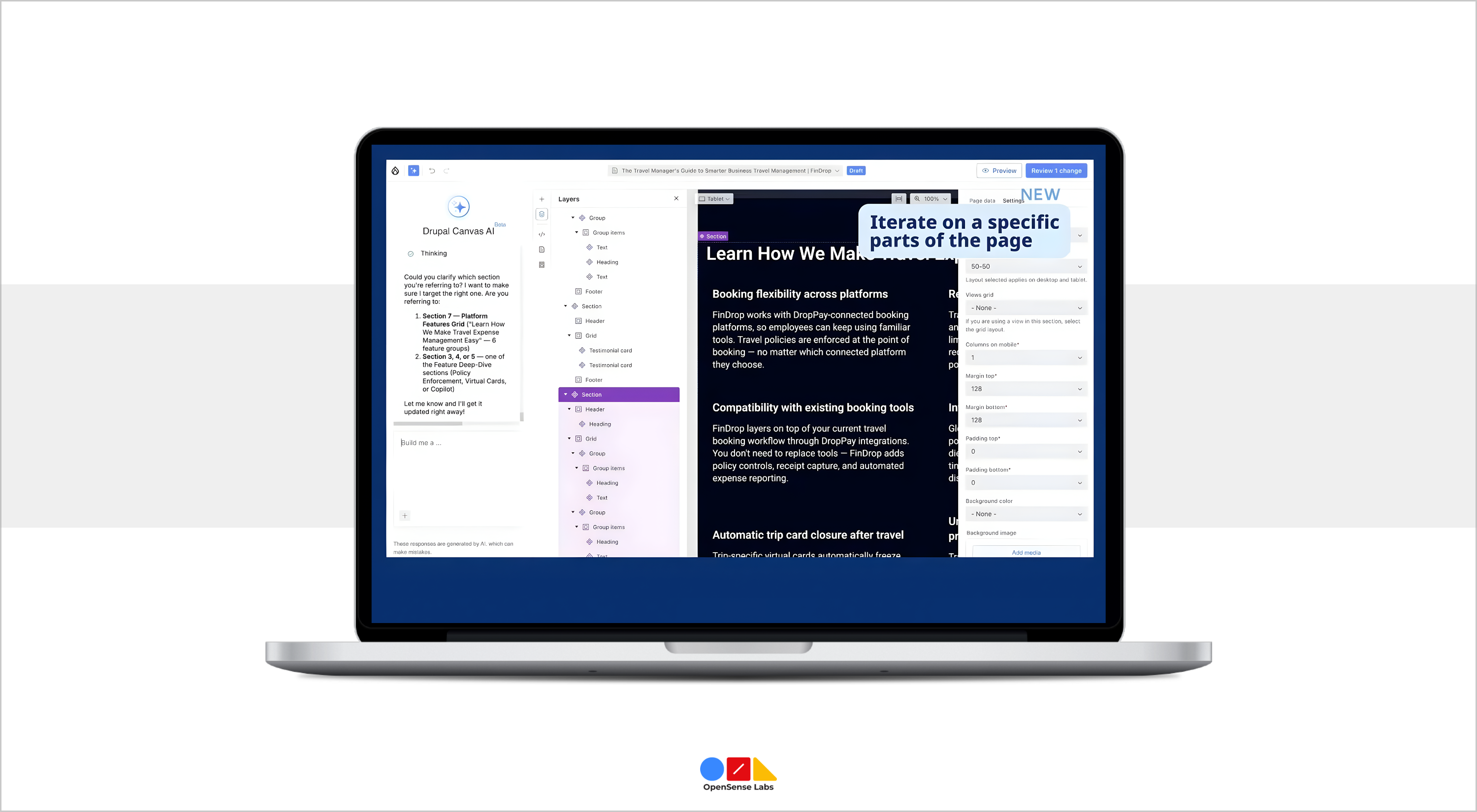
Using Drupal Canvas AI, unstructured inputs such as plain text documents can now be transformed into fully structured web pages. The system is capable of:
- Identifying the type of page (e.g., product page, landing page)
- Pulling relevant brand guidelines from the Context Control Center
- Asking clarifying questions before generating output
- Structuring content into Drupal components with proper layout, typography, and media
The generated output aligns with Drupal’s core strengths, including structured content, reusable components, and governance.
The demo also highlighted how AI can assist in:
- Enhancing content with relevant imagery
- Creating dynamic elements like FAQs
- Linking related content using semantic search
- Generating structured data for better visibility in AI-driven search experiences
The key takeaway is that AI is not replacing roles but augmenting them. It brings together capabilities similar to design, development, and SEO, allowing teams to focus more on decision-making while reducing repetitive work.
If you want to explore what’s already possible today, we have also discussed Drupal AI modules for content creation and automated workflows like Field Widget Actions, both of which are steps toward what was demonstrated.
5. AI Agents for Continuous Content Optimization
The keynote also introduced AI agents focused on monitoring and optimizing content after publication. This new capability shifts that approach by enabling continuous, AI-driven content optimization.
With this feature, teams can:
- Mark specific pages as high priority
- Define performance goals such as bounce rate, engagement, or conversions
- Continuously monitor these metrics through an AI agent
Instead of simply reporting issues, the AI goes a step further by analyzing performance in context. It can:
- Compare existing content against updated inputs from the Context Control Center
- Detect gaps caused by changes in business data, messaging, or strategy
- Recommend specific improvements based on the latest available information
- Identify inconsistencies, including potential brand misalignment, before updates go live
This approach also connects insights across multiple systems such as analytics tools, CRM platforms, and content workflows, ensuring that content remains aligned with real-time business changes.
Drupal’s Other 2 Parts: Ecosystem & Community Impact
Alongside the major changes coming to Drupal, Dries also spoke about what these shifts mean for the broader ecosystem. He focused on their impact on agencies and the community, and how each part will need to adapt as Drupal continues to evolve.
For Agencies
Drupal is growing beyond a site-building tool into a system for capturing and scaling expertise.
With capabilities like the Context Control Center, content modeling, workflows, and site templates, agencies can turn their experience into structured, reusable solutions.
In this way, Drupal can help agencies in applying their expertise more consistently, scale their knowledge across projects, and operationalize what was previously informal or experience-based.
He positioned this as a significant opportunity for agencies in an AI-driven landscape.
At the same time, initiatives like Drupal Pivot events are creating space for open conversations, helping agencies navigate challenges and adapt in an AI-driven landscape.
For the Community
As AI lowers the barrier to contribution, maintaining quality standards becomes even more important. The focus should be on contributing responsibly rather than contributing more. As Dries pointed out:
“Contributors should not submit code they do not understand.”
Ultimately, DrupalCon Chicago 2026 reflects a broader shift in how Drupal is growing as a platform, an ecosystem, and a community.
The path forward will require continuous learning, experimentation, and active participation. But as always, Drupal’s greatest strength lies in its community and its ability to evolve together.
Exploring Drupal for your next project?
At OpenSense Labs, we have over 13+ years of experience with Drupal, creating enterprise platforms, intranets, and intricate web applications. We contribute to the Drupal CMS community (including the Careshpere, the first non-profit site template) and utilize AI to enhance our development processes daily.
If you’re launching a new Drupal project, transitioning from a different platform, or exploring how AI can integrate into your content operations, our team is here to assist. Check out our development services to find out more about our approach or reach out to us directly to talk about your project.

Join Our Newsletter
Love open-source tech? Stay updated with projects that make a difference.