
Digital Maturity Model: What Stage Are You In?
Digital capability and digital maturity are not the same thing. Knowing which one your organisation actually has, and where the difference shows up day to day, changes how investment, priorities, and timelines get decided. A digital maturity model offers a practical way to see that distinction clearly.
Most organisations believe they are further along on the digital maturity model than they really are.
Leaders point to a new CMS, a redesigned website, or a mobile app as proof of digital progress. But having digital tools is not the same as delivering a mature digital experience.
BCG's research on digital transformation has found that as many as 70% of initiatives fall short of their intended objectives.
A digital maturity model changes that. It gives senior leaders a structured way to assess their current state honestly, identify where the real gaps are, and build a roadmap that reflects actual capability, not aspiration.
What is a Digital Maturity Model?
A digital maturity model is a framework that describes how organizations progress from fragmented, reactive digital activity to a connected, continuously improving digital experience strategy.
It does not measure how much an organization has spent on technology. It measures how effectively an organization uses digital channels, content, data, and team structure to serve its users and deliver on business goals.
The model does two things at once:
- It is descriptive; it tells you where you currently stand, and
- It is prescriptive; it tells you what the next stage looks like and what you need to get there. Most strategy tools do one or the other. A digital maturity model does both.
Why Organizations Need Digital Maturity Model?
The case for using a digital maturity model comes down to one problem, you cannot improve what you have not honestly measured.
Most organizations overestimate where they are. The leadership team sees the platforms purchased and assumes a high level of capability. Meanwhile, frontline teams are copying data between systems, working around disconnected tools, and building informal processes to fill the gaps. The distance between perception and reality is where transformation programmes quietly fail.
A digital maturity model helps address this in three specific ways:
- Prevents Costly Sequencing Errors: The most common mistake in digital transformation is attempting advanced initiatives on immature foundations. Launching a personalization programme without connected data will not deliver results. Investing in AI-assisted content without a coherent governance structure will not either. A maturity model shows the dependencies before organizations make those bets.
- Creates Alignment Across Teams: Without a shared framework, digital, IT, marketing, and product teams each pursue their own version of transformation, often with incompatible definitions of what maturity means. A maturity model gives everyone the same map.
- Makes Progress Measurable: Without a baseline, it is impossible to know whether investment is making a genuine difference. A maturity model gives organizations a way to track improvement over time and to catch stagnation before it becomes a problem.
The Five Stages of Digital Maturity Model
Every organisation sits somewhere on the digital maturity model, whether it has been formally assessed or not. The five stages below describe a typical progression from fragmented, disconnected digital activity through to a fully optimised, continuously improving digital experience.
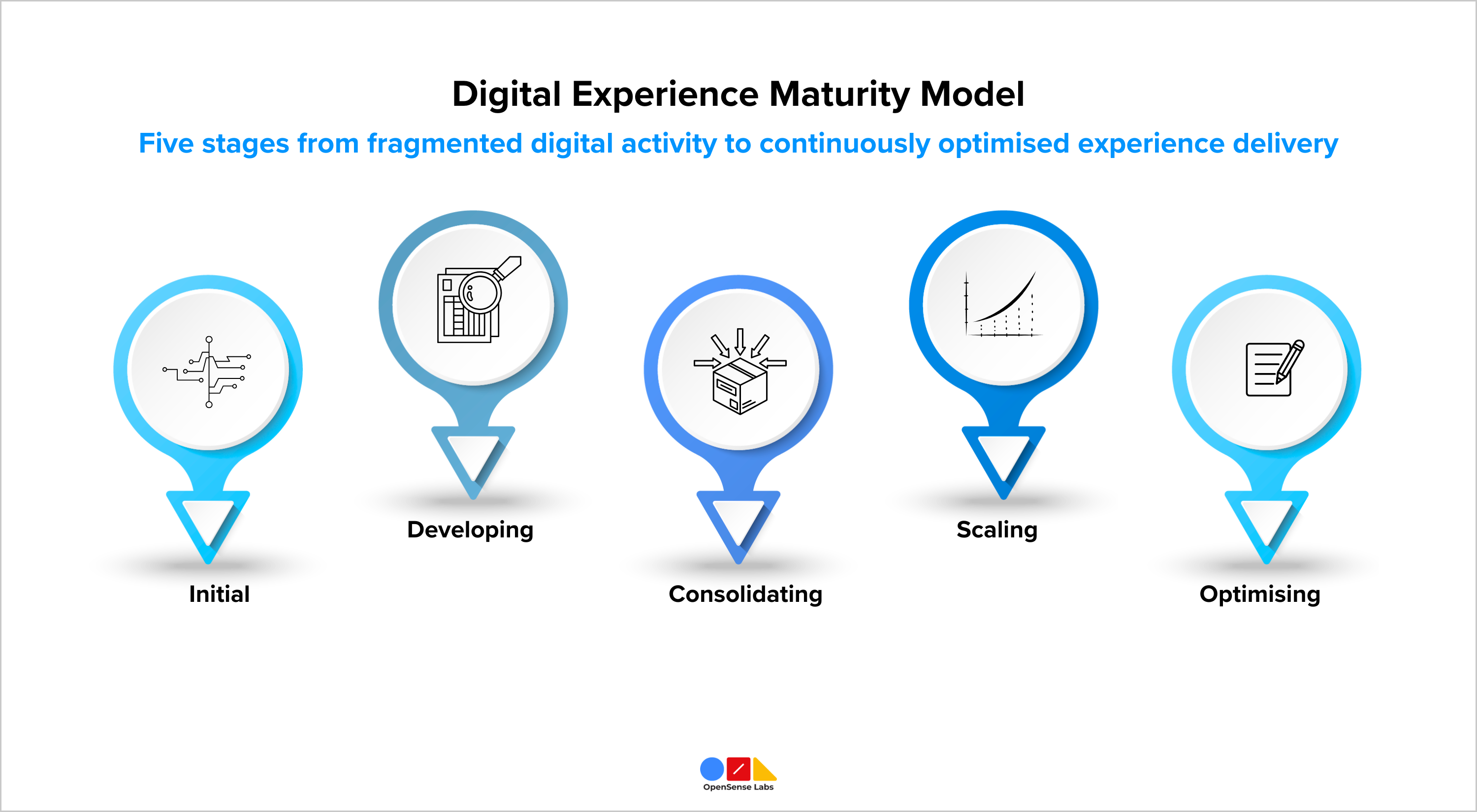
Each stage outlines what it looks like in practice, what it costs the organisation to stay there too long, and what to prioritise to move forward.
Stage 1: Initial Stage
In Stage 1 of the digital maturity model, organisations are often at the very beginning of their digital transformation journey. Digital capabilities are usually minimal and scattered. Technology decisions tend to be reactive, with little alignment between digital transformation efforts and overall business strategy.
Organisations at this stage typically show one or more of the following traits:
- Isolated digital tools with poor integration, resulting in data silos.
- Inconsistent processes and a lack of standardisation across departments impede collaboration between teams.
- Ad hoc investments and reactive responses to immediate needs lead to low adoption rates.
- Executive support shown mainly through technology spend, with no active sponsorship for digital transformation.
- Limited digital skills and awareness among employees, often accompanied by resistance to change.
- Technology is perceived as an IT issue rather than a business enabler or part of a wider business strategy.
Stage 2: Developing
At Stage 2, organisations begin testing digital tools, usually through isolated pilot programmes or informal departmental projects. There is some initial progress, but these efforts are not yet widely implemented or well coordinated, resulting in uneven digital execution and adoption across teams. Leaders increasingly recognise the importance of collaboration, data sharing, and a clear digital transformation strategy.
Organisations at this stage of digital maturity typically show:
- Use of basic digital tools with some level of automation.
- Initial process mapping and standardisation, mostly specific to individual departments and inconsistent across the organisation.
- Growing interest in developing digital skills.
- Early adopters are encouraging colleagues to engage more with digital transformation initiatives.
- Varying levels of support across the organisation.
Stage 3: Established
At Stage 3, digital tools have been adopted across the organisation. Most core systems are connected, minimising data silos and disruption, while processes are standardised enterprise-wide for consistency. At this stage of the digital transformation maturity model, digital efforts increasingly align with business goals, supported by governance and measurable objectives. Digital literacy is rising, and cross-functional collaboration becomes the norm rather than the exception.
Organisations at this stage typically exhibit:
- Implementation of enterprise-level platforms such as ERP, CRM, and data analytics tools.
- Senior leaders are taking a more proactive role in supporting digital transformation, treating it as a core responsibility.
- Increased employee confidence in using digital tools, with digital literacy improving across teams.
- Recognition that digital change is integral to the business model.
- A structured digital strategy directly connected to business objectives, enabling progress tracking and demonstrable ROI.
Stage 4: Scaling
At Stage 4 of the digital maturity model, organisations rely on data and predictive analytics for decision-making, integrating emerging technologies such as artificial intelligence and the Internet of Things into operations. The workforce often includes specialised talent to support digital initiatives, reflecting a view of digital transformation as an ongoing, valued part of the business. Innovation and cross-functional collaboration become defining features of the culture.
Organisations at this stage typically show:
- Operations that incorporate advanced analytics, AI, cloud-first strategies, and IoT solutions.
- Automated, data-driven decision-making is central to business strategy and development.
- Specialised digital roles on the team, such as data scientists and automation engineers.
- Employees actively propose new ideas for digital enhancement and recognise the value of digital transformation.
- Digital investments clearly linked to measurable business outcomes.
- A robust change management framework that supports continuous improvement and innovation.
Stage 5: Optimising
At the top of the digital maturity model, digital transformation becomes fully integral to the organisation, the point at which a business can genuinely be described as digitally mature. The business model consistently embraces new technologies, is underpinned by a strong digital transformation strategy, and operates within a culture where agility is essential. Continuous improvement and innovation are woven into processes, culture, and the use of digital technology.
Organisations that are digitally mature at this stage typically exhibit:
- Regular adoption of new technologies, supported by a structure built for scalability and flexibility.
- A culture focused on ongoing process improvement, with feedback loops that drive continuous iteration.
- Digital fluency across the organisation, supported by a talent strategy that encourages ongoing skill development.
- Deeply ingrained change agility, making digital innovation a fundamental part of the organisation's identity and culture.
- Digital transformation treated as a core business skill, supported by effective change management aligned to digital objectives.
- Comprehensive training available at every level of the organisation.
The Dimensions a Solid Framework Covers
Having walked through the five stages of the digital maturity model, it is worth understanding the dimensions used to assess where an organisation sits within them. A single overall score might not give the full picture. Most organisations are more mature in some areas than others, and the gaps between dimensions are usually where the most valuable work is.
Every serious digital maturity framework assesses more than technology. Deloitte's model covers customer, strategy, technology, operations, and culture. The EU's Digital Readiness Assessment covers six dimensions, including strategy, readiness, people, data governance, automation, and sustainability. The consistent message across all of them: technology deployment alone is not transformation.
Five dimensions matter most when assessing digital maturity:
- Strategy and Vision: Is there a documented digital experience strategy connected directly to business goals, with active executive ownership?
Organisations that treat digital as purely an IT responsibility consistently stall in the lower stages of the digital maturity model. - Technology and Infrastructure: Are core platforms CMS, CRM, analytics, and personalisation integrated?
Can data move between them without manual intervention? A large technology stack is not the same as a mature one. - Content and Data: Is content managed with clear governance, defined ownership, publishing processes, and quality controls? Is data centralised, reliable, and accessible to the teams that need it?
Organisations that skip governance find their data becomes less trustworthy over time, undermining every capability that depends on it. - People and Culture: Do teams across the business feel ownership of the digital experience? Is there a shared understanding of how digital performance is measured?
Culture is the dimension most underscored in self-assessments, and the one that cannot be fixed by a platform purchase. - Customer Engagement: Can users move between digital channels without losing context?
Are experiences adapted based on real behaviour, or static across all users?
This dimension measures the experience from the outside, which is ultimately what determines whether investment in the other four is delivering value.
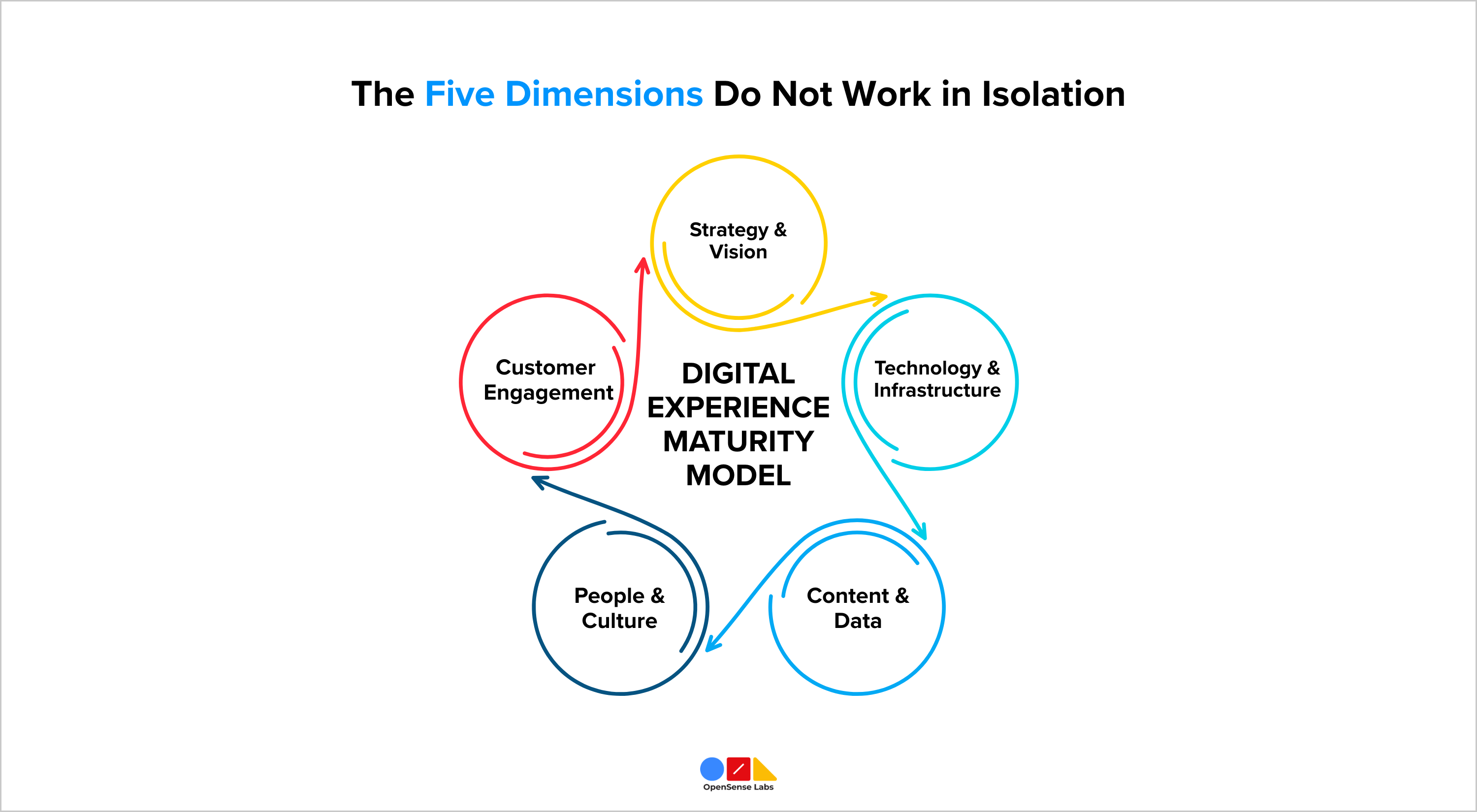
The five dimensions of the digital maturity model rarely work in isolation. Strategy shapes technology decisions, since unclear ownership leads to investments made without direction. Integration then enables clean data flow, while fragmented platforms produce fragmented, untrustworthy data.
That data quality directly shapes personalisation; poor data puts a ceiling on what experiences can achieve. Culture, meanwhile, shapes ambition. When digital is seen as IT's job, organisations rarely build the strategy needed to progress. And customer experience feeds back into priorities, revealing where people and skills gaps hold the business back.
The weakest dimension always sets the ceiling for the rest.
What Makes a Digital Maturity Assessment Rigorous?
A digital maturity model is only as useful as the assessment behind it. Several things determine whether the output is actionable or just a score.
- Evidence: the most reliable assessments collect evidence across multiple levels of the organisation. Executives almost always rate maturity higher than the people doing the day-to-day work. Both perspectives are needed to get an accurate picture.
- Dimension-level Scoring: Scoring each dimension separately, rather than producing a single composite number, reveals where the real gaps are. A business might score well on technology infrastructure but poorly on data governance. That pattern tells a very different story and demands a very different set of priorities than the composite score would suggest.
- A Sequenced Next Step: The most useful output of a digital maturity assessment is not a fifty-point roadmap. It is a clear answer to one question: what is the one capability gap that, if closed first, would create the most leverage for everything that follows?
- Reassessment Over Time: Digital maturity changes. What was accurate twelve months ago may no longer reflect reality. Organisations that treat a maturity assessment as a one-time exercise, rather than an ongoing discipline, lose the one thing that makes the model valuable: the ability to see whether the work is moving the needle.
Understanding your current stage on the digital maturity model is the starting point. It shapes where investment should go, which capabilities to build next, and what realistic progress looks like over the next twelve to twenty-four months.
OpenSense Labs works with enterprise organisations to assess their digital maturity and build practical roadmaps for progression. If your organisation is ready to understand where it sits and what the path forward looks like...

Join Our Newsletter
Love open-source tech? Stay updated with projects that make a difference.