
Why Your LMS Isn't Enough Anymore: Choosing Between LMS Vs LXP for Higher Education
Choosing between LMS vs LXP is one of the more consequential technology decisions an EdTech or higher education institution can make; it shapes budgets, faculty workflows, and how well an institution can support both structured programmes and self-directed learning.
Higher education and EdTech leaders are dealing with a familiar problem: the learning platform that once worked well no longer fits how students and staff want to learn.
Enrolment portals feel rigid, course completion rates stay flat, and faculty ask for more flexibility, and students expect the same personalized, on-demand experience they get from consumer apps.
This is where two acronyms enter the conversation, LMS vs LXP. Both promise to solve the learning technology problem, but they are built for different jobs. An LMS is designed to manage structured courses, track compliance, and support accreditation. An LXP is designed to help learners discover content on their own terms, based on their interests and skill gaps.
For most institutions, the real question is not which acronym sounds more modern, but which LMS vs LXP approach or combination actually fits how an LMS for higher education strategy needs to work.
This article breaks down what each system does, where they differ, and how EdTech and higher education leaders can decide what is right for their institution.
LMS vs LXP: What Is a Learning Management System (LMS)?
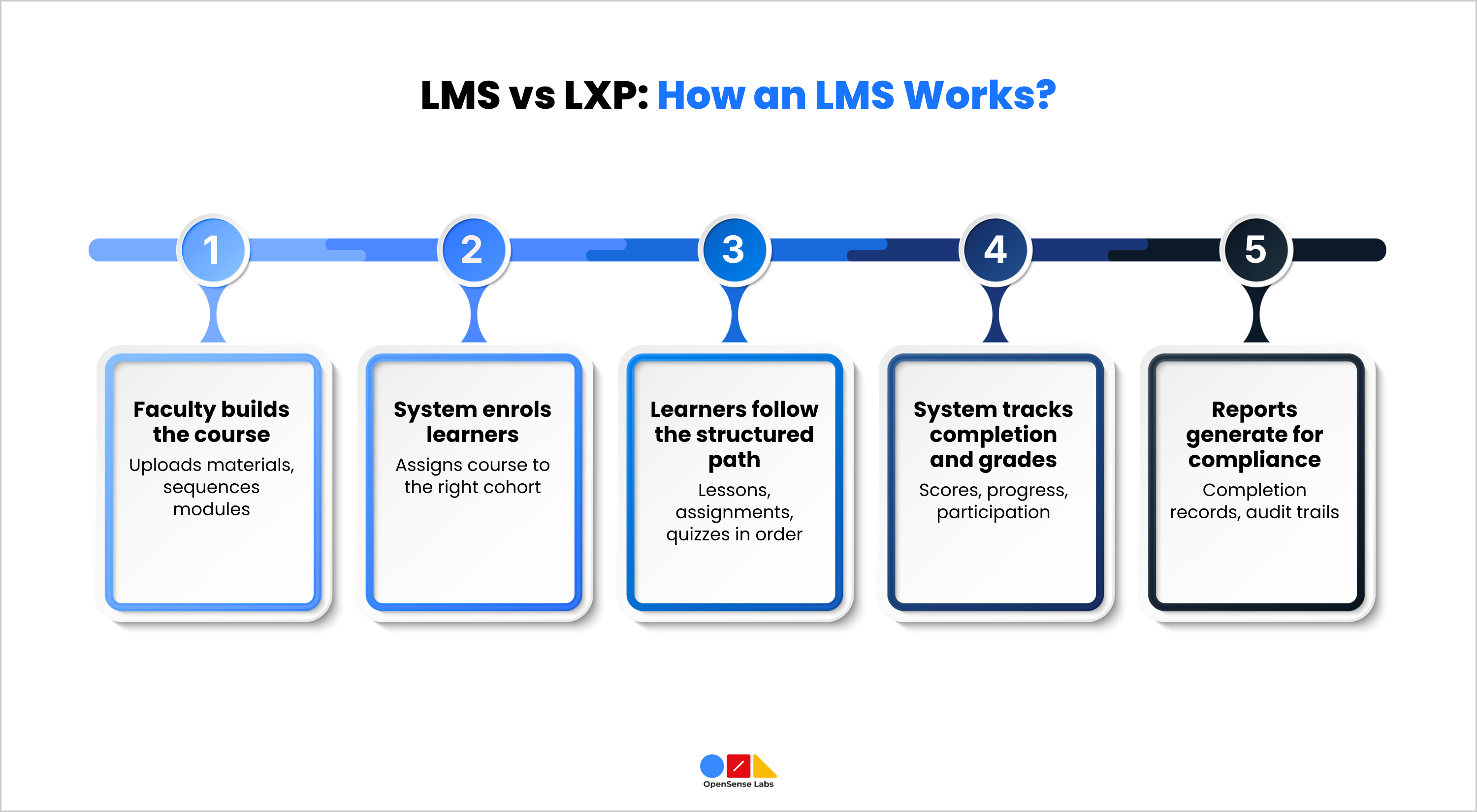
A Learning Management System is software used to build, organise, track, and deliver structured courses. It is the system most institutions already know, since nearly every college and university runs some form of LMS today.
An LMS typically provides:
- Course management tools to create modules, upload materials, and sequence lessons
- Enrolment and tracking features that record who is taking what, and their progress
- Assessment tools for quizzes, assignments, and grading
- Reporting dashboards that show completion rates and outcomes, often required for accreditation
LMS for higher education work well when learning needs to follow a set path. A semester-long course, a mandatory compliance module, or a credential programmed with a fixed curriculum all fit naturally into an LMS structure. Administrators assign the learning, and students move through it in a defined order.
The trade-off is user experience. Most LMS platforms are built around administrative control rather than learner engagement. Content discovery is limited to what is assigned or what a student searches for directly. There is little room for exploration, and the interface often feels dated compared with the apps students use every day.
LMS vs LXP: What Is a Learning Experience Platform (LXP)?
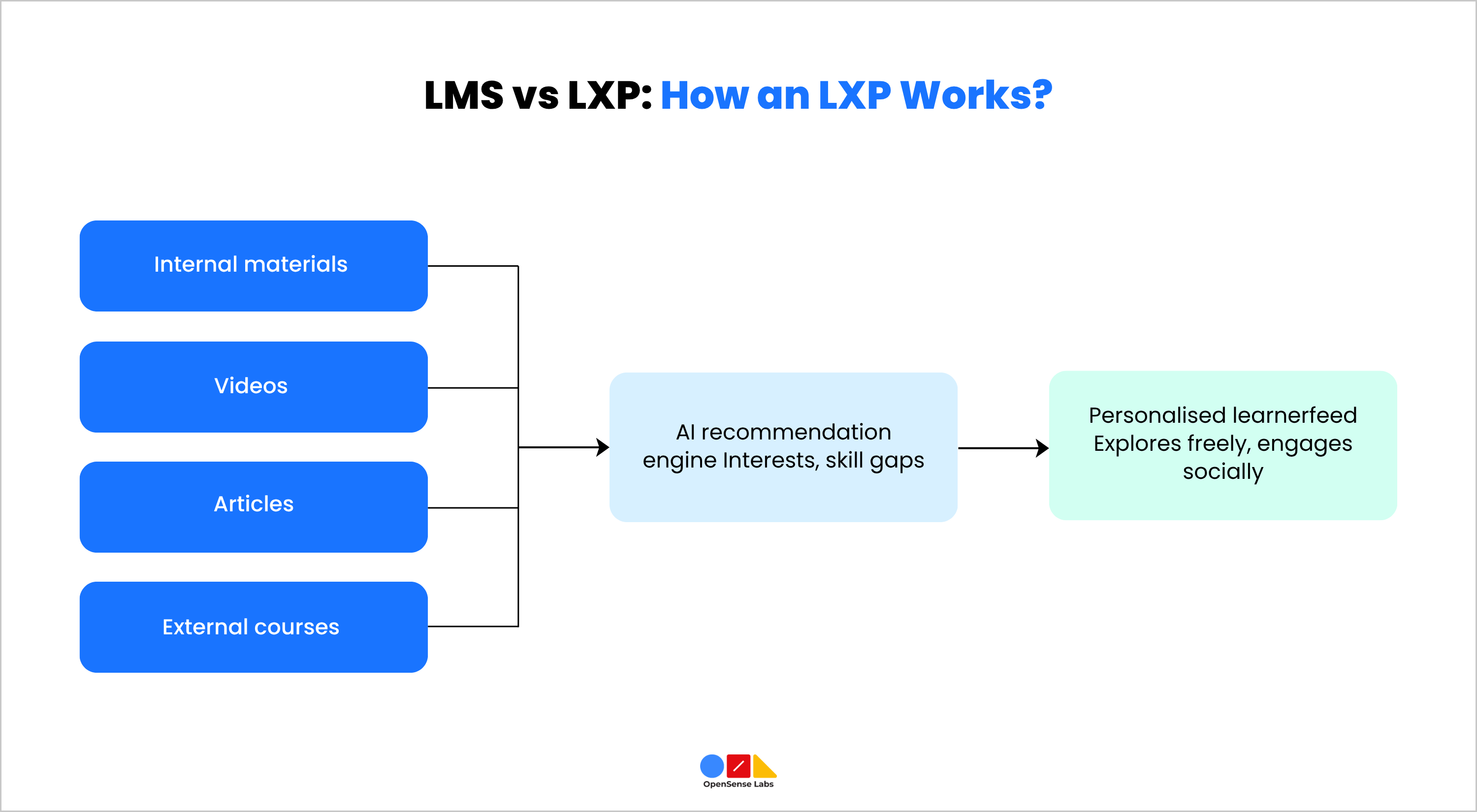
A Learning Experience Platform takes a different starting point. Instead of assigning content to learners, it helps learners find content on their own, based on their interests, role, or skill gaps.
An LXP typically offers:
- Content aggregation from multiple sources, including internal materials, videos, articles, and third-party courses
- Personalised recommendations, often powered by AI, that suggest what to learn next
- Social and collaborative features, such as peer discussions or user-generated content
- Mobile-first design built for learning in short sessions, anywhere
The LXP model works well for self-directed learning: skill-building, continuing education, professional development, or exploratory learning that does not need to follow a fixed sequence. It treats the learner as someone choosing what to learn, not someone being assigned a curriculum.
The limitation is on the administrative side. LXPs are generally weaker at producing the detailed completion of records, audit trails, and compliance reporting that structured academic programmes and accreditation processes require.
LMS vs LXP: The Structural Difference
The clearest way to understand the difference between LMS and LXP is to look at who initiates the learning and what each system is optimised to track.
Aspect | LMS | LXP |
|---|---|---|
| Learning initiated by | Administrator or instructor (assigned) | Learner (self-directed) |
| Primary use case | Structured courses, compliance, accreditation | Skill-building, exploration, continuing education |
| Content model | Curated by faculty or L&D, fixed paths | Aggregated from many sources, recommended |
| Tracking focus | Completion, grades, certification | Engagement, time spent, skill progress |
| Reporting consumer | Registrar, accreditor, compliance officer | Learner and academic advisor |
| Content format | Structured courses, SCORM/xAPI packages | Microlearning, videos, articles, podcasts |
| Learning path | Mostly mandatory or fixed | Mostly optional and flexible |
| User experience | Form-driven, administrator-centric | Discovery-driven, learner-centric |
These differences reflect two different assumptions about how people learn, one built around structure and oversight, the other around curiosity and choice.
LMS vs LXP: When an LMS Should Be the Priority?
An LMS makes sense as the primary platform when:
- Accreditation and Compliance Reporting are Central: Degree programmes, certifications, and any training that regulators or accreditation bodies review need audit-ready completion records. An LMS produces these reliably.
- Courses Follow a Fixed Structure: Semester-based courses, prerequisite sequences, and cohort-based programmes are naturally suited to an LMS.
- Grading and Credentialing Matter: When outcomes need to be scored, recorded, and tied to a credential or degree, an LMS handles this well.
- Budget is a Primary Constraint: LMS for higher education are typically less expensive per user than full-featured LXPs, which matters when the core need is structured for delivery rather than discovery.
Institutions weighing what makes the best LMS for higher education should treat these four factors accreditation, structure, credentialing, and budget as a checklist before shortlisting vendors.
LMS vs LXP: When an LXP Should Be the Priority?
An LXP is the better starting point when:
- Continuing Education and Lifelong Learning are the Focus: Alumni programmes, professional development, and micro-credentials benefit from a platform built around exploration rather than assignment.
- Learners Want to Choose Their Own Path: Adult learners and working professionals often prefer selecting what to learn over being assigned a fixed curriculum.
- Content Comes from Many Sources: If an institution wants to combine faculty-created material with external content such as industry certifications, video libraries, or partner courses, an LXP aggregates these more naturally than an LMS.
- Engagement is the Success Metric: If the goal is sustained, voluntary learning activity rather than mandatory completion, an LXP is designed to optimise for that.
LMS vs LXP: Why Many Institutions Are Moving Toward Both?
By 2026, many organisations, including higher education institutions, will have moved past treating this as an either-or decision. Instead, they are building a combined learning ecosystem, an LMS layer for structured, credentialed programmes, paired with an LXP layer for skills, continuing education, and self-directed learning.
This combined model typically includes:
- A core LMS for degree programmes, compliance training, and formal credentialing
- An LXP layer for continuing education, micro-credentials, and skills-based learning
- Integration between the two, so learner activity and progress are visible across both systems
- Shared analytics that give a single view of learner engagement and outcomes
Institutions that try to force one system to do the other's job tend to run into trouble. Customizing an LMS to feel like a discovery-driven LXP is expensive and rarely succeeds. Equally, relying on an LXP alone leaves gaps in compliance and accreditation reporting that formal academic programmes require.
LMS vs LXP: How to Evaluate and Choose?
Before selecting a platform, EdTech and higher education leaders should map their needs against a few practical questions:
- What proportion of our learning is structured and credentialed, versus self-directed and exploratory?
This determines whether an LMS, an LXP, or both should anchor the platform strategy. - What reporting do we need to produce, and for whom?
Accreditors and registrars need different reports than a student engagement dashboard. - Where does our content already live, and where should it come from?
Centralised, faculty-authored content favours an LMS. Content from many sources favours an LXP. - What does success look like?
Completion rates and credential issuance point to LMS metrics. Engagement, exploration, and skill progression point to LXP metrics. - What is our realistic budget and integration capacity?
A combined ecosystem requires more investment in integration and change management than a single platform. - Is the platform accessible to all learners?
Higher education institutions have specific ADA compliance obligations that apply to any digital learning platform, LMS or LXP alike. This should be part of vendor evaluation from the outset, not an afterthought. See our checklist for ADA compliance in higher education for what to look for.
Institutions that answer these questions before evaluating vendors are far better positioned to choose a platform that fits their actual learning model, rather than one that looks impressive in a demo.
Making the Right Choice for Your Institution
LMS vs LXP solve different problems, and most institutions building out their LMS for higher education strategy eventually need elements of both: structure and oversight for formal programmes, and flexibility and discovery for continuing education and skills development. The right starting point depends on where an institution's learning challenges are most pressing today, and where they are heading next.
OpenSense Labs helps EdTech providers and higher education institutions modernise their learning technology on an open-source, AI-powered foundation. Our Learning Experience Platform solution is built to help institutions move beyond the limits of a legacy LMS for higher education, without giving up the data ownership and flexibility that open source provides.

Join Our Newsletter
Love open-source tech? Stay updated with projects that make a difference.