
What Enterprise AI Readiness Assessment Actually Reveals?
Most vendor-led AI readiness assessment check the obvious things, data strategy, executive sponsorship, completed pilots, and miss the structural gaps that determine whether an AI initiative survives in production. Genuine readiness goes deeper than a checklist. It requires an honest evaluation of data infrastructure, governance, integration complexity, workforce capability, and whether the business case reflects what production deployment actually costs.
When Shriners Children's, an international pediatric health system with 22 hospitals, aimed to implement AI-driven clinical decision support, they had years of patient data, clear use cases, and aligned leadership. According to typical enterprise AI readiness assessment standards, they were prepared to move forward.
Before any model could generate dependable clinical results, the team needed to fully migrate its Research Data Warehouse to a standardized clinical data format known as OMOP CDM v5.4 within Microsoft Fabric.
Without standardization across all hospital sites, any AI model built on top would produce outputs that varied by source system, making them clinically unsafe to act on. The data modernization work had to come first, and it took significant time before the AI layer could begin.
This case, published by Marteau et al. on arXiv in December 2025 and accepted at IEEE BHI 2025, highlights the gap at the center of most AI readiness assessments. Shriners Children's was not unprepared for AI; it was unprepared for the specific data infrastructure that AI requires. A standard vendor assessment would have looked at the volume of data available and recommended moving forward. The real blocker only became visible when someone examined the quality, structure, and consistency of that data closely.
This is the gap that most enterprise AI readiness assessments miss.
Now let's understand...
What a Real AI Readiness Assessment Actually Does?
Most vendor-led assessments check things that are easy to verify: whether a data strategy exists, whether training has been completed, whether a sponsor has been named, and whether a pilot has been run.
These are reasonable things to know, but they do not tell you whether your AI initiative will survive the move from enterprise AI pilot to production.
A more thorough assessment examines whether your organization can handle the real conditions that production of AI deployments face. Most vendors, who have a financial interest in you moving forward to the next engagement, are unlikely to push hard on questions like:
- Whether your live data is consistent enough with what a model was trained on
- Whether your infrastructure can support inference at scale
- Whether there is a working process for catching and correcting model errors
- Whether the people working alongside the AI have enough understanding to use it well and challenge it when something looks wrong
These questions are harder to answer because they assess organizational capability rather than project progress. Yet there is often a difference between a successful pilot and a successful production deployment.
A meaningful AI readiness assessment, therefore, looks beyond checklists and evaluates AI implementation readiness, whether the organisation has the capabilities required to deploy, govern, and scale AI successfully.
The Six Dimensions That Actually Matter
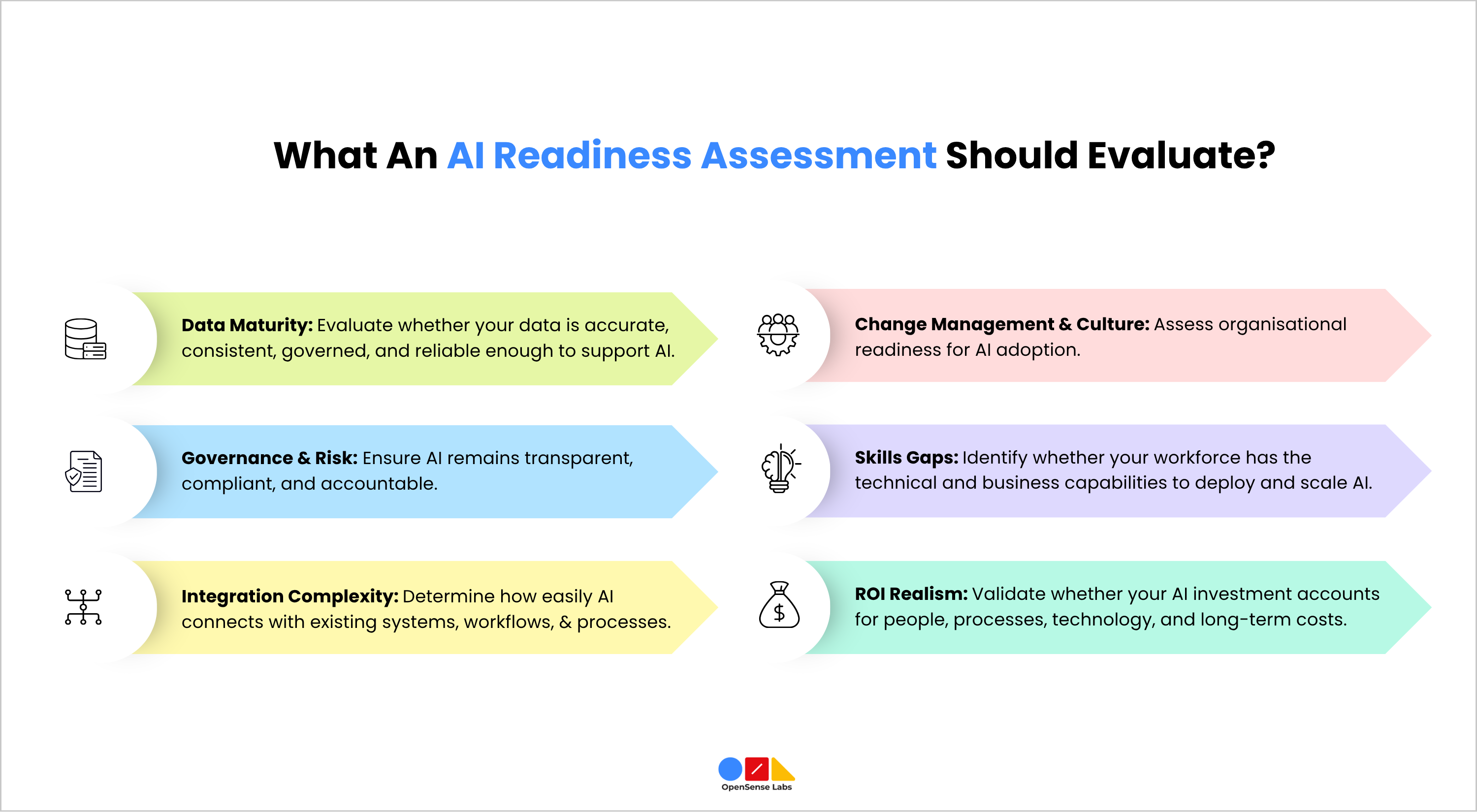
Most AI readiness frameworks assess one or two dimensions and call it sufficient. A thorough enterprise AI readiness assessment examines six distinct areas, each one capable of blocking a deployment on its own. Understanding where your organisation stands across all six is what separates a meaningful assessment from a vendor checklist.
1. Data Maturity
Having large volumes of data is not the same as having AI-ready data. A thorough assessment looks at:
- Whether data pipelines built for reporting can also support AI workloads, which have different access patterns and a much lower tolerance for inconsistency
- Whether data ownership is clearly defined and governance is operational rather than just documented
- Whether the path from raw data to usable model input is reliable enough to hold under production conditions
- Whether data is standardised consistently across systems and sites, the absence of this, as the Shriners case shows, can block an entire AI programme, regardless of how prepared everything else appears from an AI implementation readiness standpoint
2. AI Governance Readiness and Risk Posture
AI governance is often framed as a compliance requirement, but its more immediate function is to ensure that people working with AI outputs can trust them, know when to question them, and have a clear way to act on those concerns.
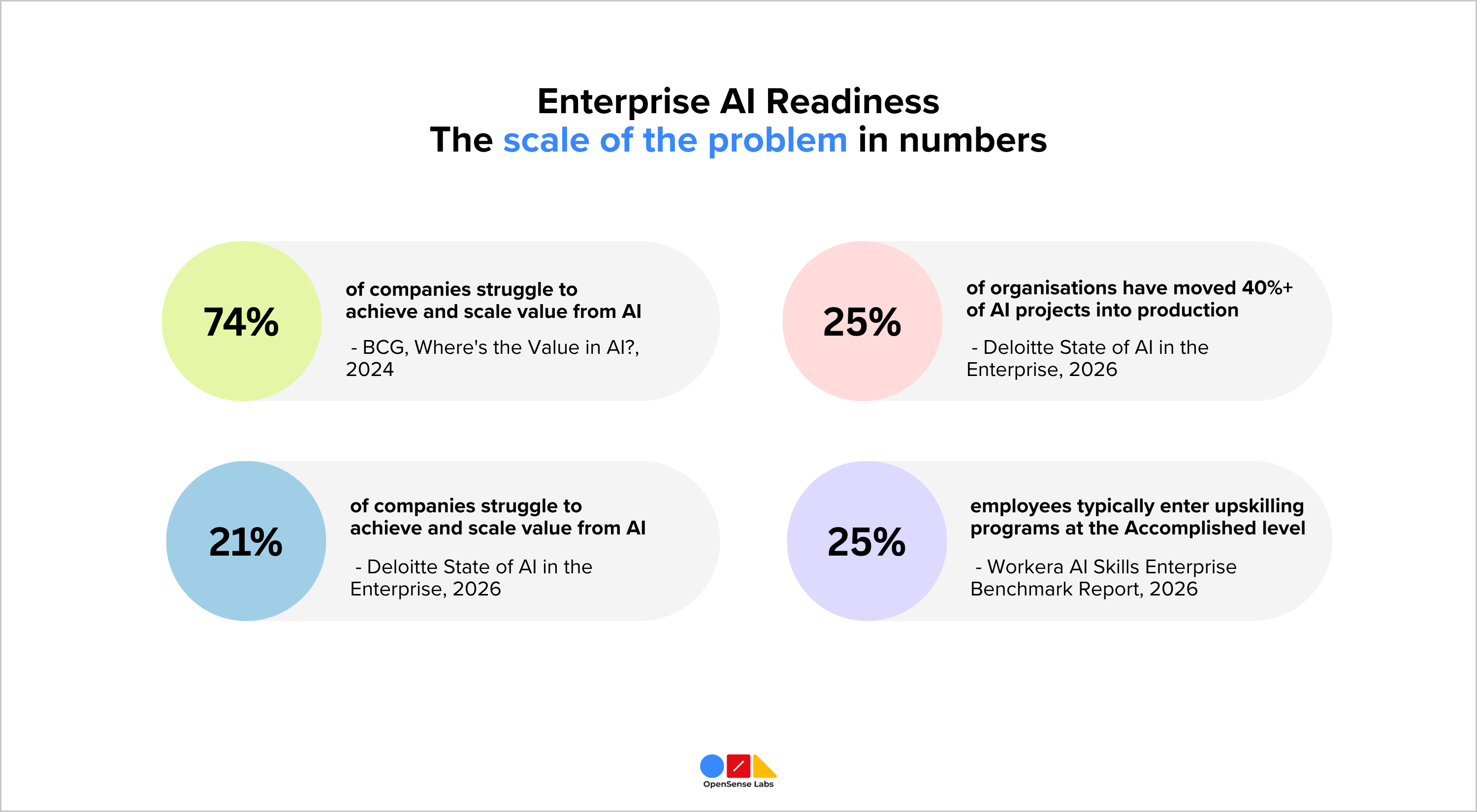
According to the Workera 2026 AI Skills Enterprise Benchmark Report, only 25% of enterprise employees reach an Accomplished level in Responsible AI before any upskilling takes place. A proper AI readiness assessment of governance should look at:
- Whether model performance is being actively monitored after deployment
- Whether audit trails exist for model outputs, particularly in regulated industries
- Whether the governance framework covers agentic AI specifically, since autonomous agents introduce significantly more risk than simpler AI tools
- Whether there is a defined process for retraining or rolling back a model when its performance deteriorates
The Deloitte State of AI 2026 found that only 21% of enterprises have mature AI governance readiness for autonomous AI agents, even as agentic AI adoption is expected to grow from 23% to 74% of enterprises within two years.
3. Integration Complexity
One of the most common ways an AI project runs into serious trouble is when a team discovers, after a business case has been approved and a model has been built, that connecting the model to live operational systems is far more complex than anticipated. This is one of the clearest signs of insufficient AI implementation readiness, and it is almost always a problem that a proper assessment would have caught earlier.
This is precisely the gap between an enterprise AI pilot to production. A pilot running on carefully prepared data can perform well while the same organisation's production systems remain completely unprepared to support it. A proper readiness assessment maps the integration surface before the project starts, looking at:
- Which source systems need to feed data into the model, and whether they can do so in real time
- Which operational systems need to receive model outputs, and how
- What latency requirements exist across each touchpoint
- What modernization work is required before any live integration is possible
4. Change Management and Culture
Most technical assessments treat change management as a secondary consideration, something to address after the technology decisions have been made. In practice, it is one of the areas where AI initiatives most frequently underdeliver, not because the technology does not work, but because the people and processes around it were never redesigned to accommodate it. A readiness assessment should examine:
- Whether the business teams that will use AI outputs were involved in defining the use case
- Whether there is a trusted process for employees to question or override model outputs
- Whether the organisation is treating AI adoption as a process redesign challenge rather than simply a technology installation
5. Skills Gaps
Checking whether data scientists and machine learning engineers are on staff is a starting point, but it does not tell you whether AI capability is distributed widely enough to support multiple simultaneous initiatives or whether the programme will be sustainable if key individuals leave.
Most organisations are asking teams to absorb AI responsibilities on top of existing workloads using role structures that were never designed for it, and this is one of the more consequential gaps in AI implementation readiness that assessments consistently underreport. A meaningful skills assessment covers:
- Data engineering capacity for building and maintaining AI-specific pipelines
- ML Ops capability for ongoing model monitoring and retraining in production
- Business-side AI literacy is sufficient for staff to evaluate model outputs critically rather than simply accepting them
- Prompt engineering and LLM integration skills beyond basic familiarity
6. ROI Realism
Pilots are designed to demonstrate capability using clean data, controlled conditions, and metrics chosen to show the model at its best. Business cases built on these results often do not account for the full costs involved in moving from enterprise AI pilot to production, including integration overhead, ongoing governance, and model maintenance. BCG research found that organisations that successfully scale AI allocate their resources roughly as follows:
- 70% to people and processes
- 20% to technology and data infrastructure
- 10% to AI algorithms
Most organisations approach this in the opposite order. An AI readiness assessment that does not challenge the business case on these grounds is leaving one of the most significant financial risks of an AI programme unexamined, and one that tends to surface only after the budget has already been committed.
What Assessment Results Look Like in Practice
Organisations that go through a thorough readiness assessment typically find themselves in one of three situations:
- Organisations With Strategic Clarity and Infrastructure Gaps: Strategic intent is clear, but the data layer is not ready for AI workloads. Data pipelines were built for reporting, legacy systems are not API-accessible, and data governance is inconsistent. The most productive investment here is six to twelve months of foundational infrastructure work before any AI project begins. Skipping this step leads to pilots that cannot move from an enterprise AI pilot to production.
- Organisations With Strong Infrastructure and Low Adoption Readiness: Infrastructure is solid, and data maturity is reasonable, but the organisation has not prepared its people and processes for AI-enabled ways of working. AI tools get deployed and then underused because the workforce does not fully trust their outputs, and workflows have not been redesigned around them. The right focus here is workforce readiness and process redesign rather than further technology investment.
- Organisations With Distributed Capability and No Sequencing Logic: Capabilities exist, and people are equipped, but too many disconnected pilots are running in parallel. Each initiative builds its own data pipelines and governance processes from scratch rather than contributing to a shared foundation. The most useful step here is a sequencing framework that identifies which use cases build the infrastructure that subsequent ones can rely on.
How to Prepare Legacy Systems for AI: Practical Implementation Steps
For many organisations, the readiness assessment reveals that legacy infrastructure is the main constraint that needs to be addressed before meaningful AI deployment can happen.
Step 1: Audit and Classify Your Legacy Data Landscape
Map every data source a planned AI use case would need, documenting:
- Format, location, and ownership
- Update frequency and current accessibility
- Governance controls and regulatory obligations
- Distance from the quality and consistency standards that AI workloads require
The goal is to identify which assets are close to production-ready and which need significant remediation, so that effort can be prioritised rather than spread evenly.
Step 2: Build an API Layer Before You Build Models
AI systems need to read data from operational systems and write outputs back in near real time. If legacy systems are not accessible through clean, well-documented APIs, this becomes the bottleneck that slows every subsequent AI initiative.
Building an API-first modernisation layer before the first model is deployed means each new use case can build on the same foundation rather than solving the same integration challenge from scratch.
Step 3: Choose Phased Migration Over Lift-and-Shift
Replacing all legacy systems at once is rarely practical and more disruptive than necessary. A more effective approach is to:
- Identify the specific systems and data flows that your first two or three AI use cases depend on
- Modernise those specifically and validate them before moving further
- Expand the infrastructure incrementally as subsequent use cases are planned
Step 4: Establish Governance Infrastructure Before Models Go Live
Before any model enters production, define:
- Who is responsible for reviewing outputs, and how frequently
- How errors are flagged, escalated, and corrected
- What audit trails are maintained and for how long
- When the model will be retrained, and under what conditions it will be rolled back
Having these processes in place from the start is what allows a deployment to remain trustworthy, auditable, and maintainable over time, which matters considerably more in year two of a deployment than it does at launch.
Step 5: Design Pilots That Mirror Production Conditions
Where possible, pilots should use:
- Production data or a closely representative sample under controlled access
- The same integration patterns that will apply at full deployment
- The same governance oversight that will govern the live model
Finding integration gaps and data quality issues during a pilot is far less costly than finding them after the business case has been approved.
Why AI Readiness Requires Continuous Assessment, Not a One-Time Evaluation
A common pattern across industries is that organisations continue to launch AI pilots without successfully scaling them because the integration challenges, governance gaps, and infrastructure limitations that hinder deployment were never addressed during the assessment stage.
AI readiness is therefore not something an organisation achieves once. It requires continuously strengthening data infrastructure, governance, workforce capabilities, and strategic planning to support AI as it evolves and as the organisation's use of it becomes more complex.
An AI readiness assessment gives you an accurate picture of where your organisation actually stands, so that the investment you make in AI is directed at the right things, in the right order, before the wrong things become expensive to fix.
If you are at the point of asking whether your organisation is ready, that question deserves a rigorous answer. Start with a structured framework to assess your current state and identify the next steps.

Join Our Newsletter
Love open-source tech? Stay updated with projects that make a difference.