
Agentic Marketing and AI Governance for CMOs and CIOs
Agentic marketing uses AI agents to plan and run marketing tasks. It also includes how AI assistants help buyers find and evaluate brands. Both depend on the same base. These are content machines can read, platforms agents can work within, and rules that define what agents may do.
A 2026 survey of 500 CMOs, CIOs, and CTOs shows how far many firms are from that base. Among the CMOs, 61% said their content sits in so many systems that nobody has one reliable source of truth, and only 40% said their stack is prepared for AI agents to operate within it right now (Acquia, September 2026). Control remains unclear, as 25% of CMOs reported that marketing teams make AI choices together while 24% said the IT department makes them.
This article explains what agentic marketing means and where it is used. It then sets out a four-layer model that CMOs and CIOs can use to check their platforms and rules. A staged plan for adoption follows.
What is Agentic Marketing?
Agentic marketing describes marketing work carried out by AI agents. An agent is a piece of software that figures out what steps to take, uses available tools and information, and tries to reach a goal without needing much help from people. Generative AI tools create content when you ask them to. Generative AI tools write content when asked. An agent can also decide what to do next, start actions in other systems, and check the result.
A campaign agent, for example, can draft variants, publish them to approved channels, read performance data, and adjust the next round within set limits.
The term has two related meanings, and the difference matters for planning:
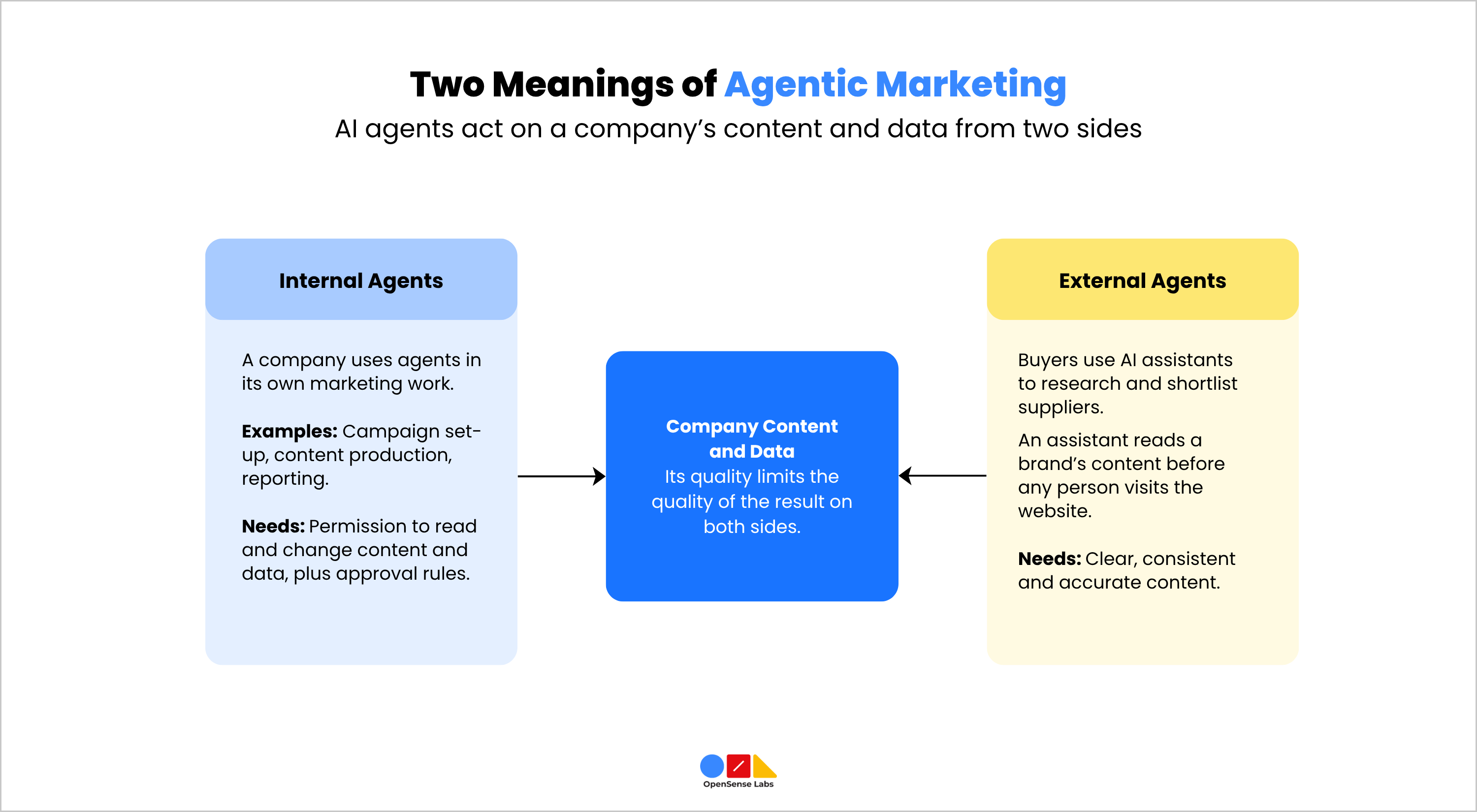
These two situations create different needs for your organization. Internal agents need access to read and modify content and data, plus clear guidelines about what they can do without asking for permission. External agents need content that is structured, consistent, and accurate, because they cannot ask a colleague what a page means.
In both cases, the quality of the underlying content and data limits the quality of the result, which is why platform readiness and governance recur throughout the rest of this article.
Where AI Agents Are Being Used in Marketing Right Now?
AI agents help marketing teams most when the work follows the same steps over and over. Real examples show they work best in four main areas:
- creating and updating content, plus changing it for different regions
- analysis of performance and audience data
- campaign planning and orchestration
- media optimization, where agents modify bids, spending limits, and creative combinations while staying within set boundaries
While adoption spreads widely, the benefits gained remain small. McKinsey reported in April 2026 that nearly 90% of CMOs are experimenting with AI across the marketing process, while fewer than 10% have captured value across end-to-end workflows (McKinsey, April 2026). McKinsey connects some of that difference to outdated marketing tools.
Many organizations operate multiple content management, asset storage, customer relationship, and data tracking platforms. These systems were not originally designed to work together or support live agent processes. According to McKinsey, the real constraint is usually how effectively systems link up, not the underlying technology. This means the connecting layer is what truly determines success, as discussed next.
Four Levels of AI Readiness for Marketing Agents
AI readiness for agentic marketing is often discussed as a question about tools, although the evidence points to platforms and data. A practical assessment looks at four layers, each of which can be checked independently and each of which has a primary owner. The ownership listed below shows where responsibility typically belongs and can be changed to fit your organization's needs.
| Layer | What to Check | Typical Gap | Primary Owner |
|---|---|---|---|
| Content Structure | Information is organized into separate, reusable pieces. Each piece has clear, matching labels. Everything comes from a single, controlled location. | The same information exists in multiple systems, but each one describes it using different words | CMO |
| Platform Access | Agents can read and change content through documented APIs with defined permissions | Access is manual or granted too broadly | CIO |
| Governance | Usage policy, approval rules, brand and legal guardrails, and an audit trail are in place | Rules exist as documents but are not enforced as controls in the platform | Shared |
| Measurement | The team tracks how AI assistants describe and cite the brand and logs what agents do | There is no way to see AI responses or what agents do | Shared |
How you organize your content is important for both types of agentic marketing. Internal agents need consistent fields and metadata to produce reliable output, and external AI assistants read the same structure when they assemble an answer about a brand.
Structured data markup and consistent facts across pages support answer engine optimization (AEO), which is the practice of making content easy for AI assistants to find, interpret, and cite. IT has its own stake in this layer, because 56% of CIOs and CTOs in the Acquia survey said they would not deploy AI until content structure and data integrity were in place (IT Brief, 2026).
The platform access layer decides what an agent can reach and change. APIs that are documented and use role-based permissions allow IT to restrict what each agent can access, whether that's certain content types, specific fields, or particular actions. This also helps marketing teams give agents just enough access to do their jobs well. When many agents share the same broad credentials, it becomes hard to figure out who did what.
The measurement layer covers two records. The first shows how AI assistants talk about and reference the brand. The second is a record of what internal agents see and modify. Without both records, neither marketing nor IT can show whether agents are accurate or whether governance rules are working.
Assessing each layer as ready, somewhat ready, or not ready helps CMOs and CIOs see together where to focus first. Problems with how content is organized and who can access platforms often hold back what governance and measurement can do, because you cannot apply rules to content without proper structure or to systems that people cannot reach with proper controls.
For example, imagine a team wants to use an agent to translate product pages into different languages. They might discover that some parts are prepared: product information is stored in one CMS system, and the CMS has public APIs they can use. However, other parts need work: there are no approval rules for machine-translated content, and there is no way to track what the agent changes. In this situation, the team should first create an approval rule and set up a system to log agent edits.
Governing Agentic Marketing Across Marketing and IT
Agentic AI governance, meaning the policies and controls that define what agents may do, is the area in which the CMO and CIO most need a shared position. Acquia’s survey found no clear owner, with 25% of CMOs naming marketing as the lead for shared AI decisions and 24% naming IT (Acquia, September 2026).
It also found a confidence gap, as 41% of CMOs were confident their teams could embed real governance into AI initiatives, compared with 73% who were confident in driving revenue growth. Marketing leaders view this as a reputation concern, with 66% of CMOs saying that showing their AI-generated marketing is properly managed and monitored is now important for their brand's image.
A practical governance model makes decisions based on what each person does, not which department they work in. The items listed below can be decided together and then put into action through the system:
- who approves each agent action, who takes responsibility, and who should be asked for input
- approval thresholds that separate actions agents may take alone from those needing human sign-off, such as publishing to public channels
- brand and legal guardrails written as controls in the platform as well as in policy documents
- a record that tracks what each agent viewed, modified, or shared
- one roadmap owned jointly by marketing and IT, so that platform priorities reflect both growth targets and security requirements
Assigning rights by action avoids a debate over which function owns AI as a whole, and it gives brand, legal, and security teams a record they can review. Acquia found that both groups want to reduce handoffs, use standard policies, and have a clear record of what the platform can do. This method helps achieve that.
Proof of return adds to the pressure, as 43% of CMOs named failing to prove a return on AI investment as the single biggest threat to their position in 2027. The audit trail and measurement records described above also supply part of the evidence needed to report on that return.
A Staged Approach to Adopting Agentic Marketing
Adoption can be staged so that autonomy increases only when the readiness layers support it. Three stages are described below, each with a criterion for moving to the next:
- Assisted: Agents suggest content, analysis, or next steps, and people carry out every action. The team can proceed once the content for the selected workflow is stored in a single controlled location and agent access is set up using clear, documented APIs.
- Supervised: A person reviews and approves each action that agents perform before it happens. The team moves on when the audit trail has been reviewed over a sustained period, and the approval record shows that agent output consistently meets brand and legal rules.
- Bounded Autonomy: Agents work freely within set boundaries like approved channels, spending limits, or allowed content without needing approval for each action. The system keeps watch, and if an agent goes beyond these boundaries, it switches back to requiring human oversight.
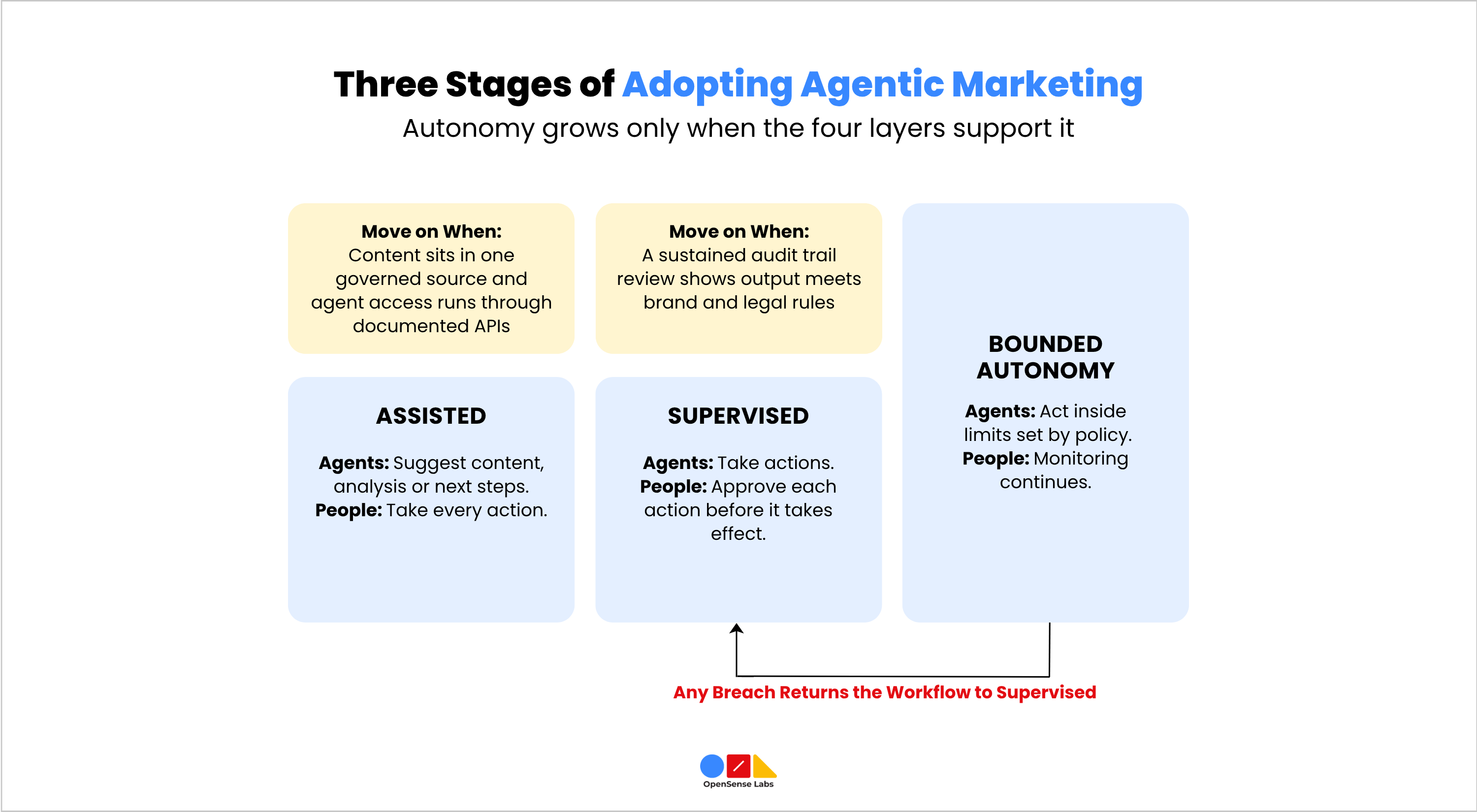
Risk and reversibility are useful criteria for choosing the starting stage. Tasks that are easy to fix fast, like writing internal reports, work well for giving people more freedom sooner. Tasks that customers see or are hard to change, like publishing content, setting prices, or making legal claims, need longer review times by people.
Metrics for each stage can be drawn from the audit trail, such as the share of agent actions approved without change, the number of policy breaches, and the time taken to correct errors. A high approval rate without changes, together with few breaches, supports a move to the next stage.
Stages apply to single workflows, not to a whole company. Starting with one workflow keeps the first review small and gives the team real data before it widens the scope. A team may run reporting at bounded autonomy while customer-facing content remains supervised. McKinsey also recommends rolling out workflows in stages, considering technical readiness among other key factors.
Next Steps for CMOs and CIOs
Agentic marketing places shared demands on marketing and IT. Agents depend on structured content, controlled platform access, clear rules and measurement. A practical first step is for the CMO and CIO to score the four layers together for one workflow. They can then agree the stage at which that workflow should start.
The team can repeat the same check for other workflows as the layers improve. Each move to a higher stage should rest on the tests above, not on a fixed timetable. Content that is structured and governed for internal agents is also easier for external AI assistants to read. The same work therefore serves both meanings of agentic marketing.
Governance rules only help when the platform enforces them. OpenSense Labs’ AI Governance solution scores, filters, and corrects AI output in real time, so content produced with AI meets brand and compliance standards before it reaches users.

Join Our Newsletter
Love open-source tech? Stay updated with projects that make a difference.