Content Authenticity and Provenance: What Does C2PA in DAM Mean?
Every enterprise DAM claims its content can be trusted, but few can actually prove where an asset came from or what happened to it since. C2PA in DAM is changing that equation, turning provenance from a nice-to-have into something leadership teams will soon be expected to answer for.
Enterprise content libraries in 2026 hold a mix that did not exist a few years ago, assets captured by cameras, drafted by writers, and generated in whole or in part by AI systems, often within the same campaign and the same folder.
For most digital asset management systems, a file's origin has been a matter of manually entered metadata, easy to omit and easier still to get wrong.
As disclosure expectations around AI-generated content grow and content moves across more platforms and jurisdictions, being able to show where an asset came from and what has happened to it since is becoming an operational necessity rather than a courtesy.
The Coalition for Content Provenance and Authenticity, known as C2PA, was formed to address this problem directly, giving digital content a verifiable, tamper-evident record of its origin and history.
What began as a specification followed mainly by camera and software manufacturers now has direct implications for how enterprises structure their asset libraries, manage rights, and assess brand risk.
This article sets out what C2PA in DAM actually establishes, what it does not, and what content provenance means in practice for enterprise digital asset management specifically, and how a DAM system should be built to preserve that record rather than quietly discard it.
What C2PA in DAM Establishes?
C2PA is an open technical standard that embeds verifiable provenance metadata into digital content such as images, videos, audio, and documents, founded in February 2021 by Adobe, Arm, BBC, Intel, and Microsoft. It has since become the foundation for how enterprises approach content provenance in digital asset management at scale. The standard rests on three core mechanics:
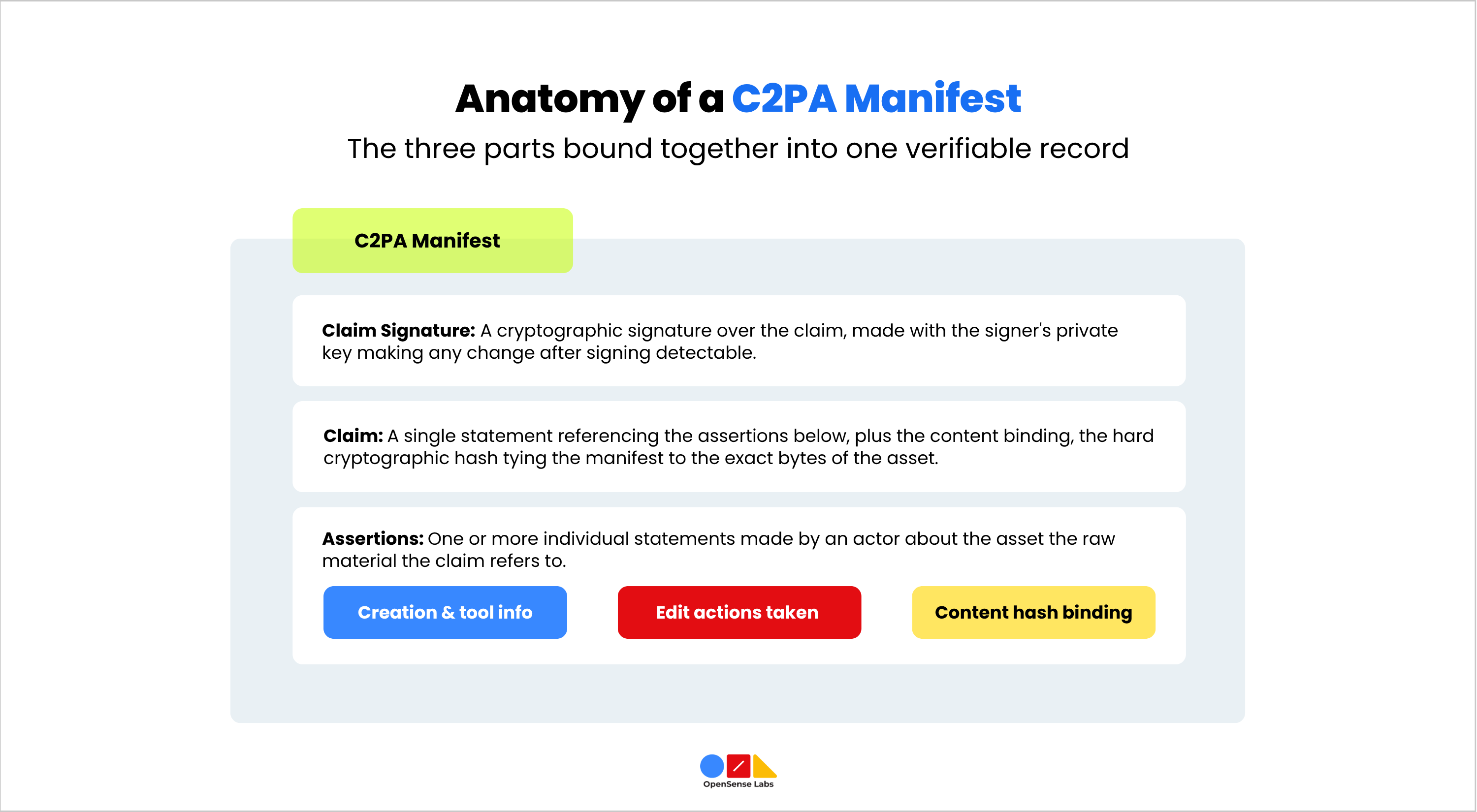
- The Manifest: A cryptographically signed record, built on X.509 digital certificates and hashing, documenting who created a piece of content, what tools were used, and what edits were made. Because the record is cryptographic, it cannot be edited after the fact without the alteration being detectable.
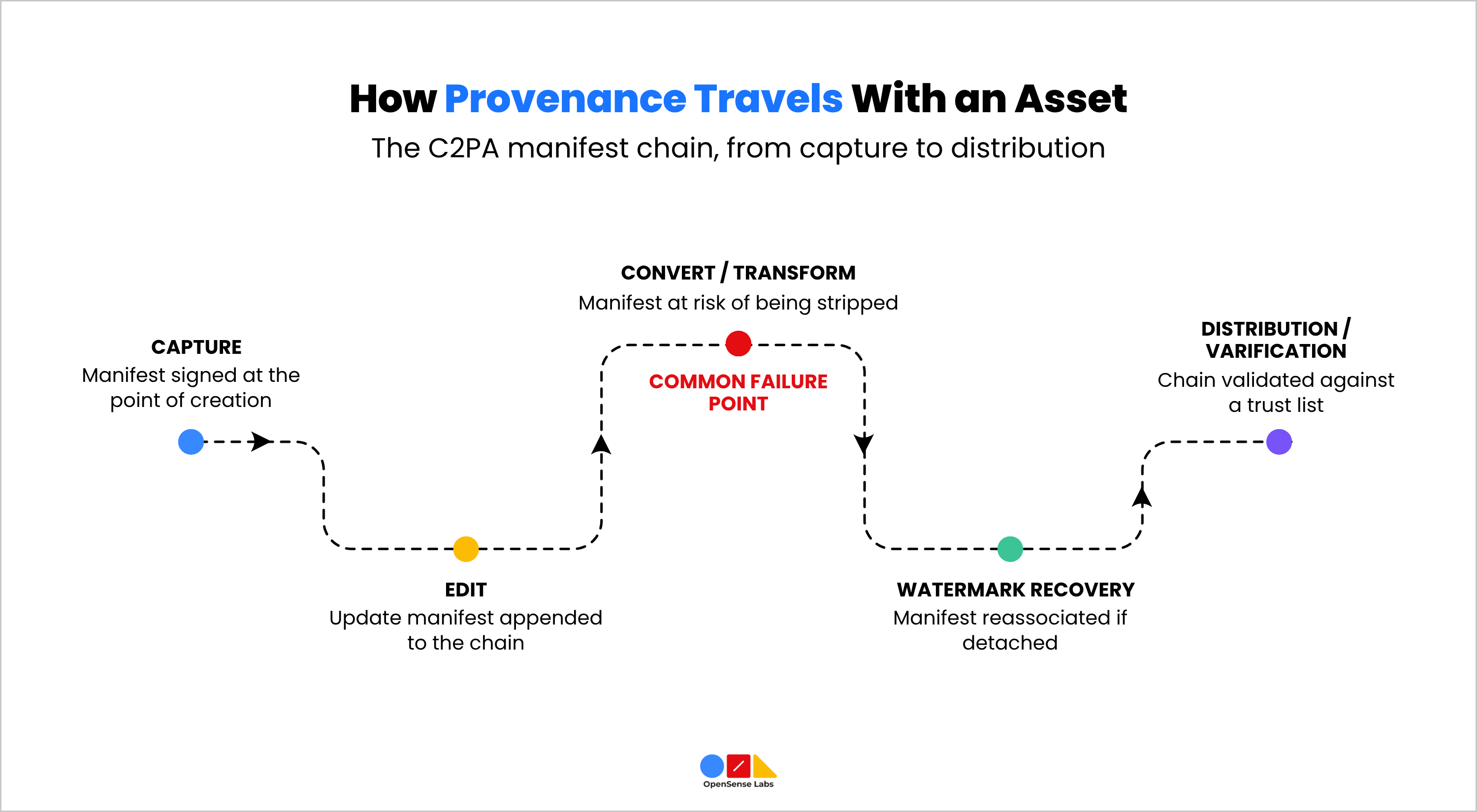
- A Growing Chain: Each time an asset changes, its existing provenance is preserved, and the new change is appended to it, so the manifest accumulates a full history rather than being overwritten.
- A User-Facing Layer: Content Credentials, the implementation of C2PA that end users see, is often described as a nutrition label for digital media, a standard way of showing a file history rather than making a claim about its quality.
Adoption of the standard has grown considerably:
- As of January 2026, C2PA has more than 6,000 members and affiliates, including Google, Meta, OpenAI, Sony, Nikon, and Leica.
- Its steering committee includes Adobe, BBC, Google, Intel, Microsoft, OpenAI, Sony, and Truepic.
- The specification's current version is 2.3, released in January 2026, reflecting ongoing development rather than a settled standard.
Why the Standard Has Gained Operational Weight in 2026
For several years, C2PA adoption was mostly limited to professional imaging and publishing tools, relevant to photojournalists and news organizations but distant from most enterprise content operations. That distance has narrowed for three main reasons:
- Provenance Now Arrives at the Point of Capture: Samsung's Galaxy S25 marked the first time a consumer smartphone integrated C2PA signing directly into its native camera app, moving the standard from a professional niche toward mass-market hardware.
As capture devices increasingly sign content by default, provenance data enters an organization's systems with the asset, rather than being reconstructed later by a DAM administrator. - The Standard has a Track Record: Having closed out its fifth year, the Content Authenticity Initiative has grown from a small group of collaborators into a global community of more than 6,000 members, growth the initiative attributes to sustained demand rather than hype or regulation. A standard with a five-year track record and major vendor backing carries considerably less implementation risk than a newer alternative would.
- Disclosure Expectations are Tightening in Specific, Practical Ways: Making content authenticity an enterprise priority rather than a niche publishing concern. Several US states now require disclosure labels on AI-generated political advertising, and provenance infrastructure is one of the few mechanisms that can support that kind of disclosure without relying on manual, after-the-fact labelling.
It's worth adding a caveat here, digital provenance infrastructure in 2026 remains a growing but still incomplete system spanning hardware manufacturers, software platforms, creation tools, distribution networks, and verification applications. Adopting C2PA today means adopting a standard with strong momentum, not one with universal coverage across every tool in a content pipeline.
The Limits of What C2PA Verifies
A provenance record answers a narrower question than it might first appear. C2PA does not judge content as real or fake; when an AI tool supports Content Credentials, the provenance record simply discloses that AI was used, leaving users to make their own informed judgement about the content.
A manifest can confirm that an image was created using a particular generative tool and subsequently edited in a particular application. It cannot confirm that the underlying subject matter is accurate, that a claim made in an image is true, or that a document's content is factually sound.
This distinction matters for how the standard should be communicated internally. Provenance is a record of process, where a manifest has been maintained without gaps; it provides strong evidence of an asset handling history, which is valuable for compliance, licensing, and brand-risk purposes. It does not substitute for the editorial, legal, or fact-checking judgement an organization would otherwise apply to sensitive content, and treating it as though it does would overstate what the standard was designed to do.
Building a Provenance-Ready DAM: Where the Mechanics Matter
For a digital asset management system, provenance is not a feature to switch on so much as a property that must be preserved through every stage an asset passes through. Two mechanics matter in particular:
- Update Manifests for Governance Actions: C2PA supports update manifests for situations where a change needs to be recorded against an asset's provenance without the underlying content itself being affected, such as the addition of a new assertion or the redaction of an existing one. This lets a DAM record a rights update or an internal approval without breaking the existing provenance chain.
- Watermark-Based Recovery: C2PA 2.1 introduced digital watermarking to create a more durable link between an asset and its manifest, allowing the manifest to be recovered even if it becomes detached during editing, format conversion, or platform transfer. This addresses one of the most common points of failure in real content workflows, where converting a file or passing it through a tool that doesn't preserve embedded metadata has traditionally erased any record of its origin.
For an enterprise evaluating its own DAM environment, the practical question is whether these two mechanisms are actually supported end to end, or whether the DAM behaves like most legacy systems, built around descriptive metadata fields rather than a cryptographically verifiable chain. This is the dividing line that separates genuine C2PA in DAM implementation from a platform that merely stores files alongside metadata.
Where Enterprise DAM Platforms Fall Short Today
Vendor commentary on C2PA in DAM currently splits into two camps, both incomplete:
- DAM-Side Explanations Stay at the Definition Level: Existing DAM-focused explanations of C2PA describe it in terms of embedded provenance metadata, cryptographic signing, and verification tools that help maintain asset integrity, which is accurate but leaves open what actually happens to a manifest as an asset moves through a typical enterprise pipeline, resized, converted, or passed through a tool never built with C2PA in mind.
- Certificate and Infrastructure Providers Solve the Signing Side Only: Enterprise-grade C2PA certificate issuance is positioned around scalable certificate management, automated provisioning and renewal, and integration with existing content management systems, which assumes the DAM downstream will preserve what's been signed.
Similarly, cloud implementation guidance for C2PA has focused on the technical mechanics of signing at scale, such as using serverless functions for image signing and containerized processing for video, which is useful infrastructure guidance but not a framework for evaluating whether an existing DAM honors that signature once the asset is inside it.
The practical gap sits between these two conversations; certificate providers and cloud vendors can get provenance data attached to an asset; whether that data survives contact with an enterprise's actual asset management workflows is a separate, and currently under-addressed, question that any serious C2PA DAM evaluation needs to answer directly, rather than assuming compatibility.
Evaluating Provenance Readiness
For an organisation running its own C2PA in DAM evaluation, or assessing digital asset management AI content verification claims from a vendor, a small number of concrete checks are more useful than a general assurance that a system is provenance-aware:
- Whether manifests are preserved, rather than stripped, when an asset is resized, converted between formats, or passed through the platform's standard transformation or rendition pipeline.
- Whether the platform can validate a manifest against a recognized trust list, rather than merely displaying whatever metadata happens to be present in the file.
- Whether watermark or fingerprint-based recovery is supported, so a manifest can still be reassociated with an asset if it becomes detached during editing or distribution.
- Whether update manifests are supported for internal governance actions, such as rights changes or approval decisions, without breaking the existing provenance chain.
- Whether the platform maintains an audit log of provenance-related actions that would hold up under external scrutiny, rather than only an internal activity log.
None of these checks require an organization to take a vendor's provenance claims at face value. They are the kind of questions an IT or governance team can put directly to a platform during evaluation or renewal.
Provenance as Part of Broader Content Governance
Provenance is best understood as one control within a larger content governance programme rather than a standalone DAM feature. It sits alongside access permissions, approval workflows, and rights management as part of how an organisation demonstrates that its content can be trusted a pattern consistent with the broader shift toward AI content governance across enterprise content operations.
The stakes are highest in exactly the sectors where governance obligations are already strict. Organisations in financial services, healthcare, and other regulated industries face particular exposure here... For those organisations, provenance is not a peripheral concern but a direct extension of the content governance obligations regulated industries are already managing elsewhere.
As AI-assisted content production continues to scale across enterprise content operations, the organizations best placed to respond will be those that treat provenance as a foundational governance requirement now, while the standard and its supporting infrastructure are still maturing, rather than as a retrofit once disclosure expectations have hardened into a formal compliance obligation.
Getting C2PA in DAM right is ultimately a governance decision, not just a technical one. OpenSense Labs works with enterprises to build AI content governance frameworks that hold up as content production scales, including how content provenance fits into a broader digital asset management and governance strategy.

Join Our Newsletter
Love open-source tech? Stay updated with projects that make a difference.