
Enterprise Website Redesigns Fail Without an Audit First
Most enterprise redesigns fail at the decision stage. This article argues for a structured audit before any rebuild, covering what that audit needs to catch, content debt, platform limits, and compliance exposure, and how those findings should shape the call to rebuild, fix, or leave a system alone.
Enterprise website redesigns fail for a consistent reason, the decision to rebuild is made before anyone understands what is actually broken.
Gartner's Magic Quadrant for Digital Experience Platforms puts a number on this. By 2027, 40% of organizations will fail to deliver impactful digital customer experience because of a lack of AI-driven content coordination and content operations strategy. That is not a design problem. It is a governance and diagnosis problem, and it shows up long before the first wireframe is approved.
The pattern is familiar to anyone who has sat through a redesign post-mortem. Leadership commissions a rebuild because the homepage feels dated, a competitor's site looks sharper, or organic traffic has quietly stalled. Design and development proceed at a pace. Content, architecture, and integrations are treated as implementation details rather than open questions. Months later, the new site launches, and the numbers that matter barely move, or move in the wrong direction.
What tends to be missing is a structured audit before the redesign begins, an evidence-based account of what the current site is actually doing, where users disengage, which technical and content assets carry real business value, and what risks a migration would introduce if left unmanaged.
Without that baseline, a redesign is a bet placed on assumption rather than data, and the scale of what can go wrong grows with the size of the organization.
Deloitte Digital's own global site modernization, which involved migrating 150,000 pages, reducing content volume by 65% and removing 98% of legacy custom code, illustrates the order of magnitude an audit is built to surface before a rebuild, not after one. This is the case for why enterprise website redesigns fail when audits are skipped, and what a structured audit catches before it's too late.
Now, let's understand...
Why Enterprise Website Redesigns Fail: The Data
The distinction between a redesign built on evidence and one built on visual preference is the record of what happens when that distinction is ignored, which is long and well documented.
McKinsey's Design Index, based on tracking 300 publicly listed companies across 5 years of financial data and design activity, found that top-quartile design-led companies outperformed their industry counterparts on two measures:
- 32% higher revenue growth over the 5 years
- 56% higher total returns to shareholders over the same period
This pattern held consistently across medical technology, consumer goods, and retail banking. The differentiator was whether design decisions were grounded in structural discipline and user evidence.
The cautionary cases are equally instructive, precisely because they involve companies with substantial design budgets and experienced teams:
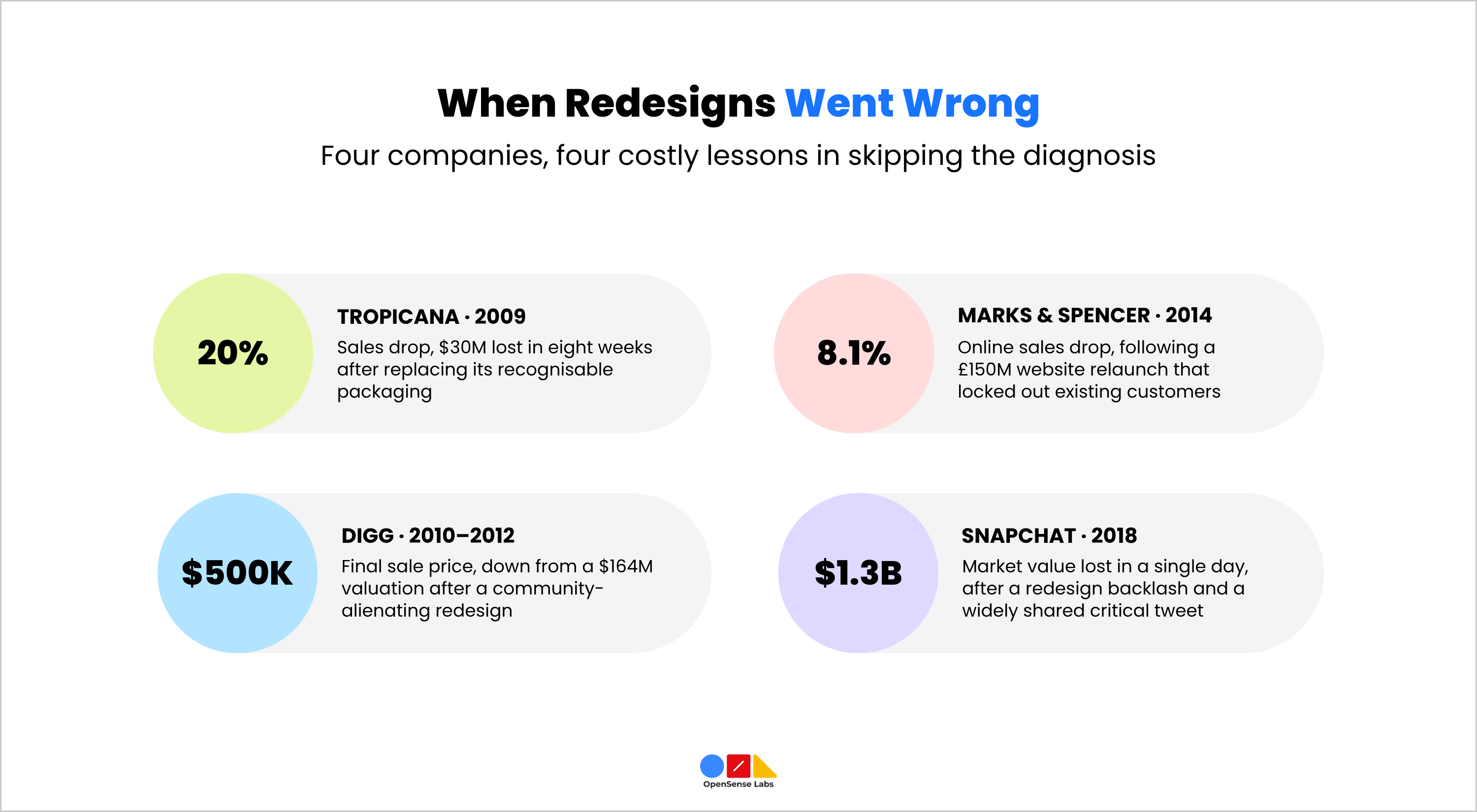
In each case, the redesign prioritized what the company wanted to change over how users behaved, and none of the failures were caught before launch because none were preceded by a structured evaluation of the existing user experience against the proposed change. A website audit is what surfaces that gap while it is still cheap to close.
What an Audit Actually Evaluates That a Redesign Brief Doesn't
A redesign brief typically starts from a destination, a new look, a new platform, and a new set of templates. An audit starts from the present state, and the two documents ask fundamentally different questions.
Content and Governance Debt: A redesign brief tends to assume existing content will simply move across to the new site, restyled but otherwise intact. An audit asks which of it should move at all, and who is accountable for the answer. In practice, this debt typically takes a few recurring forms:
- Pages built for campaigns that ended years ago and were never retired
- Service or product descriptions that no longer match what the business sells
- Duplicate content created by regional or departmental teams that lack a common source of truth
Left unexamined, this debt does not disappear during a redesign; it migrates into a more expensive environment and becomes harder to fix once it is embedded in new templates and workflows.
Technical and Platform Constraints: A redesign brief outlines the functions of the new site. It rarely accounts for what the current platform, integrations, and third-party dependencies will allow, or resist. An audit examines:
- The CMS's actual structural limitations against the redesign's ambitions
- The health of API connections to CRM, marketing automation, and analytics tools
- The load carried by legacy scripts and plugins accumulated over several years
This matters because a platform decision made without this visibility tends to surface its costs only after development is underway, when the fix is far more disruptive.
SEO and Analytics Baseline: Every claim a redesign makes about future performance higher conversion, lower bounce rate, stronger organic visibility, depends on an honest measurement of the current state. Without a documented baseline for rankings, indexed pages, top-performing URLs, and existing conversion paths, there is no way to demonstrate afterwards that the redesign actually improved anything, and no way to know which pages carry SEO equity that the migration needs to protect.
Security, Accessibility, and Compliance Exposure: A redesign brief rarely treats these as diagnostic categories in their own right; they tend to surface only when something has already gone wrong. An audit evaluates them directly:
- Vulnerability exposure across the current codebase, dependencies, and infrastructure
- Conformance against WCAG accessibility standards, including semantic structure and ARIA labelling
- Legal and regulatory exposure carried forward from the existing site, rather than assumed to improve automatically with a new build
None of these are things a redesign fixes by default. A visually new site built on an unpatched, inaccessible, or non-compliant foundation carries the same exposure forward, just with a fresh coat of paint over it.
Website Audit vs Website Redesign: Where the Line Actually Sits
The distinction between website audit vs website redesign is one of scope and purpose:
| Website Audit | Website Redesign | |
|---|---|---|
| Nature of work | Diagnostic | Implementation |
| What it examines | User experience, technical performance, content quality, accessibility, conversion paths | Site structure, design, technology, and often the underlying platform |
| Primary output | A prioritised account of what is working, what is not, and what is costing the business the most | A rebuilt or restructured site, based on decisions the audit should have already informed |
| Basis for decisions | Evidence gathered from the current site | Direction set by the audit's findings, or, when skipped, by assumption and preference |
Confusing the two tends to produce one of two costly outcomes. Some organizations commission a full redesign to solve a problem that a handful of targeted fixes, a faster load time here, a clearer navigation path there, would have resolved at a fraction of the cost and disruption.
Others commission a light audit when the underlying issue is structural, a CMS that can no longer support the organization's content operations, or an information architecture built for a business that no longer exists in its current form.
The audit job is to make that distinction explicit, so the decision that follows is based on the size of the actual problem rather than how the problem happens to feel to the people closest to it.
The Redesign Risks an Audit Catches Before They Become Expensive
Enterprise website redesigns fail in fairly predictable ways once governance, accessibility, and content debt are left unexamined:
- Governance Risk: Enterprise redesigns typically involve marketing design, IT owning the technology stack, and content produced by whichever team has capacity at the time. Accessibility and compliance requirements are frequently assigned to no one until legal raises them late in the process. An audit forces an early answer to who owns the integrated outcome, rather than leaving that question to surface after launch.
- Accessibility and Compliance Exposure: Redesigns built without an accessibility baseline risk carrying forward, or introducing, conformance gaps that create legal and reputational exposure well beyond the cost of fixing them during design. An audit establishes what the current site's accessibility posture is, rather than assuming the new design will simply be better by virtue of being new.
- Content Debt at the Point of Migration: Content that was manageable as clutter on the old platform becomes a liability once it is carried into a new one with different structural expectations, particularly where a CMS migration is involved. The audit is what determines what survives the move, what gets consolidated, and what gets retired.
Site Migration Guardrails: Protecting What Already Works
Once a redesign proceeds, its greatest risk is rarely the new design itself. It is the technical execution of the migration, and specifically, protecting the organic visibility, user journeys, and tracking accuracy that the current site has already earned.
A defensible migration typically works from a documented pre-launch checklist:
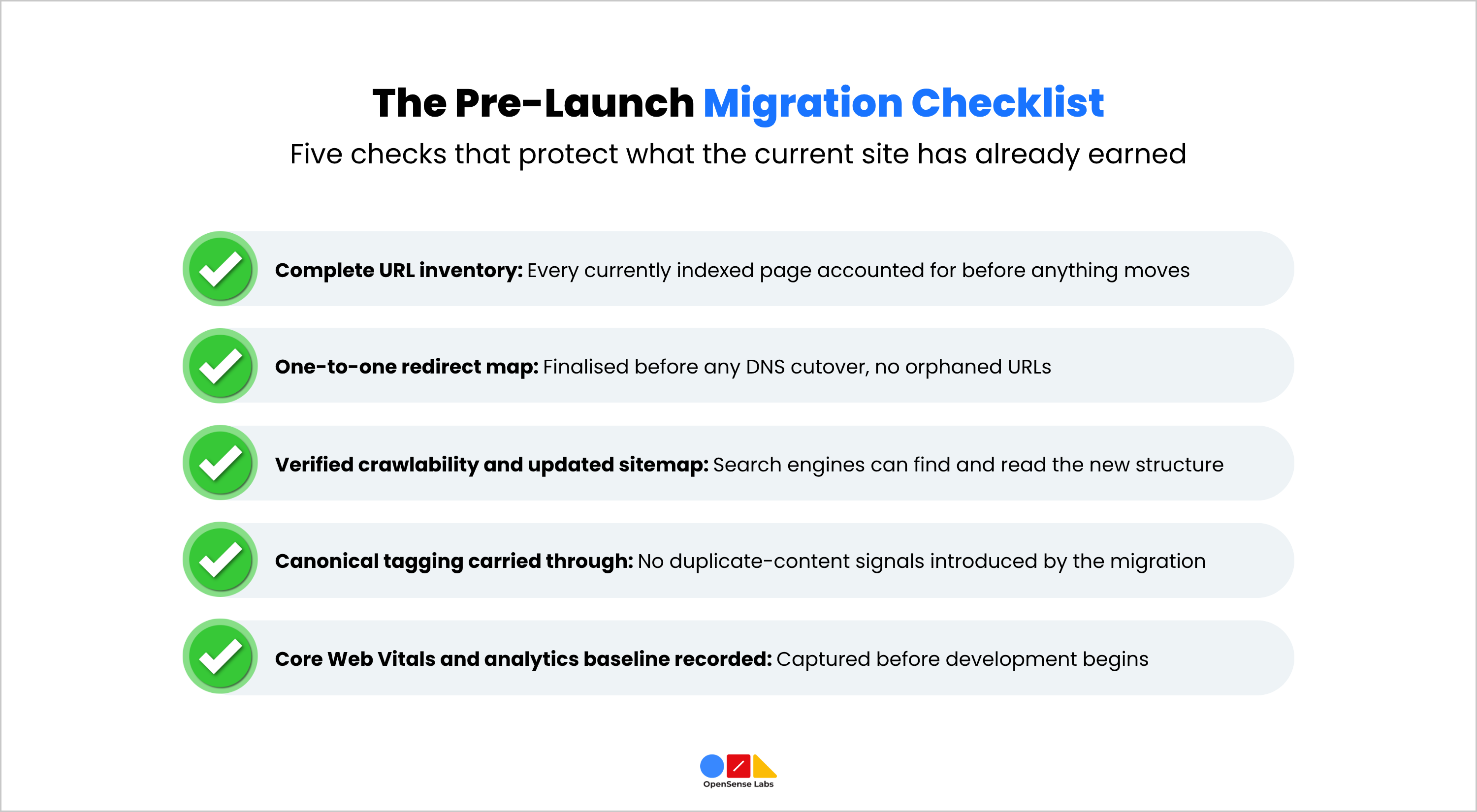
Skipping this sequence is how a redesign turns into a traffic incident. Broken redirects, lost indexing, and disrupted analytics tracking are rarely the result of a poor design decision; they are almost always the result of a migration executed without the guardrails the audit was supposed to establish. For organizations running or considering a Drupal-based platform, this is also where an audit surfaces whether the existing architecture, or a planned migration path, can support the content operations the business needs going forward.
The AI Perspective: Why This Will Be More Important in 2026
There is a further reason a pre-redesign audit has become more urgent in 2026, a growing share of B2B buyers are removing themselves from direct contact with vendors altogether and increasingly using AI agents to conduct that evaluation on their behalf. Gartner's March 2026 survey of B2B buyers found:
- 67% now prefer a rep-free buying experience
- 45% reported having used AI during a recent purchase decision
The consequence for enterprise websites is structural. A small set of common issues can block an AI agent evaluating a vendor on a buyer's behalf:
- Text embedded in images rather than in readable HTML
- Inconsistent or non-semantic heading hierarchy
- Content that assumes a human reader will infer meaning from layout and visual emphasis rather than from the text itself
The risk this creates is difficult to detect through ordinary analytics: there is no bounce, no abandoned form, no support ticket. The vendor is evaluated, found to be too unclear to recommend, and passed over, with no visible trace of what happened.
A cosmetic redesign, focused on visual refresh without addressing semantic structure and content clarity, does nothing to close this gap and may leave it exactly where it was. This is precisely the territory a technical and content audit is built to assess, whether the underlying architecture of a site can be accurately read and represented by the systems that are increasingly standing between a business and its buyers, not only by the people who land on the page directly.
Building the Audit-to-Redesign Decision Framework
Understanding why enterprise website redesigns fail is only useful if it changes what happens next. The purpose of an audit is not simply to produce a list of findings. It is to convert those findings into a decision the organization can defend to proceed with a full redesign, invest in a series of targeted improvements, or address a specific structural constraint, such as a platform limitation, before either.
A useful framework ranks findings along two dimensions: business impact and implementation effort. This separates high-impact, low-effort fixes that can be addressed immediately from the structural issues that justify a larger redesign investment. This is also where platform performance becomes a determining factor rather than an afterthought.
An audit that surfaces persistent page speed issues, unstable Core Web Vitals, or a CMS that cannot scale with the organization's content demands effectively answers the redesign question before the design conversation even begins. Where platform performance is the binding constraint, the audit output should point directly to what needs to change at the infrastructure level, not just at the level of layout and visual design. Enterprise website redesigns fail most often when this evidence never gets gathered in the first place.
Getting the right platform performance baseline before any redesign decision is where OpenSense Labs' Platform Performance solution comes in, helping enterprise teams establish exactly this evidence before committing to a rebuild.

Newsletter abonnieren
Open-Source-Technologie begeistert Sie? Bleiben Sie mit Projekten auf dem Laufenden, die einen Unterschied machen.