
Digital Asset Governance for Brand Compliance: What Legal and Marketing Teams Need from a DAM
A single asset with an expired licence can turn a routine campaign into a legal claim overnight. Digital asset governance is what tells a brand, before that happens, which assets are safe to use and which are not.
Every brand produces more content than it did a year ago. Campaign photography, product shots, influencer content, video, social assets, the volume keeps rising, and Legal and marketing teams both have a stake in this content.
Digital asset governance is what keeps that content under control. Marketing wants assets moving quickly into campaigns. Legal wants proof that every asset in circulation is cleared for the way it's being used.
Digital asset governance means building one shared system that works for both teams. Most discussion of digital asset management treats this as one problem with one answer. It rarely is. A system built only around speed creates blind spots for legal. A system built only around control slows marketing down enough that people work around it.
Digital asset governance is the practice of building a shared system that satisfies both, and it starts with understanding where the two teams' requirements overlap and where they genuinely differ.
The Difference Between Digital Asset Management and Digital Asset Governance
A basic digital asset management system stores files and makes them searchable. Digital asset governance adds a layer on top, structured rights data attached to each asset, controlled access by role and region, and a record of who approved what and when.
| Capability | Storage Only DAM | Governance Ready DAM |
|---|---|---|
| Rights Tracking | A file sits in a folder with no attached record | Consent, licence and territory data attached to the file itself |
| Access Control | One shared login for most users | Role-based permissions by team, region and asset sensitivity |
| Expired Content | Stays downloadable indefinitely | Flagged or blocked automatically once a licence or consent expires |
| Proof of Approval | An email trail, if one exists at all | An exportable audit log tied to each asset |
This difference matters. Brand compliance software is not judged on how well it stores files. It is judged on whether it can prove, on demand, that a piece of content was cleared for how it was used. That proof is the real test of digital asset governance. It is also one of the clearer markers of an organisation's overall digital maturity; governance rarely improves on its own once other systems have moved ahead of it.
A List of the Regulations That Create Risk in Brand Content
Several distinct legal frameworks apply to the kind of content marketing teams publish every week, and each creates a different obligation for a digital asset management system to meet.
- GDPR treats an identifiable photograph or voice recording as personal data. Article 83(5) allows fines of up to €20 million or 4% of global annual turnover, whichever is higher, for violations involving unlawful processing or a failure to respect a data subject's rights, including a withdrawn consent that keeps getting used anyway.
- CCPA gives California residents the right to have their personal data, including images used in marketing, deleted on request. A DAM without a way to locate and remove a specific person's likeness across every asset that features them cannot support that request.
- California Civil Code Section 3344 makes it unlawful to use a person's name, voice, signature, photograph or likeness for advertising without prior consent. Statutory damages start at $750 or the actual loss suffered, whichever is greater, plus any profit attributable to the unauthorised use.
- The FTC's Endorsement Guides, updated in 2023, require any paid partnership, gifted product or other material connection between a brand and an endorser to be disclosed clearly, on the content itself, not buried in a hashtag list. This applies to influencer content, employee advocacy posts and reposted user content alike.
- Stock and licensed content terms attach their own restrictions; a licence bought for one region, one campaign duration or one media type does not automatically extend to a new market or a new use.
- The Advertising Standards Authority in the UK, and equivalent self-regulatory bodies elsewhere, oversee whether marketing claims and representation are accurate and appropriate for the audience, separate from data protection law entirely.
None of these frameworks were written with digital asset management in mind. All of them depend on an organisation being able to show, asset by asset, where a piece of content came from and what it was cleared to do.
Examples of Where Brand Assets Create Compliance Exposure
The risk rarely shows up as a dramatic breach. It shows up in small, everyday gaps:
- A stock photo licence lapses midway through a campaign, and the image stays live on the website.
- A customer or employee photograph, taken with consent for one purpose, gets reused in a new campaign the person never agreed to.
- Influencer content approved for one region gets reposted into a market the original consent never covered.
- User-generated content gets pulled into paid advertising without the disclosure that paid use requires.
- A legacy campaign asset resurfaces years later, and nobody can confirm whether its rights ever expired.
- Automated tagging processes a face in an image without anyone checking whether that counts as biometric data requiring its own lawful basis.
Each of these is small on its own. Multiplied across a content library with thousands of assets and multiple contributing teams, they add up to a real gap in digital asset governance that no amount of manual spreadsheet-tracking closes reliably.
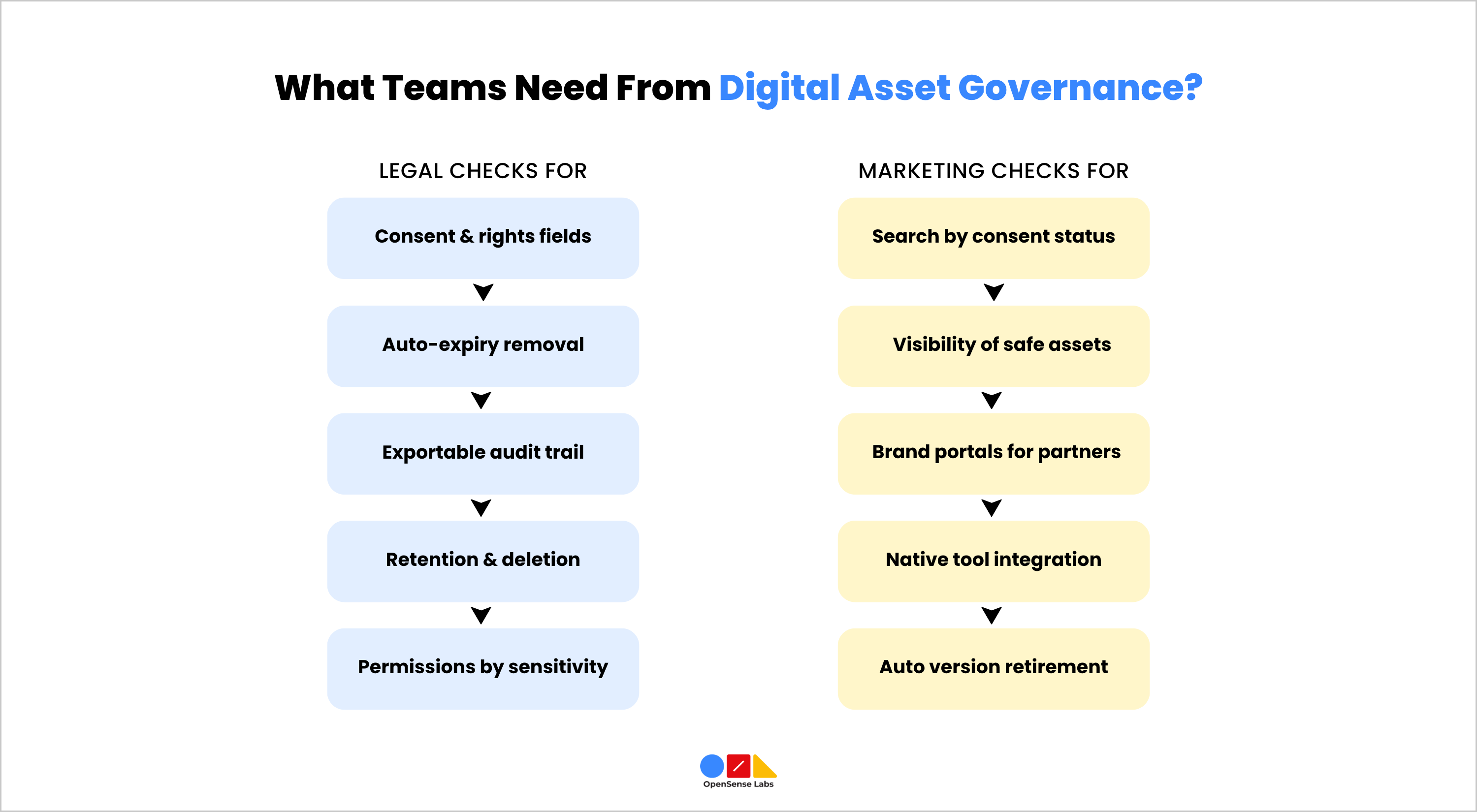
What Legal Teams Look For in a DAM
Legal teams evaluating digital rights management software tend to look past the interface and go straight to the specifics:
- Structured metadata fields for consent type, signor, territory, expiry date, and licensor, attached directly to the asset rather than tracked in a separate document.
- Automatic removal from search or download the moment a licence or consent expires, rather than a manual reminder that depends on someone reading it.
- An audit trail detailed enough to show who approved a specific asset, when, and on what basis, and exportable in a form that holds up during a compliance review.
- Retention and deletion workflows that can act on a data subject's request without a manual search through every folder.
- Clear documentation of the lawful basis for any biometric or facial recognition processing, along with the ability to switch that feature off entirely.
- Permission tiers that can be set by how sensitive an asset is, not only by which team requested it.
What Marketing Teams Look For in a DAM
Marketing teams are looking for a different but complementary set of things from the same brand asset management software:
- Search and filtering by consent or licence status, so an asset cleared for use in one region can be found without a separate check with legal.
- Clear visibility into what is safe to use, rather than defaulting to caution and avoiding an asset because nobody is sure.
- Brand portals that give agencies and regional teams access only to current, approved content.
- Native integration with the design tools already in daily use, so approved assets stay inside the working process rather than being downloaded, edited, and re-uploaded.
- Version control that automatically retires an outdated file, instead of relying on a naming convention like "logo_final_v3" to signal which version is current.
How an Asset Moves Through a Governed DAM
A single photograph illustrates how digital asset governance works in practice. It is uploaded, and at that point its metadata is captured, who is in it, what consent was given, which territories it can be used in, and when that consent expires. It moves through an approval workflow with a named sign-off.
Once approved, it is distributed only to the teams and regions its permissions allow. As its expiry date approaches, the system flags it; once it passes, the asset is automatically removed from search or blocked from download. At any point in that lifecycle, an audit-ready record can be exported showing exactly what happened and who was responsible for each step.
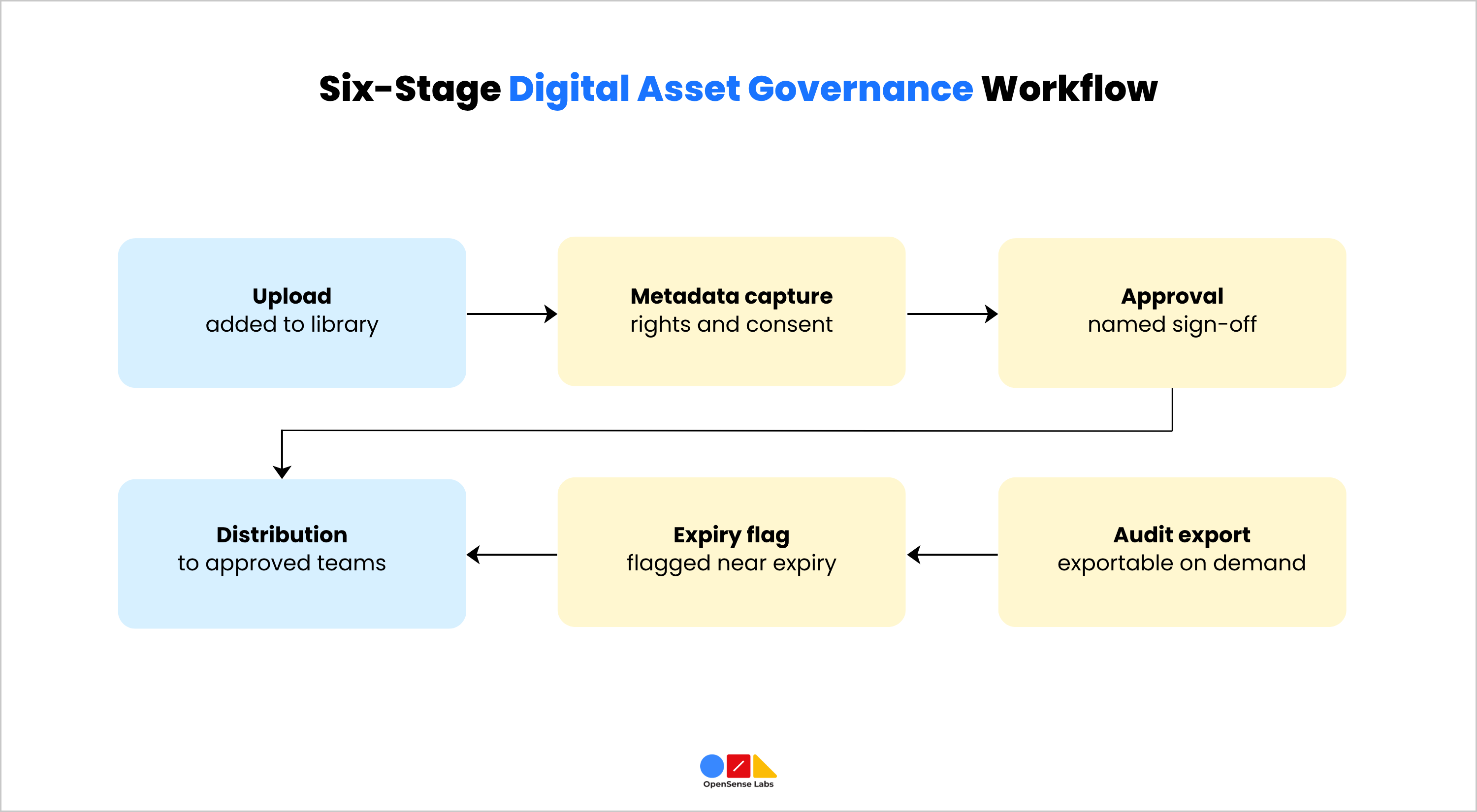
This sequence is what separates digital asset governance from simple storage. Every stage leaves a record. No stage depends on someone remembering to check. Organisations that also need to prove an asset's origin, not just its rights, often pair this with content provenance standards like C2PA, a related but distinct layer of trust.
Questions to Ask Before Choosing a DAM for Brand Compliance
Vendor demonstrations tend to show search speed and interface polish. A shorter set of specific questions reveals more about how the system actually handles governance:
- What happens to a shared download link the moment the underlying licence expires?
- Can the system produce an exportable record showing who approved a specific asset, and when?
- Does facial recognition or biometric tagging require its own documented lawful basis, and can it be turned off entirely?
- How does the system respond to a request to remove a specific person's image from every asset that features them?
- Can permissions be set by how sensitive an asset is, in addition to which team or region requested access?
A vendor that answers all five with specifics, rather than a general assurance that the platform is compliant, is the one worth taking further.
How To Get Started
The most common reason a DAM rollout stalls is that legal and marketing were never brought into the same conversation before a vendor was chosen. A few steps close that gap early.
- Audit the existing content library for assets with missing consent or unclear rights before evaluating any vendor. This surfaces the scale of the problem being solved and gives both teams a shared starting point.
- Agree on a shared metadata taxonomy, the specific fields both teams will actually use, such as consent type, expiry date, territory, and approval owner, before implementation begins, not after assets have already been migrated.
- Assign named ownership for tracking renewals and expiry dates, rather than leaving it to whoever happens to notice first.
- Pilot the new system with one high-risk category of content first. Imagery featuring identifiable people is the obvious starting point, since it carries the clearest legal exposure and the fastest way to prove the system works before rolling it out across the full library.
When legal and marketing agree on these fundamentals before selecting a platform, the resulting system tends to satisfy both from day one, rather than being retrofitted with governance controls after a gap in brand consistency or a near-miss forces the issue. This is what digital asset governance looks like once it is working, not just something promised in a pitch.
See how OpenSense Labs' Intelligent DAM solution brings governance and speed together in one system.

Newsletter abonnieren
Open-Source-Technologie begeistert Sie? Bleiben Sie mit Projekten auf dem Laufenden, die einen Unterschied machen.