
Custom LMS Development: What Goes Into the Build and Where the Cost Sits
"Custom LMS development typically costs between $10,000 and $500,000, with some projects exceeding these amounts. The gap comes from scope, and two quotes for the same feature list can differ widely because each assumes different integrations, languages and compliance requirements."
Custom LMS development timelines vary as widely as their prices, with development firms stating anywhere from three months to twenty-four months for a build. A CTO or L&D leader comparing quotes therefore has two unknowns to resolve, which are how long the platform will take and which layers of the build each price covers.
Those layers include integrations with HR and student systems, assessment and certification, analytics, mobile access, security, and accessibility. Each can be scoped lightly or heavily, and those choices determine the total.
This article explains what a custom learning platform includes, how cost behaves over the life of a build, and where it concentrates by layer. It also covers post-launch costs, how to sequence a build, and the questions to settle before requesting quotes. This content is designed for CTOs, learning and development leaders, and finance teams who are evaluating different proposals.
What Custom LMS Development Includes?
A custom learning management system is built to an organisation's requirements, not configured from a commercial product. Its components fall into three groups.
The learning core handles enrolment, content delivery, assessment, progress tracking and reporting. Every other capability reads from the data this core produces, which is why it is built and tested first. Content management sits here, including support for SCORM and xAPI where third-party content or consistent learning records are required.
The connecting layer joins the platform to the rest of the organisation. It covers single sign-on, HR or student information systems, CRM, payment and video services, and the roles and permissions that decide who can see and change what.
The protective layer covers security, privacy compliance, and accessibility. These rules apply to all other parts and are not distinct features.
The budget for platform expenses and the budget for content expenses are kept as two different line items. Course production is normally priced per finished hour of learning, involves different suppliers, and follows a different timeline. The figures in this article cover the platform only.
A learning experience platform adds discovery, recommendation, and social features to this foundation. The choice between the two platform types is covered in LMS vs LXP for higher education.
Why Published Cost Estimates Disagree?
Four development-firm sources published between 2024 and 2026 give the following ranges for custom LMS development.
| Source | Date | Published Range | Stated Timeline |
|---|---|---|---|
| Rootstack | 2024 | $10,000–$30,000 basic; $30,000–$80,000 intermediate; from $80,000 advanced | Not stated |
| RBMSoft | February 2026 | $15,000–$30,000 basic; $30,000–$120,000 mid-level and advanced; $120,000–$250,000+ custom enterprise | 3–4 months for an MVP; 6–9 months or more for enterprise-grade |
| Sisgain | September 2026 | $25,000–$60,000 MVP; $60,000–$150,000 full-featured; $150,000–$400,000+ enterprise or multi-tenant | 3–4, 5–8, and 6–9+ months respectively |
| AllenComm | April 2026 | $200,000–$500,000 custom-built LMS; above $500,000 for enterprise applications with advanced analytics or AI personalisation | 12–24 months |
Vendor-published cost ranges for custom LMS and learning platform builds, in US dollars.
Tier names do not line up. One source labels any build from $80,000 as advanced, while another places advanced platforms between $60,000 and $120,000 and reserves $120,000 and above for custom enterprise builds. Timelines diverge in the same way, with enterprise-grade builds stated at 6 to 9 months in some sources and 12 to 24 months in another.
All of these figures are vendor estimates, and none is an independent benchmark. Two sources describe their figures as indicative and state that no fixed price exists. You can compare two quotes only when they assume the same number of user types, integrations, languages, tenants, and compliance requirements. The sections below set out how those assumptions turn into cost.
How Cost Behaves in a Custom LMS Build?
Cost in a learning platform behaves in four different ways. An estimate that merges them into one figure is difficult to compare with another.
- Scope Cost: It is incurred once and is set by the number of things the platform must do or connect to. User types, integrations, languages, tenants, and compliance regimes all add scope. Doubling the number of learners does not double this cost, while adding a second HR system does.
- Volume Cost: It grows with the number of learners and the amount of content. Storage, video streaming, concurrent-user capacity, and analytics processing sit here. It is usually a smaller share of the total at launch and increases with adoption.
- Run Cost: It recurs every year. Hosting, monitoring, security patches, framework upgrades, and support fall into it. The sources above place annual maintenance at 15 to 25 percent of the original build cost, with one giving 15 to 30 percent.
- Change Cost: It arises when something outside the platform moves. A connected system changes its interface, a regulation is updated, or a business unit asks for a new learner group. This is the hardest cost to forecast, and platforms with clear integration boundaries and a documented data model absorb it more cheaply.
A quote that shows only a build price covers the first category. A 3 to 5 year view has to include the other 3.
Where Does the Cost Sit in Custom LMS Development?
None of the sources reviewed publish a percentage split of custom LMS development cost by layer, so this article does not assign one. Integrations appear among the largest cost variables in those sources, and one names them the largest. The table sets out the work in each layer and the decision that moves its cost.
| Layer | Work Involved | Decision that Moves the Cost |
|---|---|---|
| Integrations | Identity mapping, sync direction, conflict rules, error handling, monitoring and testing for each connected system | Number of systems, whether each has a documented interface, and which system holds the authoritative record |
| Data Migration | Extracting, cleaning and mapping learner records, enrolments, completions and certificates from the legacy system | Data quality, how much history to retain, and whether records must stay audit-ready |
| Assessment and Certification | Question banks, grading rules, certificate issue, recertification and expiry tracking | Regulated credentials, proctoring or identity verification, and audit reporting |
| Roles and User Experience | Permission tiers, groups, manager views, interface design and usability testing | Number of user types and how far each interface departs from standard patterns |
| Analytics and Reporting | Data capture for engagement and outcomes, dashboards and role-based reports | Number of report audiences and whether learning data is joined to business data |
| Mobile and Offline | Responsive layouts or native apps, offline access and progress sync | Whether learners are deskless, and native app versus responsive web |
| Security, Privacy and Accessibility | Encryption, access control, audit logs, privacy compliance and conformance testing | Regimes that apply by region and learner age, and the named accessibility level |
| AI Features | Recommendation, adaptive paths, content generation and data pipelines | Quality and volume of learner data already available |
| Infrastructure and Tenancy | Hosting, scaling, tenant isolation and white-label configuration | Number of client organisations or brands on one platform |
Integrations concentrate cost because each connection is a small project. The work includes agreeing which system owns each record, mapping fields, deciding sync direction, handling failed updates, and testing against the connected system as it changes. A single sign-on connection to an identity provider is a modest task, while a two-way sync with an HR system that has no documented interface is a much larger one.
A recent LMS modernisation delivered by OpenSense Labs for STEM Fuse shows how much work sits behind ordinary-looking features. Sign-in through Google and Clever, dashboards personalised by profile and subscription, and progress tracking that lets students resume where they stopped were all listed among that project's requirements. Each involves design, build, and testing work beyond the course catalogue itself.
Timing matters for the protective layer. Security controls, privacy compliance, accessibility conformance, and tenant isolation cost least when they are part of the original architecture. Adding them after launch means revisiting components that are already built and tested, which usually costs more than including them in the first estimate.
AI features depend on data. Recommendation and adaptive paths need clean, structured learner records collected over time, so an AI feature budgeted for launch may have little data to work from. Placing it after the core platform has produced data protects that spend.
How Identical Feature Lists Produce Different Quotes?
Consider two organisations that each request a platform with course delivery, quizzes, certificates and reporting for 5,000 learners. The details below are illustrative and are not drawn from any project.
Organisation A uses one HR system with a documented interface, needs one language, expects a standard security review, and has no learning history to migrate. Organisation B uses an HR system and a CRM, needs three languages, must keep 5 years of completion records from a legacy platform, and requires a named accessibility level with third-party testing.
The feature list is the same for both. Organisation B's quote includes more integration work, a migration project, translation and localisation, and formal testing. Neither quote is wrong, since they describe different projects. Comparing the two headline figures would suggest that one vendor costs more, although the difference sits in the assumptions.
Costs That Continue After Launch
In custom LMS development, run cost starts on the day of launch. The sources above put annual maintenance at 15 to 25 percent of the original build cost, with one giving 15 to 30 percent. On a $200,000 build, that equals $30,000 to $50,000 a year. Hosting is added to this, and one source estimates it at $100 to $1,000 a month depending on traffic.
Maintenance covers framework and security upgrades, bug fixes, performance work, and changes forced by connected systems. A structured support arrangement gives this cost a defined line in the budget. The STEM Fuse platform, for example, operates under a support and maintenance SLA in which users across different roles raise issues through a ticketing workflow, and the work includes regular core and module upgrades for security patches.
A fair comparison between a custom build and an existing platform covers 3 to 5 years. For the custom option, it includes the build, maintenance, hosting, and internal staff time. For the alternative, it includes licence fees, configuration, and integration work.
Sequencing a Build to Control Cost
Sequencing decides how much of a custom LMS development budget is committed before anyone has used the platform. Building in phases keeps early spend on the layers that everything else depends on.
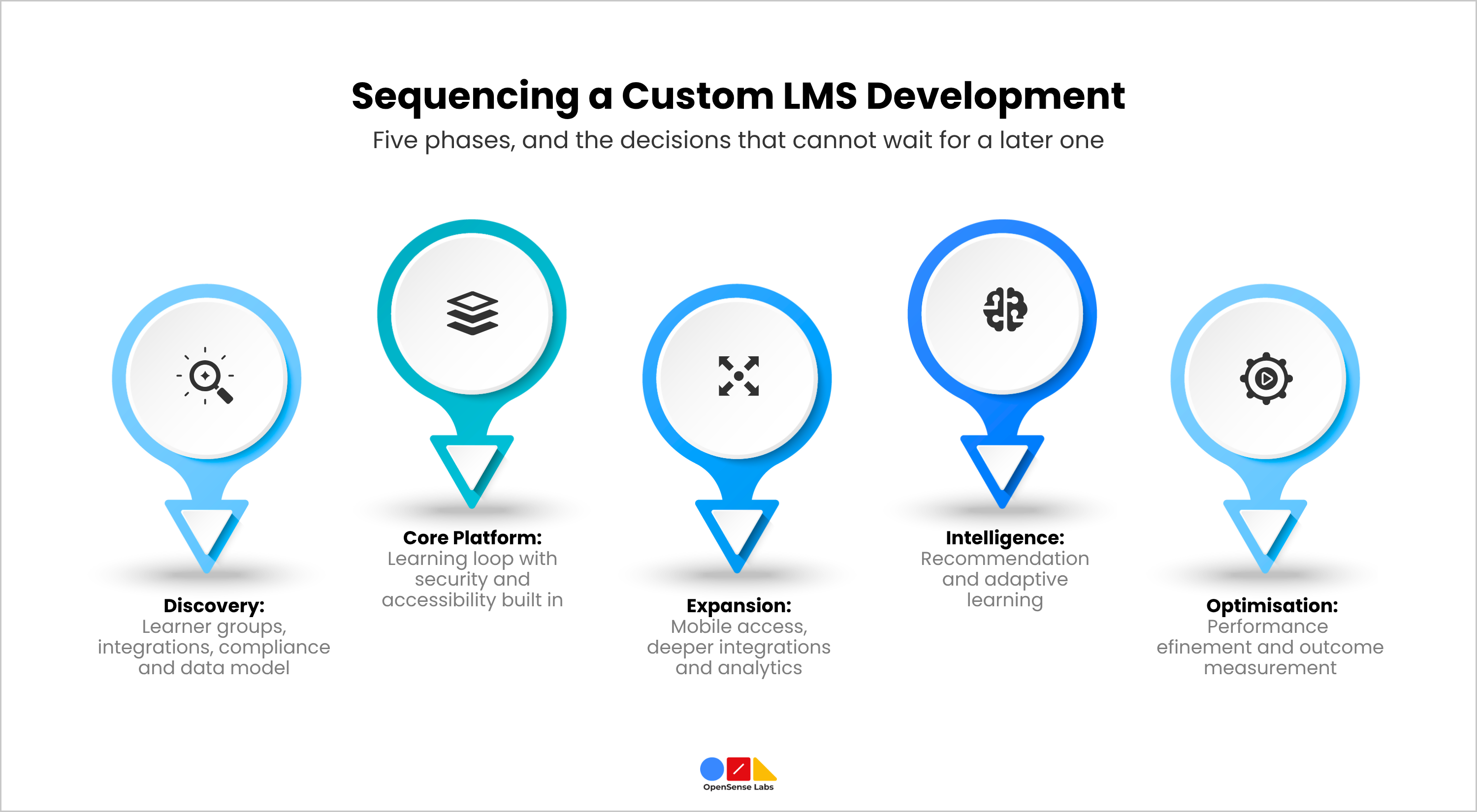
- Discovery defines learner groups, integrations, compliance requirements, and the data model.
- The core platform delivers the learning loop, with security and accessibility in the architecture.
- Expansion adds mobile access, deeper integrations, and analytics.
- Intelligence adds recommendation and adaptive learning once enough clean data exists.
- Optimisation refines performance and measures learning outcomes.
Some decisions cannot wait for a later phase. The data model, the permission structure, tenancy, security, and accessibility affect every component built afterwards, so changing them later means reworking finished work. Features that read from those foundations, such as advanced analytics and AI, can be deferred at little cost.
Custom LMS Development, Configuration or Hybrid Approach
Custom LMS development is one of three routes an organisation can take when planning a learning platform, alongside configuring an existing platform and a hybrid approach, and each route carries a different cost profile and level of control:
- A custom build gives full control over features, integrations, and data, with the cost profile described above.
- Configuring an existing commercial or open-source platform reaches launch sooner, and its cost is mostly recurring licence or hosting fees plus configuration work.
- A hybrid approach combines a proven platform core with custom services and a custom interface for the parts that standard products do not cover.
A custom build is the stronger choice when learning is central to the product or business model, when integration or compliance requirements exceed what existing platforms offer, when several client organisations need separate branded spaces, or when the learner base is large enough to spread the build cost. Configuration suits standard requirements and a short timeline. A hybrid approach suits organisations with mostly standard needs and a small number of requirements that products do not meet.
Annual subscription figures and one-time build figures cannot be compared directly. Adding maintenance to the build figure and comparing over three to five years puts the paths on the same footing.
Planning a Custom LMS Development
The cost layers above show where a custom learning platform spends its budget, from integrations and data migration to assessment, security and the run cost that follows launch. Organisations can control that spend by choosing a path according to these cost drivers and by checking every quote against the same scope assumptions.
Starting from an existing foundation is one way to reduce exposure to the largest layers. OpenSense Labs' Learning Experience Platform solution is built on open-source Drupal with a proprietary core, which shortens the route to launch compared with a full custom build. Assessment, analytics, role management and secure cloud architecture are part of that core.
Custom work then concentrates on the organisation's own integrations, such as HR systems, CRM and single sign-on, and on requirements that standard products do not meet. The organisation keeps ownership of its learning data throughout.

Newsletter abonnieren
Open-Source-Technologie begeistert Sie? Bleiben Sie mit Projekten auf dem Laufenden, die einen Unterschied machen.