
Distributed Team Management: Choosing a Governance Model
Distributed team management comes down to three real models, centralized, decentralized, and federated. Most operations leaders have only ever compared their current setup against itself, never against the other two.
As a company opens offices in more locations, more decisions pile up. What stays centralized and what each office decides for itself grows faster than most operations teams revisit it. A reporting format gets set once and never questioned. An access rule gets added for one office and never extended to the next. Within a year, distributed team management stops being a deliberate choice. It becomes whatever accumulated by accident.
This article sets out what to decide instead, which governance model fits distributed team management, what a single source of truth needs to contain, how access stays useful without turning into a bottleneck, how bottlenecks get caught across offices before they become backlogs, and what changes when a client is watching the same data.
Centralized, Decentralized, or Federated: Choosing a Distributed Team Management Model
Three models exist for governing visibility across offices, and most organizations default to one without comparing the other two.
Centralized Governance
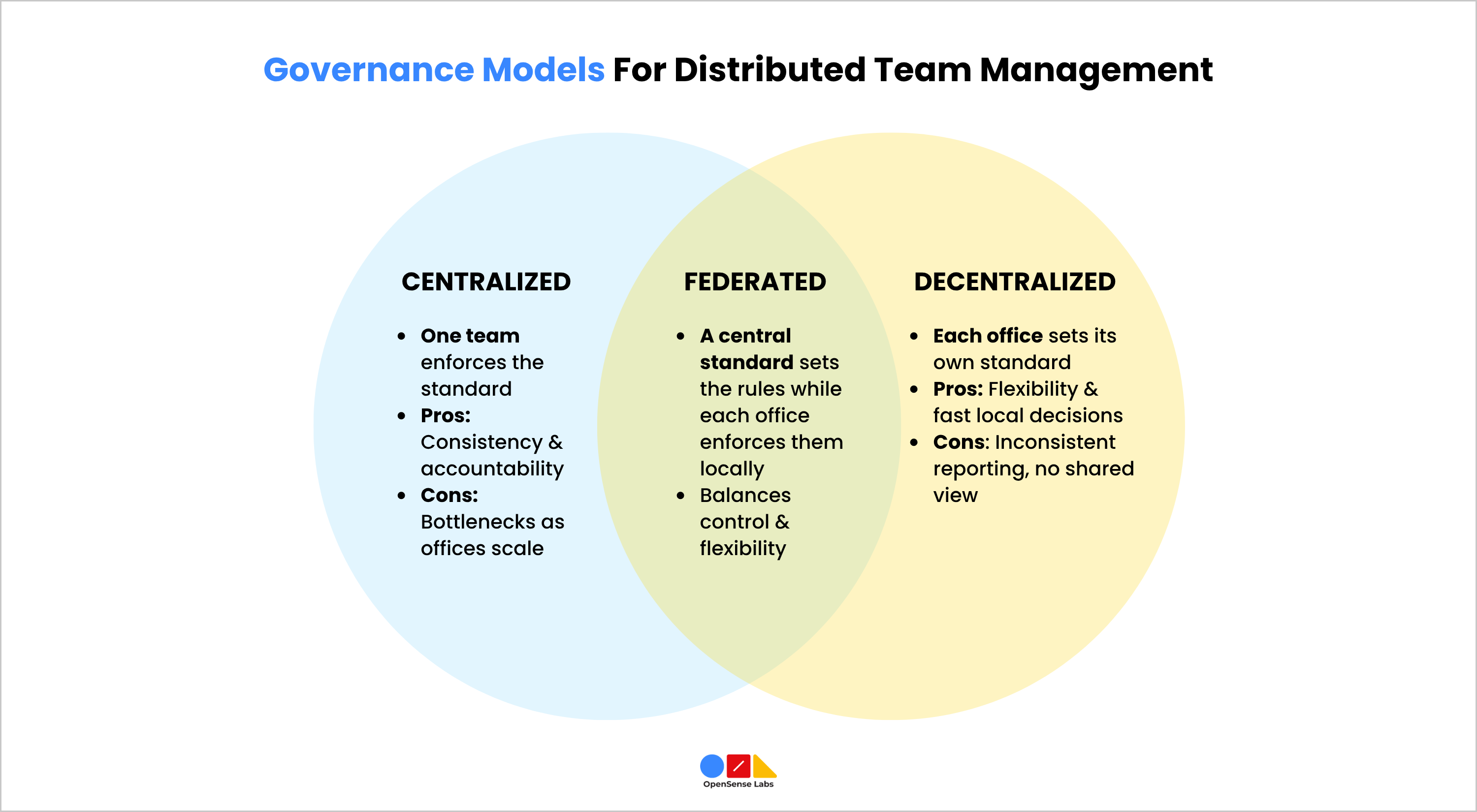
Centralized governance is the version of distributed team management where one team or system sets and enforces the rules for every office. Reporting formats, access rules, and reporting cadences are defined once, at the centre, and every office follows the same version.
Its core characteristics:
- One point of accountability for the whole organisation's delivery data
- Reporting that looks identical regardless of which office produced it
- Rules changed once and applied everywhere, without each office interpreting them separately
- A single team that fields every request for cross-office data
This works well while the number of offices is small enough for one team to service directly. Past a certain point, that same team becomes the constraint, since every request or exception has to pass through them first.
Decentralized Governance
Decentralized governance is the version of distributed team management where each office makes its own visibility decisions. Each office chooses its own tools, sets its own reporting cadence, and decides what counts as useful data for its own work.
Its core characteristics:
- Decisions made locally, without waiting on approval from a central team
- Tools and reporting formats that can differ from one office to the next
- Fast adaptation to what each office's specific work actually needs
- No single team responsible for reconciling data across offices
This model moves quickly at the office level. It leaves leadership without a comparable view across the business, since two offices can solve the same problem in two different ways without either side finding out, and a leader comparing performance across offices ends up reconciling incompatible reports by hand.
Federated Governance
Federated governance is the distributed team management model many organisations eventually adopt. It sets a central standard for what every office must report, and how, while each office keeps its own tools and day-to-day management underneath that standard.
Its core characteristics:
- A shared definition of what gets tracked and how it gets reported, set centrally
- Local control over the tools and workflows each office uses to produce that data
- One consistent view at the top, built from data that stays comparable across offices
- A central team that owns the standard, while each office runs its own daily operations underneath it
This is the model most distributed organisations converge on once they outgrow the other two. Reporting stays comparable without forcing every office through an identical workflow, and no single team becomes the only place cross-office questions can be answered.
Choosing a model here is not a one-time decision. As offices are added, the model needs to be revisited, since a rule that worked for two offices at two hundred people does not automatically hold at eight offices and two thousand.
What a Single Source of Truth Needs to Include Across Distributed Offices
A single source of truth means every office's delivery data lives in one place, not scattered across office-specific spreadsheets and locally chosen tools. Without it, an operations leader is reading four different reports written in four different formats and must reconcile them by hand before any comparison is possible.
Four categories of data need to feed into that single view:
- Task and ticket status, so progress reads the same regardless of which office logged it
- Code or work-product activity, so output is visible without asking a team lead directly
- Communication threads relevant to delivery, so context isn't lost when someone changes offices
- Timeline and forecast data, so a delay in one office is visible before it affects another
The test for whether distributed team management is really working here is simple. If answering "how is Office B doing this week" requires a phone call, the source of truth does not exist yet, no matter how many dashboards are technically available.
How Role-Based Access Keeps Distributed Team Management From Becoming a Bottleneck
Centralizing visibility solves the reporting problem and creates a new one; if every request for data must go through one central team, that team becomes the constraint. Role-based access is what keeps a centralized model from collapsing back into the bottleneck it was meant to avoid.
An office lead needs live access to their own office's data without waiting on a weekly report someone else compiles. A regional director needs the rollup across every office they oversee, not the detail underneath each one. Finance or compliance may need only the audit history, not day-to-day activity. Each of these is a different slice of the same underlying data, and none of them should require a person to manually assemble it.
Done well, this also solves a second problem. When access is tied to role rather than to a person remembering to share a file, it survives staff changes automatically. Someone moving into a new office or a new role gets the access that role requires the moment the change is recorded, not whenever someone remembers to update a permissions list.
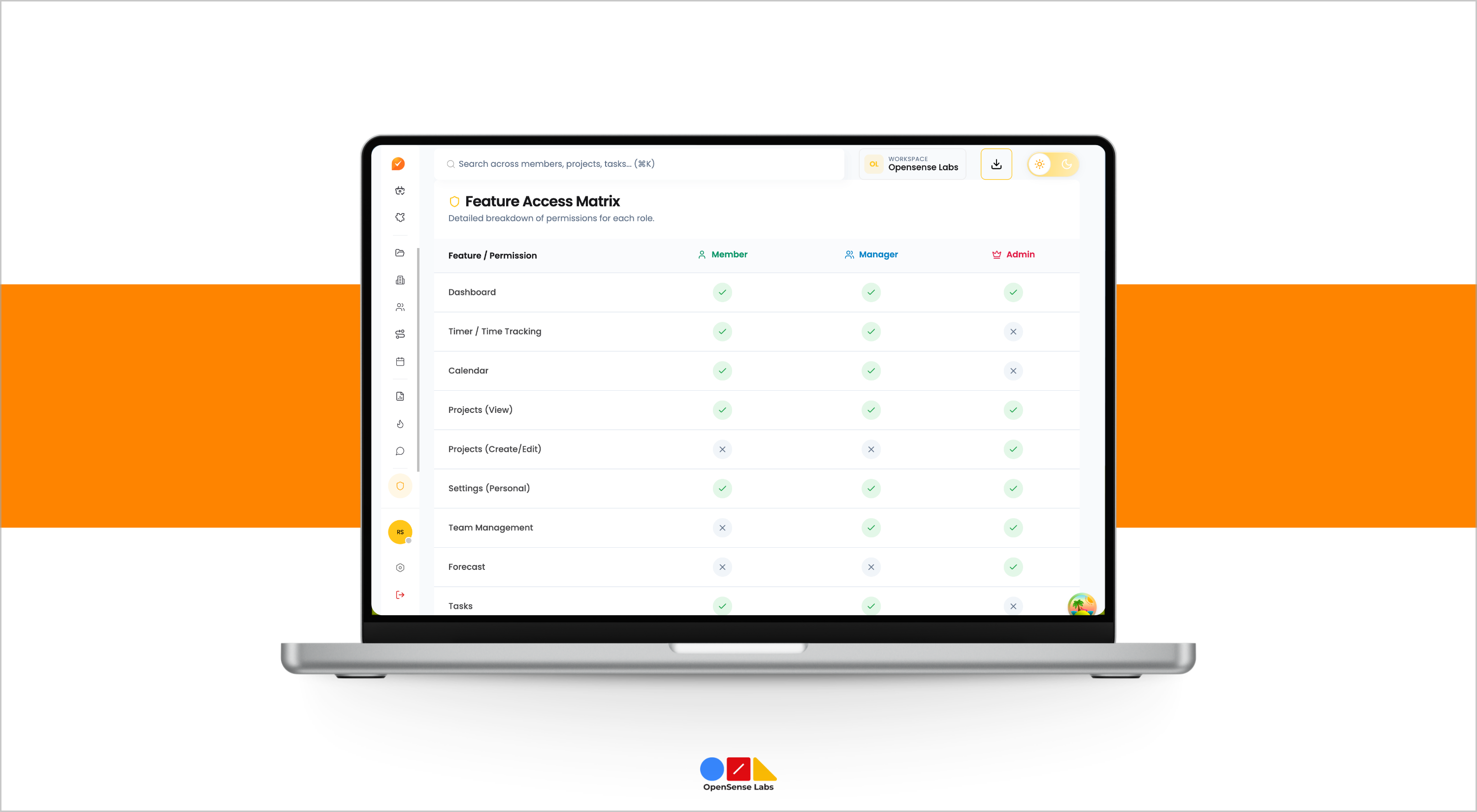
OSL's own workforce automation platform is built around this same principle. Access is set at the feature level rather than the account level. A member can track their own time and view assigned projects, a manager gets the same operational access without administrative controls, and only an admin can create or edit projects, manage billing, or add new members. The screenshot below shows this as a permission matrix, feature by feature, rather than a single access toggle applied per role.
Detecting Bottlenecks Across Multiple Offices Before They Become Backlogs
A bottleneck in one office rarely stays contained in that office. A dependency stalled in Office A shows up two weeks later as a missed deadline in Office B, and by the time anyone notices, it has already become a backlog rather than a delay.
Catching this earlier requires a live view across offices, not a summary produced after the fact. Three signals are worth watching directly:
- Tickets or tasks that have stalled longer than the office's own average
- Workload that has become uneven across offices doing comparable work
- A widening gap between when an office says work is complete and when the next office can pick it up
None of these signals require judgement calls once the data is visible in one place. They require the data to be visible in one place at all; that is the part most fragmented, office-by-office reporting fails to deliver, and it's exactly the gap distributed team management is meant to close.
What Client-Facing Transparency Requires from Centralized Governance
For organisations delivering work to external clients through distributed teams, distributed team management has to answer to someone outside the organisation as well as inside it. This raises the bar over internal reporting.
A client watching delivery data needs a consistent view regardless of which office is doing the work at a given time, since work handed between offices should look seamless from the client's side even when it isn't seamless internally.
The client also needs that view to reflect what has actually happened, not a summary someone compiled the night before a status call. A dashboard that updates in real time removes the gap between what is true and what gets reported, and it removes the need for a status meeting whose entire purpose is relaying information that should already be visible.
This is also where the access question from earlier returns. A client needs enough visibility to trust the work without seeing internal detail that was never theirs to see, which is a role-based access decision applied to an external stakeholder rather than an internal one.
What to Track Across Every Distributed Office
- Who has access to what data, and at what level, in every office?
- Whether delivery data updates in real time or still requires someone to compile it manually?
- How long does it take to spot a bottleneck once it starts affecting a second office?
- Whether reporting looks identical regardless of which office produced it?
- What a client sees compared with what the internal team sees?
- How access changes automatically when someone moves between offices or roles?
If more than one of these still depends on a person remembering to do something manually, governance is not yet centralized; it is just distributed unevenly.
A workforce automation platform built to unify delivery data across tools and offices into one real-time view, with access governed by role, answers each of the six points above directly rather than as an afterthought bolted onto existing tools. For the technical case behind this kind of visibility, covering how invisible work accumulates inside a single distributed team, see. To see how centralized governance works in practice across distributed offices...

Newsletter abonnieren
Open-Source-Technologie begeistert Sie? Bleiben Sie mit Projekten auf dem Laufenden, die einen Unterschied machen.