Remote Team Monitoring Without Keystroke Logs: Which Delivery Signals Replace Activity Monitoring
Remote team monitoring is often the first answer when leaders must show that distributed engineering teams are productive. Monitoring software records screenshots, keystrokes, application use, and idle time. These tools produce a large volume of activity data. CTOs and delivery heads usually need to know whether work is moving towards release.
Monitoring also carries legal obligations in Europe and the United States, and it affects how engineers respond to being measured.
This article sets out why activity data does not show delivery, what the main legal requirements are, and which delivery signals can replace remote team monitoring.
Why Activity Data Does Not Show Delivery?
Activity monitoring records what a device does. The measures it produces describe presence at a keyboard. They do not show whether a change has been reviewed, tested, or released. Engineering work includes reading code, discussing design, and waiting for reviews. None of these produces consistent input activity. Common activity measures miss delivery in the following ways:
- Keystroke counts and mouse movement do not distinguish reading, designing, and typing.
- Active windows show where attention was but not what it produced.
- Idle time records time spent reading code or waiting for a review as inactivity.
A developer who spends a morning reading an unfamiliar service before changing it can register as idle. A developer who edits the same file repeatedly without finishing can register as busy.
Monitoring also affects the people who are measured, according to three surveys:
- In the American Psychological Association’s 2024 Work in America survey, 51% of workers who knew they were monitored reported feeling tense or stressed during a typical workday. The figure was 38% for workers who said they were not monitored or did not know whether they were.
- The association’s 2023 survey found that monitored workers more often reported feeling micromanaged, at 51% against 33%.
- Research commissioned by the UK Information Commissioner’s Office in 2023 found that 70% of people surveyed would find monitoring by an employer intrusive.
These surveys cover workers in general and not engineers specifically. Delivery leaders still have two reasons to look beyond activity data. Activity data measures presence instead of output, and the people it measures tend to react negatively to it.
What European Rules Require Before Remote Team Monitoring Starts?
Monitoring software that records an identifiable employee’s activity processes personal data, so data protection law applies. Three sets of European rules shape what employers can do before monitoring starts:
Data Protection Law
- In the United Kingdom, the Information Commissioner’s Office expects employers to tell workers about any monitoring in an understandable way. Employers should keep only information relevant to its purpose. They should also carry out a data protection impact assessment for monitoring likely to result in a high risk to workers’ rights.
- The EU General Data Protection Regulation applies comparable principles of purpose limitation and data minimisation.
- Screenshots and keystroke logs capture far more than is needed to measure delivery. This makes the minimisation principle difficult to meet.
German Works Council Rights
- Section 87(1) no. 6 of the Works Constitution Act gives the works council a right of co-determination when the employer introduces technical equipment intended to monitor employee conduct or performance.
- The Federal Labour Court reads this broadly, and objective suitability to store performance data is sufficient to trigger the right.
- A works council may seek an injunction requiring the employer to stop and follow the procedure when such systems are introduced without it.
- Employers with German staff therefore usually need a works agreement covering scope, purposes, access roles and retention.
EU AI Act
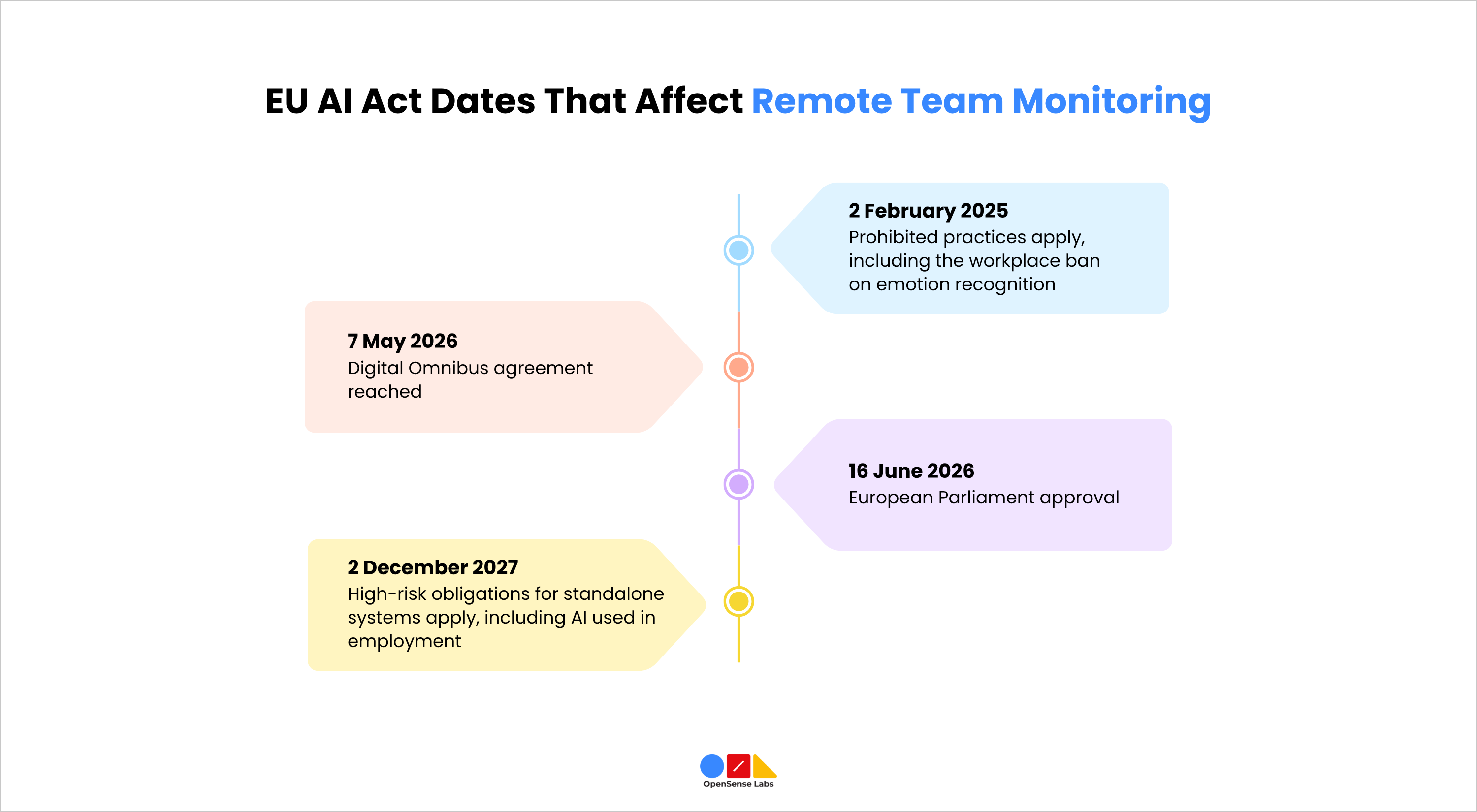
- Prohibited Practices: These have applied since 2 February 2025. They include a ban on emotion recognition in the workplace. The Commission’s guidelines give the example of a call centre using webcams and voice recognition to track employees’ emotions. Exemptions apply for medical and safety purposes.
- High-Risk AI Used in Employment: Obligations were due on 2 August 2026. The Digital Omnibus agreement reached on 7 May 2026 postpones the obligations for standalone systems to 2 December 2027. The European Parliament approved the agreement on June 16, 2026. One law firm reports that it entered into force on 27 July 2026. The delay is not a repeal.
A dashboard built from tickets and deployment records is less likely to be high-risk if it does not score individuals automatically. A tool that rates engineers automatically is more likely to fall into that category. Classification still needs legal assessment.
What United States State Rules Require for Remote Team Monitoring?
New York, Connecticut, and Delaware are among a small number of states with statutes requiring employers that monitor electronic communications to give prior notice. New York’s law applies to private employers regardless of size and requires prior written notice upon hiring. Delaware requires notice upon hire without employee acknowledgement, while Connecticut requires a notice posted in the workplace. The New York Attorney General enforces the New York law.
Other state privacy laws can also apply, so counsel should review each state where engineers are based. Whether delivery records such as tickets and pull requests fall within these notice laws depends on how each statute defines monitoring.
Five Delivery Signals that Replace Activity Data
Delivery signals that replace remote team monitoring are measures taken from records engineers create while doing the work. Examples are tickets, pull requests, deployments, and incident logs. Five signals cover delivery from the movement of individual changes to the condition of the team:
- Flow is the time from first commit to production and the time pull requests wait for review. It shows where work waits. When pull requests sit idle for days waiting for review, that is a team process question and not an individual speed issue.
- Reliability is the change failure rate and the time taken to restore service. The four DORA metrics also include deployment frequency and lead time for changes. They focus on system-level outcomes and not on individual output. The 2025 DORA report, as summarised by one analyst, found that teams using AI ship faster while stability gets worse. Therefore, throughput is best read alongside reliability.
- Commitment is the share of planned scope delivered in each sprint or release, with the reason for each change recorded.
- Capacity is how work is distributed across the team and how much uninterrupted time the team has. It is reported for the team and not for each person.
- Health is a short periodic survey on blockers, workload, and tooling. It captures conditions that delivery records do not show.
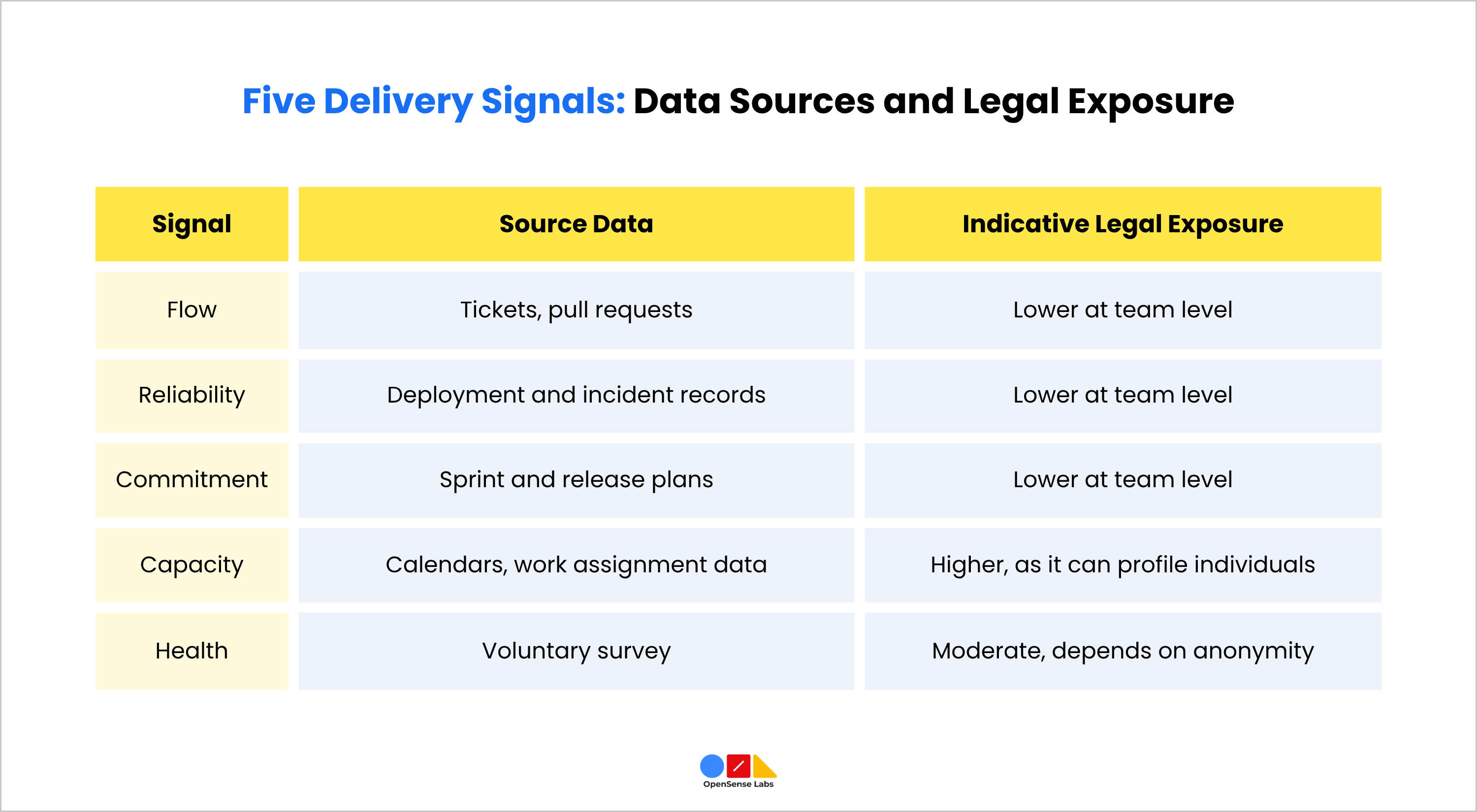
The exposure ratings are indicative and need legal review for each jurisdiction.
Designing Signals at Team Level
Delivery tools can raise the same legal questions as remote team monitoring tools if they can be used to rank individuals. The German right depends on objective suitability for monitoring and not on the employer’s intention. A dashboard that breaks cycle time down by named engineer may therefore need a works agreement. This applies even if managers never open that view. Several design choices reduce exposure.
- Aggregate each signal to team or service level, with a minimum group size before any breakdown appears.
- Exclude individual views from the reporting layer, or limit them to the engineer concerned.
- Use only records created for work purposes, and do not add collections such as screen capture or calendar content.
- Document the purpose, data sources, access roles, and retention period for each signal.
- Keep automated scoring of individuals out of the system. This also lowers the likelihood of falling into the high-risk employment category under the AI Act.
Questions about individual performance remain a matter for managers. They can use reviews and one-to-one conversations, based on the same records the team already produces.
Rolling Out a Measurement Policy
A rollout that replaces remote team monitoring works best when each step produces a document. Employees can see the document and, where required, so can a works council or regulator.
- Define the decision each signal supports, such as staffing, release planning, or process change. Drop any signal that supports none.
- Write a policy listing the data collected, the data not collected, who can see each view, and how long records are kept. This policy can also serve as the notice that the New York, Connecticut, and Delaware laws require where they apply.
- Consult employee representatives or the works council where required. Complete a data protection impact assessment where the processing is likely to be high risk.
- Pilot with one team for a quarter. Show the team the same dashboard that leadership sees, and compare the signals with the team’s own view of its delivery.
- Set a review date and remove signals that did not change a decision.
When Remote Team Monitoring is Still Appropriate
Remote team monitoring remains reasonable for contractors who must show their time, regulated work that requires activity records, and security investigations. In these cases, the monitoring needs a documented purpose and a scope limited to the relevant systems and roles. It should use the least intrusive means available, in line with the ICO’s position that monitoring must be necessary and proportionate.
Conclusion
Remote team monitoring answers questions about presence, while engineering leaders need answers about delivery. Activity data is a weak measure of delivery. Monitoring obligations differ across Germany, the wider EU, the United Kingdom and individual US states. Delivery signals taken from records the team already produces can answer the delivery question at team level with lower legal exposure. They still need careful design, notice and, in Germany, often a works agreement.
OpenSense Labs designs and builds workforce automation for distributed delivery teams based on the data those teams already produce. Further background is available in the Workforce Automation guide for CTOs and on the Workforce Automation solution page. The legal references in this article were current in November 2026 and are not legal advice. Employers should confirm them with counsel before acting.
Join Our Newsletter
Love open-source tech? Stay updated with projects that make a difference.