



HIPAA-Compliant CMS for Healthcare: Architecture Guide



HIPAA-compliant CMS for healthcare projects succeeds or fails on architecture decisions made before development begins not on which platform gets shortlisted. This piece breaks down what actually determines compliance, from hosting agreements to how patient-adjacent content moves through the system.
An enforcement body resolved twenty-one HIPAA enforcement cases in a recent twelve-month period, with the large majority involving penalties for risk analysis failures. For healthcare organizations running digital platforms, this is the context that makes CMS architecture a compliance question rather than a technical preference.
Enforcement focus has also expanded from checking that organizations identified compliance risks to requiring that they demonstrate acting on them, with documented remediation.
A content platform that stores, displays, or transmits anything connected to a patient, appointment reminders, personalized care pages, treatment-specific education material, sits inside this scope, whether or not the team that built it thought of it as a "healthcare system."
The most valuable data for healthcare organizations, clinical histories, treatment records, and diagnostic information, is also the most regulated, and mishandling this Protected Health Information (PHI) can trigger enforcement actions costing millions of dollars and years of corrective oversight.
A CMS that touches any of this inherits the same exposure as the clinical systems around it, and the architecture decisions made at build time determine whether a HIPAA-compliant CMS for healthcare controls that exposure or creates it.
What is a HIPAA-Compliant CMS?
A HIPAA-compliant CMS for healthcare is a content platform architected so that its hosting, access controls, audit logging, and integrations are each covered by a Business Associate Agreement and configured to protect PHI.
Can any vendor sell this as a certified feature?
Is HIPAA compliance a certification a CMS can hold?
No, it is not a badge earned once and kept forever; it is a status that depends on how the platform is configured, hosted, and maintained on an ongoing basis. For any organisation classified as a covered entity or business associate, HIPAA compliance is mandatory, not a competitive differentiator to opt into.
The HIPAA-Compliant CMS for Healthcare Architecture Framework
Building a healthcare content platform that can survive regulatory scrutiny requires decisions across five layers. Each layer addresses a different point where Protected Health Information can move, be stored, or be exposed, and each needs its own set of controls.
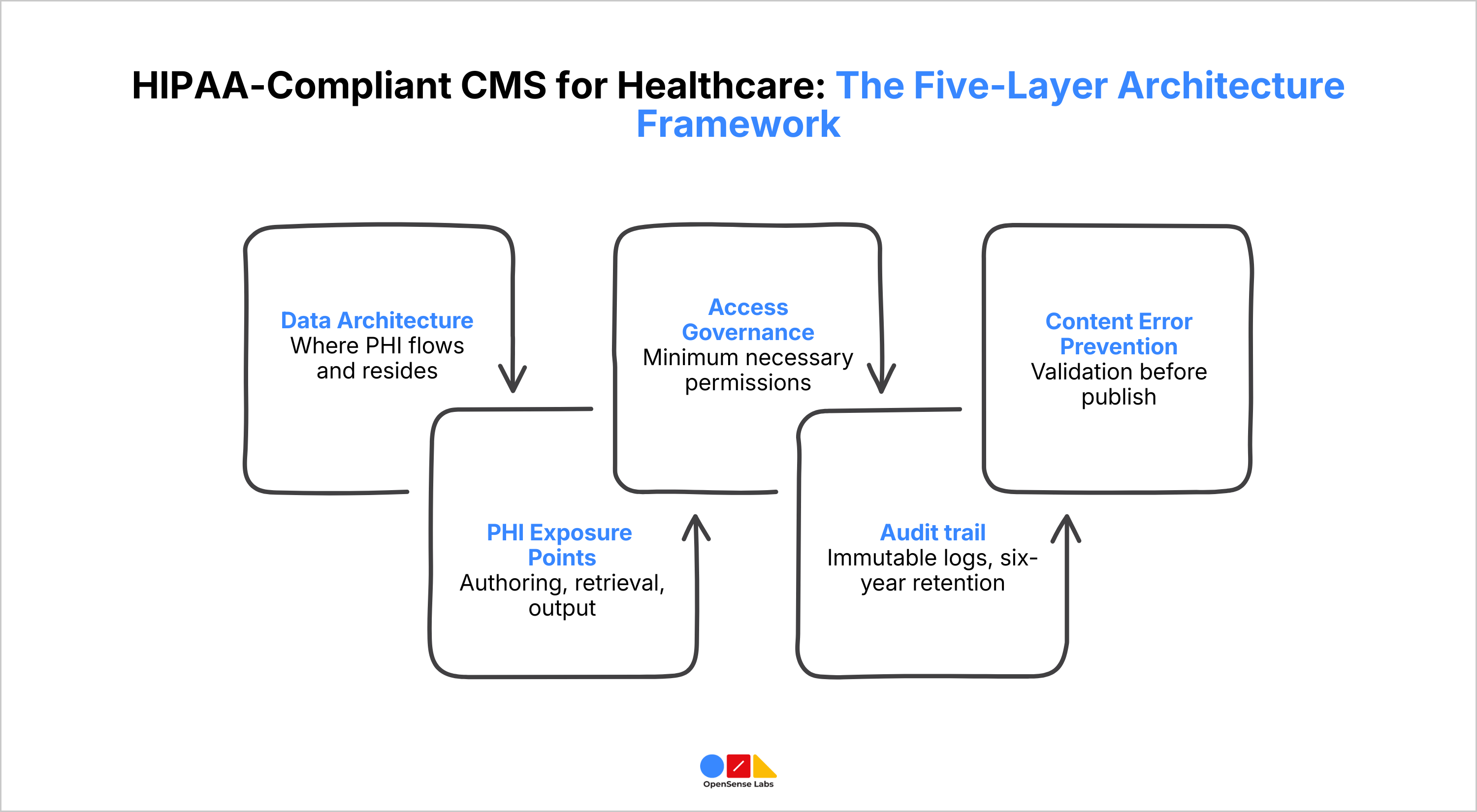
1. HIPAA-Compliant Data Architecture: Where Content-Adjacent PHI Actually Goes
The foundational question in any HIPAA-relevant system is deceptively simple: where does the data go? For a healthcare CMS, this means tracing every point where content might reference a patient through to the hosting environment, any connected third-party services, and every integration downstream.
The answer determines legal exposure, compliance requirements, and vendor relationships for the entire stack. A hosting provider, CDN, or SaaS integration that will not sign a Business Associate Agreement (BAA) is not a viable option once patient-adjacent content is in scope, regardless of its features. A BAA should define permitted uses and disclosures of the data, require subcontractors to meet the same obligations, and spell out each party's security responsibilities.
This is also the answer to who is responsible for HIPAA compliance on a CMS project; it is never one party. The hosting provider, the CMS vendor, and the implementation team each carry a share of the obligation, and the BAA is what makes each share legally explicit.
The critical mistake organisations make is assuming a system is compliant because "we don't send real patient names," while overlooking that combinations of data can still identify a person.
What counts as HIPAA-compliant data is not about whether a record contains a name it is about whether the combination of details could identify a person.
A content block referencing "diabetes patient, ZIP 90210, prescribed metformin" is PHI even without a name attached, and any part of the platform that stores or transmits it, including caches, search indexes, and analytics logs, must meet the same safeguards as a system storing identified records.
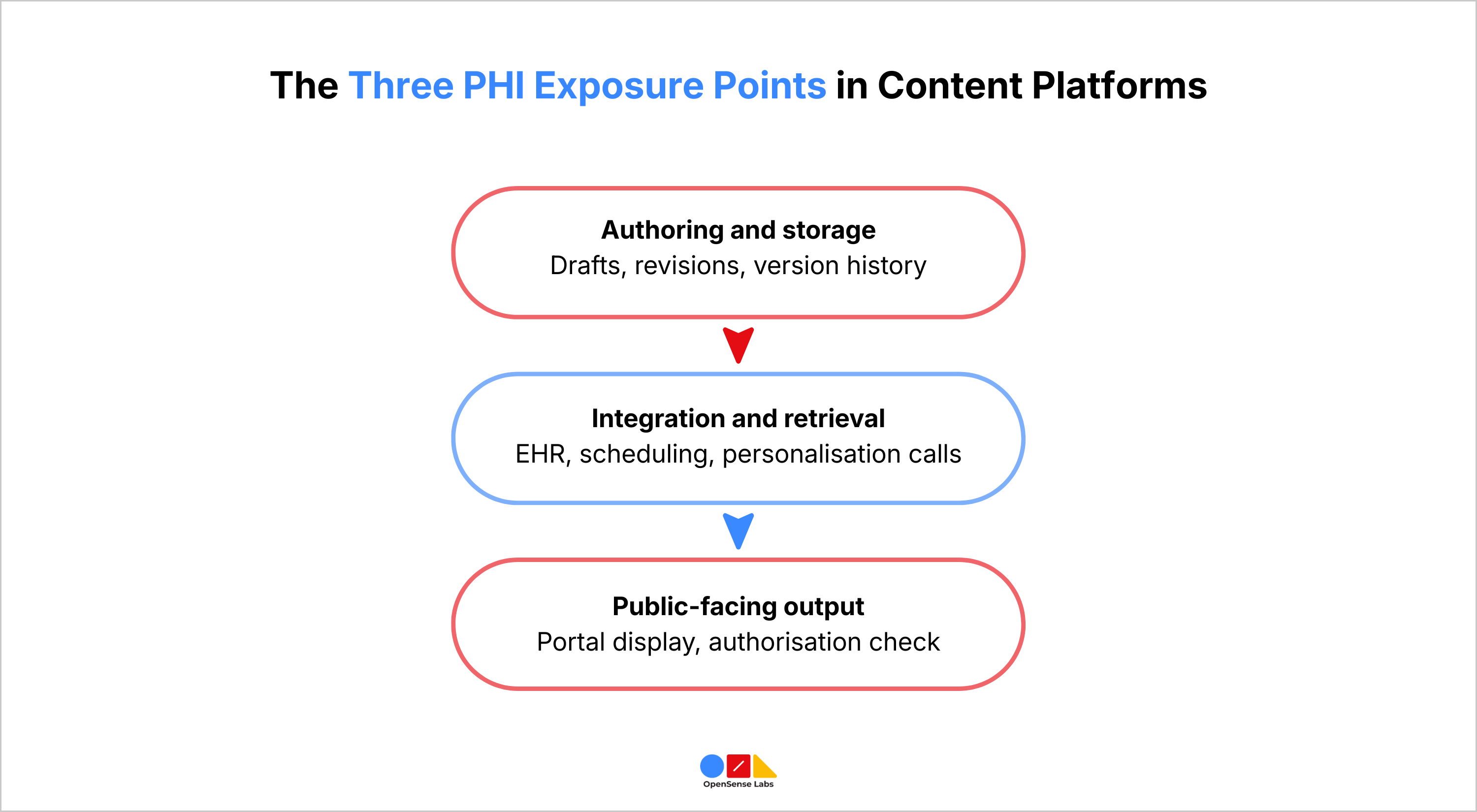
2. Three PHI Exposure Points in a Healthcare CMS
Traditional CMS security concentrated on locking down the database. Modern healthcare content platforms with personalisation engines, third-party embeds, and increasingly AI-assisted authoring expose PHI at points that database-level controls were never designed to catch.
- Authoring and Storage: Content drafted or stored within the CMS personalised portal content, patient-specific instructions, and case-study material can retain identifying details long after a page is unpublished, in drafts, revisions, and version history. Removing identifiers requires HIPAA's Safe Harbor method, which specifies 18 categories that must all be stripped; missing even one, or leaving any remaining data re-identifiable, means the content is still PHI and fully covered by HIPAA requirements.
- Integration and Retrieval: Whenever the CMS pulls data from an Electronic Health Record (EHR) system, a scheduling tool, or a personalisation engine to populate a page, it retrieves PHI into an environment with a different security posture than the source. HIPAA's minimum necessary standard requires that access be limited to what a specific task needs. A page rendering a patient's appointment time should retrieve the appointment time, not the full clinical record. Retrieval should happen inside a controlled workspace rather than surfacing PHI beyond the immediate task context, and least-privilege design with role-based access helps ensure each part of the system sees only the minimum data required for its function.
- Public-Facing Output: Even when retrieval is controlled, a system can still surface PHI to a user or viewer who is only authorised for a narrower view. A personalised health portal summarising a patient's care plan needs to confirm, structurally, that the logged-in user is the one authorised to see it, not just that the underlying query was scoped correctly. PHI should also be secured with encryption in transit and strong encryption at rest throughout processing and storage.
3. Access Governance in Editorial Workflows
A compliant CMS needs role-based permissions calibrated to the minimum necessary standard, not the default administrator access most platforms ship with. Role-based access control lets healthcare organisations define specific permissions for each user, keeping content workflows secure and streamlined while limiting access based on responsibilities and expertise.
Customisable workflows can enforce approval processes at each stage, restricting a compliance review step to specific users with the relevant expertise, for instance, which supports internal accountability as much as it mitigates unauthorised access. A marketing contributor drafting patient education material does not need the same access as the compliance reviewer approving it for publication, and the platform's permission model should make that distinction structurally, not by convention.
4. Audit Trail Design That Withstands OCR Scrutiny
Audit trails are required not only for every access to PHI, but for edits, exports, and system actions involving it. For a healthcare CMS, this means logging more than a standard content-management history typically captures:
- Every access to content containing or referencing PHI, including who, when, and what was viewed
- Every edit, publish, or export action, with the before-and-after state preserved
- Every integration call that pulled patient-adjacent data into the CMS
- Every permission or role change affecting who can reach that content
Implementation requirements that cannot be skipped include append-only logging, since audit records must never be deleted or modified; separate, access-controlled storage for logs distinct from application data; a minimum six-year retention period; and encryption at rest for all audit log storage.
Written policies describing these controls are not sufficient evidence during an investigation. What the Office for Civil Rights (OCR), the federal body that enforces HIPAA, expects to see are the actual logs, the actual remediation actions taken, and the actual security controls operating in production.
A CMS that generates logs nobody reviews satisfies the letter of this requirement without satisfying its purpose.
5. Preventing Content Errors in Patient-Facing Systems
When a personalisation engine or an AI-assisted authoring tool populates a patient-facing page with the wrong care instructions or a stale treatment detail, the consequence is not a poor user experience; it is a patient safety and compliance event. Architecture needs to prevent errors like this from reaching a live page unreviewed.
Three patterns help here, adapted from how clinical AI systems manage the same risk: grounding any generated or personalised content in verified source data rather than general templates; validating content against that source before publication rather than after; and routing low-confidence or high-sensitivity content to a human reviewer instead of auto-publishing it. A healthcare CMS that auto-publishes personalised content without one of these checks is trading editorial speed for exactly the kind of error an OCR investigation would flag first.
Common Mistakes in Building a HIPAA-Compliant CMS for Healthcare
Before evaluating implementation partners, it helps to recognise the patterns that derail most healthcare CMS projects.
- Building the Platform First, Compliance Later: If the architecture does not account for PHI data flows from day one, retrofitting compliance costs three to five times more than building it in. Compliance is an architectural decision, not a checklist applied at the end. Organisations that treat it as a post-launch task tend to rebuild core systems once an audit reveals fundamental data flow problems.
- Assuming a Labelled Template Removes the Need for Review: No CMS, plugin, or theme is compliant simply because it is marketed that way. Every claim needs verification against the organisation's specific data flows, hosting environment, and integrations, not the vendor's marketing page.
- Embedding Third-Party Widgets Without a BAA: Chat widgets, appointment-booking embeds, and analytics scripts are common on healthcare websites, and each one that touches patient-adjacent data is a potential business associate. Using a vendor that has not signed a BAA, even if "no names are sent," is a HIPAA violation once combinable data is involved.
- Treating Caches and Derived Content as Exempt from PHI Rules: Content derived from PHI cached pages, search index entries, and personalisation embeddings carries the same status as the source data and needs the same encryption and access control. Most caching and search infrastructure does not provide a BAA by default, and this needs verifying before patient-adjacent content passes through it.
- No Review Gate Before Personalised Content Goes Live: A system that generates or personalises patient-facing content without human oversight creates a safety and compliance liability that will not pass an audit. Personalisation and AI-assisted drafting can accelerate content operations, but only inside a workflow where a reviewer signs off before publication.
Evaluating Implementation Partners
HIPAA does apply to contractors; any implementation partner, agency, or freelance developer who touches patient-adjacent content is a business associate under the law, not an exception to it.
The difference between partners who have shipped a HIPAA-compliant CMS for healthcare and those who have only built demonstrations and those who have only built demonstrations shows up in the questions they ask during scoping and the documentation they provide during due diligence.
Certifications worth checking for:
- SOC 2 Type II, validating that security controls are in place and operating effectively over time, not just designed on paper
- ISO 27001, demonstrating a systematic approach to protecting sensitive data
- Willingness to sign a BAA before accessing any patient-adjacent content; hesitation on this point signals the infrastructure is not there yet.
Implementation Timeline and Investment Considerations
How much does it cost to build a HIPAA-compliant CMS for healthcare?
More than a standard implementation, and the reasons are structural rather than arbitrary. Compliance-related costs typically run thirty to fifty per cent higher for implementation, and dedicated infrastructure and BAA-covered hosting can add forty to sixty per cent to hosting costs compared with standard tiers.
A realistic build accounts for compliance architecture setup, BAA execution, encryption standards, access control framework, and audit logging infrastructure before any editorial features are built, followed by a security review and penetration test ahead of launch rather than after it. Teams that promise a compliant platform on a standard implementation timeline have usually either underestimated the work or are not building compliance in from the start.
Patch management adds an ongoing cost too: critical security patches need applying within forty-eight to seventy-two hours of release, which requires a standing operational commitment rather than a one-time project.
State Law and International Compliance: Beyond Federal HIPAA
HIPAA sets the federal floor, but state and international rules can extend further, and a HIPAA-compliant CMS for healthcare serving patients across jurisdictions needs to account for the strictest applicable requirement at each point.
| Jurisdiction | What it adds beyond federal HIPAA |
| Federal HIPAA | Baseline: Security Rule and Privacy Rule for covered entities and business associates |
| California (CCPA) | Extends health-data rights to consumer-facing tools outside traditional HIPAA-covered entities |
| Texas (Texas HIPAA, HSC §181) | Stricter disclosure requirements than federal HIPAA in certain cases |
| New York (SHIELD Act) | Requires reasonable safeguards for private data, including health data, even for non-covered organisations |
| EU (GDPR) | Health data as a special category; data residency within the EEA or an adequacy jurisdiction; right to erasure covering derived and cached copies |
Moving Forward: Architecture as Strategy
Organisations succeeding with compliant healthcare platforms are not treating compliance as a post-development checklist. They are designing it into the architecture from the initial specification, making data governance a foundational requirement that shapes data flow, integration design, and infrastructure choices before development begins.
This discipline extends naturally beyond the CMS itself. Many healthcare digital teams are now layering AI-assisted personalisation, chatbots, and content generation on top of their platforms. What is HIPAA-compliant AI, and which AI platforms are HIPAA-compliant?
Follow the same logic as the CMS itself: it depends on the BAA, the data flow, and the audit trail around the tool, not the model's name. It introduces the same data flow, retrieval, and audit questions this article has walked through, just in a different system. The richest and most restricted healthcare data are the same information, and the organisations that build the governance layer before the application layer are the ones that move from pilot to production without rebuilding along the way.
Extending this architectural discipline to the AI-assisted tools sitting alongside a HIPAA-compliant CMS for healthcare is the natural next step for teams that have got the content platform right.
OpenSense Labs' AI Governance solutions help healthcare organisations map data flow, retrieval, and audit requirements into any AI system connected to their digital platform, building on the same architectural principles that keep a HIPAA-compliant CMS for healthcare covered.
Subscribe
Related Blogs
Headless CMS for Media and Publishing: Solving Content Delivery Bottlenecks at Scale

Media and publishing organizations are outgrowing the content management systems that once served them well. As audiences…
Free Learning Content Management System: Best 10 List For 2025

In today's fast-changing education and training landscape, a free Learning Content Management System (LCMS) is a smart…
Headless CMS vs Traditional CMS: What's The Difference?

If you are looking for a new content management system, you may have come across the term ‘headless CMS.’ Today, businesses…