
Case Study | Healthcare and Wellness
Food is Medicine Institute (FIMI): From Repository to Story
Client Background and Mission
The Food is Medicine Institute (FIMI) is a university-wide collaborative effort based at Tufts University's Gerald J. and Dorothy R. Friedman School of Nutrition Science and Policy. Backed by a significant investment from Tufts, FIMI brings together researchers, clinicians, and policy experts from across the university, along with national partners, to advance food-as-medicine research, training, patient care, and policy engagement, work that spans initiatives such as produce-prescription programs and medically tailored meals aimed at treating and preventing diet-related disease.
FIMI's project portfolio includes the evaluation of Fresh Connect, a produce-prescription program from About Fresh, Inc. that pairs a prepaid benefits card with a cardholder platform to help patients access nutrient-dense food. FIMI researchers, including Research Assistant Professor Dr. Ronit Ridberg and FIMI Director Dr. Dariush Mozaffarian, have published findings on how Fresh Connect participants use the program and what it means for healthcare costs and access. That research became the working example for OSL's redesign.
Needs and Challenges
Where FIMI's project pages were losing readers:
The page format worked against the story
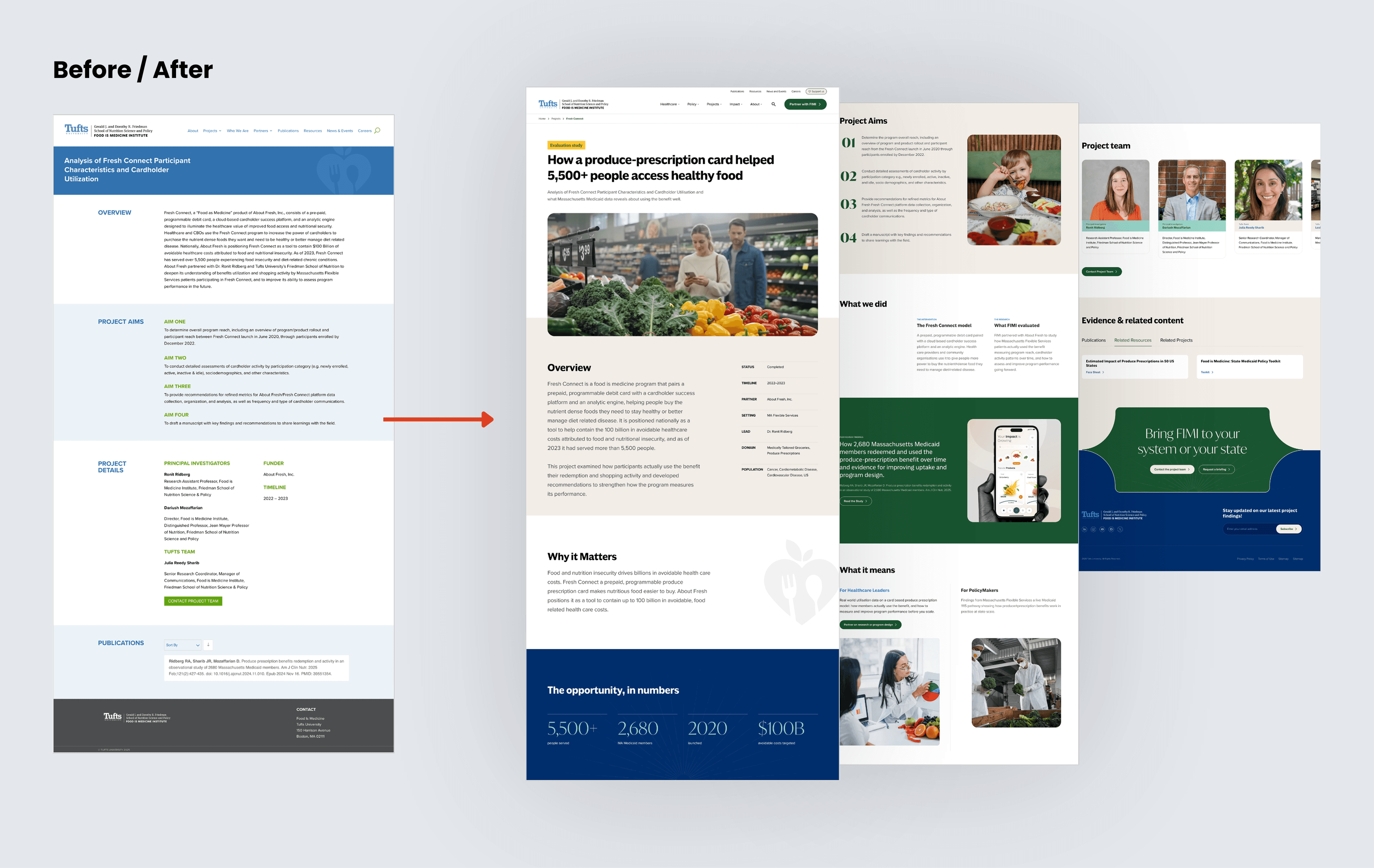
- Project pages followed a dense academic structure: a technical title, one long “Overview” paragraph, and four internal “Aims” written for grant reviewers, not general readers
- Outcomes and key figures were buried inside paragraphs instead of surfaced for scanning
- Pages carried no imagery and little visual hierarchy, so every section read with equal weight
Different readers, no direct path
- A health-system executive or legislative staffer landing on a page had no fast way to answer what is this, does it work, why should I care, and what do I do next
- There was no mechanism to translate the same research into different next steps for different audiences
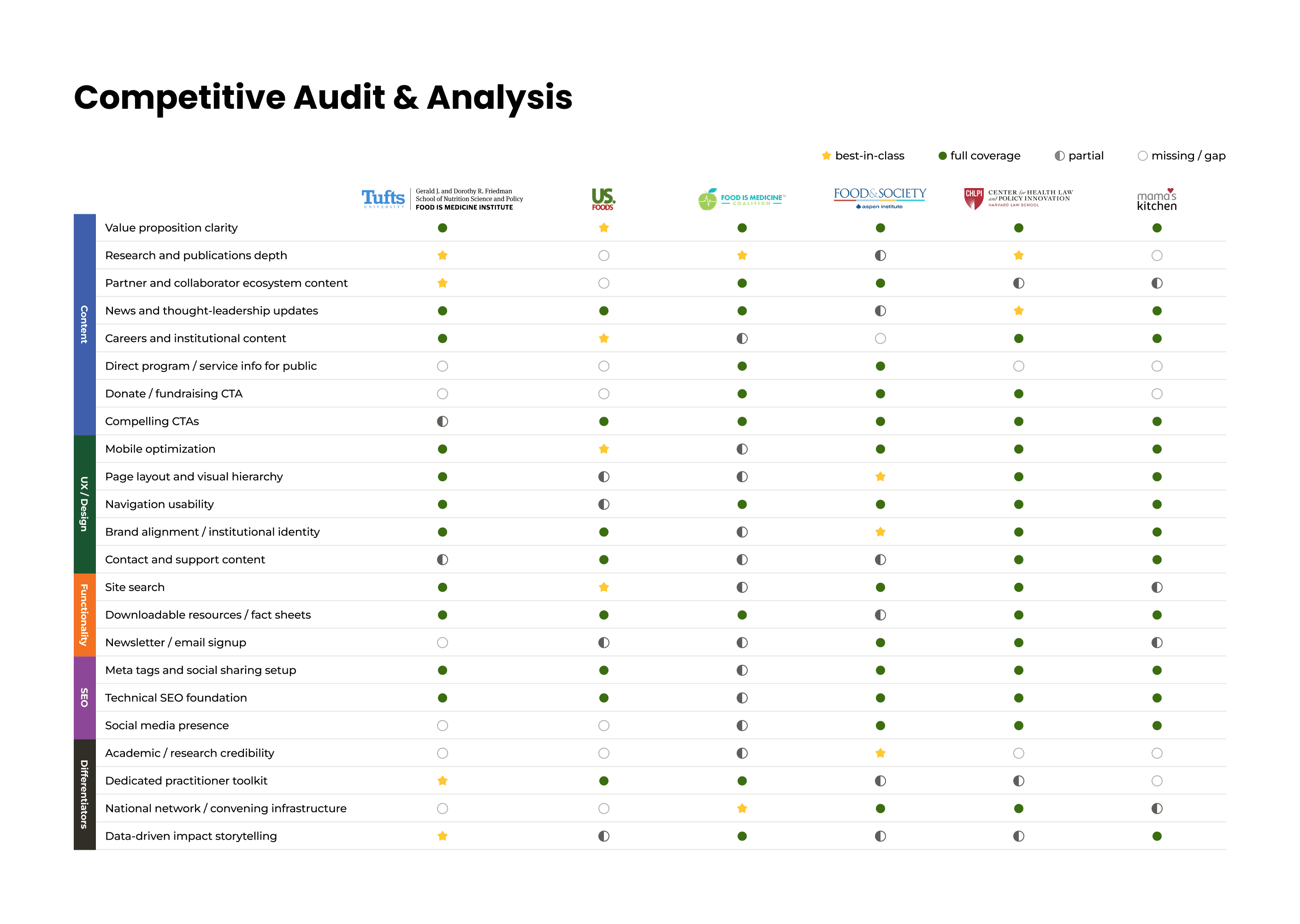
- A competitive audit benchmarking FIMI against five peer and adjacent organizations across 22 criteria spanning content, UX, functionality, SEO, and differentiation confirmed specific gaps, including direct program information, donation/fundraising CTAs, and data-driven impact storytelling
Strong research, missing narrative
- The underlying content was substantive: real program data, a peer-reviewed finding, named research leadership
- What the pages lacked was a structure that could carry that content to a non-academic reader
- OSL framed the challenge as a storytelling gap, not a content gap
OSL Approach
OSL's process runs in three phases: Discovery, Definition, and Design/Hand-off. For the FIMI pitch, some work was built specifically for FIMI; other steps were illustrated using representative examples from OSL's broader design practice to show FIMI's team what each stage typically delivers. Both are noted below.
Discovery
- Competitive Audit & Analysis (built for FIMI): Benchmarked FIMI's site against five peer and adjacent organizations across content, UX/design, functionality, SEO, and differentiators
- OSL's Discovery Phase: Includes stakeholder interviews and customer experience research, surveys, 1:1 interviews, and moderated focus groups used to surface business goals, success metrics, and pain points directly from users
Definition
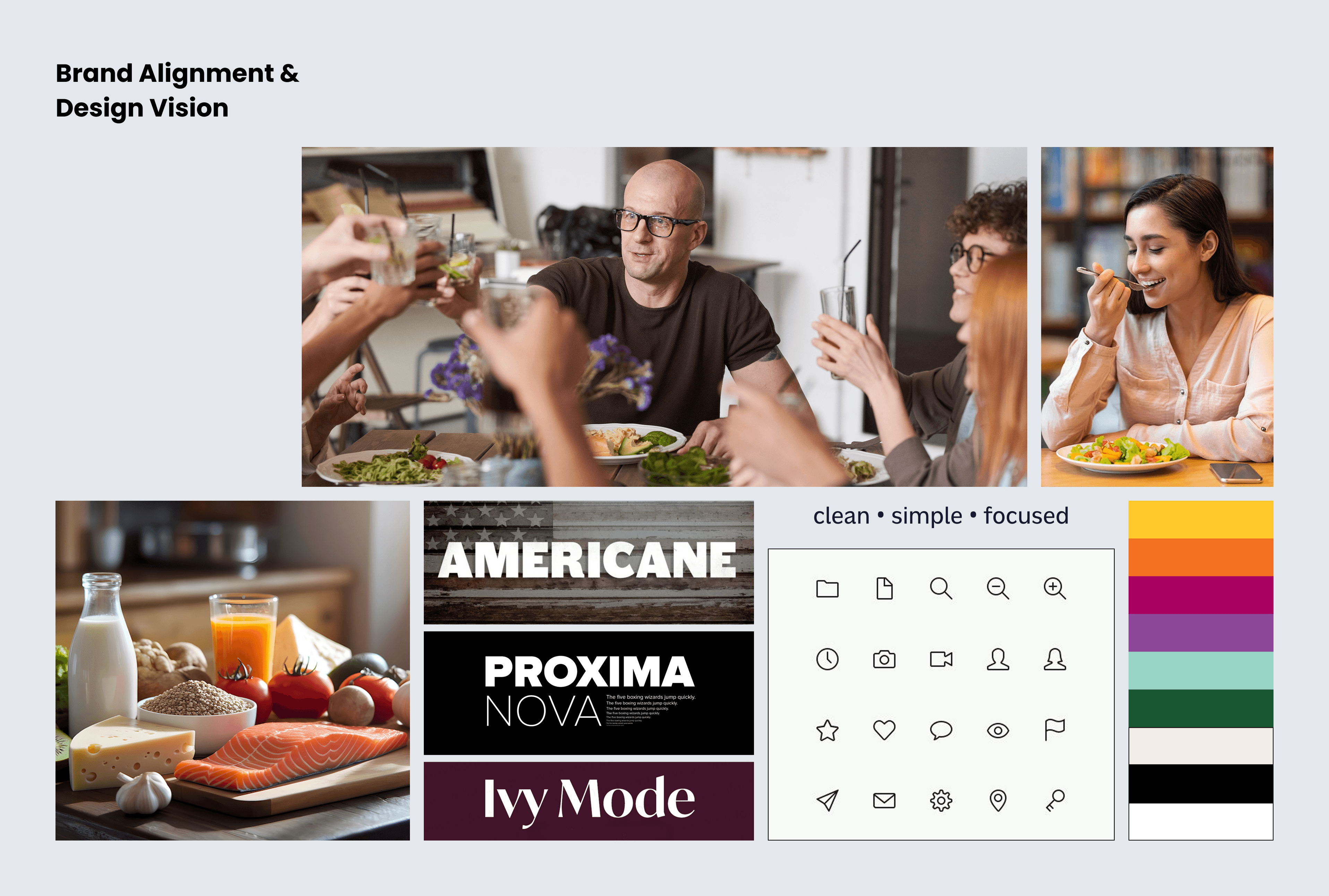
- Brand Alignment & Design Vision (built for FIMI): A Voice/Visual/Vibe (VVV) exercise, visual listening, and mood-boarding that landed on a “clean, simple, focused” direction, including typography, color palette, and iconography aligned to FIMI's identity
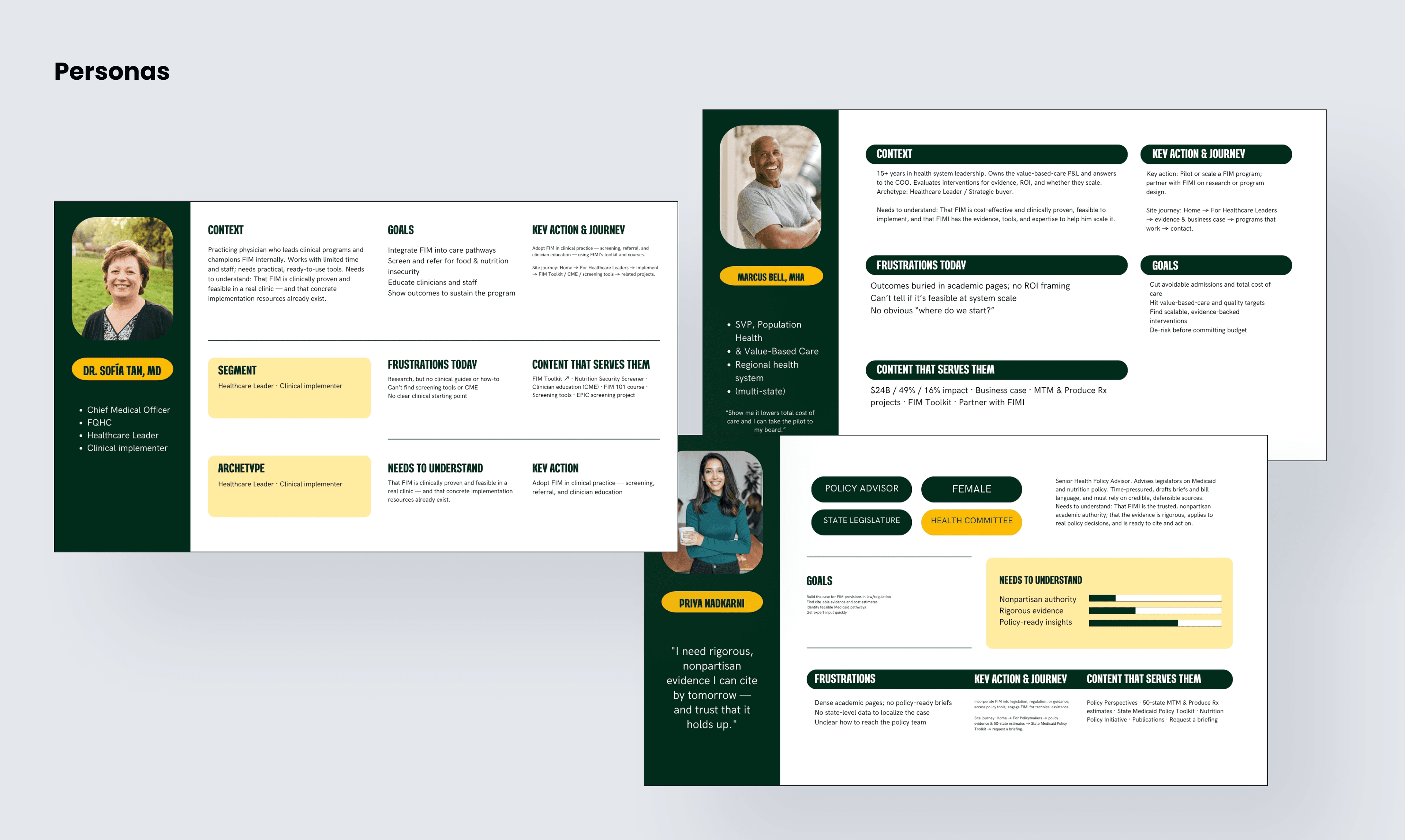
- Personas (built for FIMI): Three primary personas grounded in FIMI's real audiences, a clinical implementer, a health-system population-health leader, and a state policy advisor, each mapped to context, frustrations, goals, and the content that would serve them
- OSL's Discovery Phase: Includes feature/function prioritization, personalization planning, and sitemap/template mapping to turn research into a structured site plan
Design & Hand-off
- Project Detail Page redesign (built for FIMI): a full redesign of the template, demonstrated using FIMI's live Fresh Connect evaluation page as the worked example, the centerpiece of the pitch
- OSL's Design & Hand-off Phase: Includes wireframing, mobile-responsive comps, prototyping and usability testing, functional requirements documentation, and governance materials such as style guides, component guides, and SEO documentation
Strategy
Every decision in the redesign traced back to one principle:
“Lead with the stakes, put the reader at the center, show progression, make the data mean something, always leave a next step.”
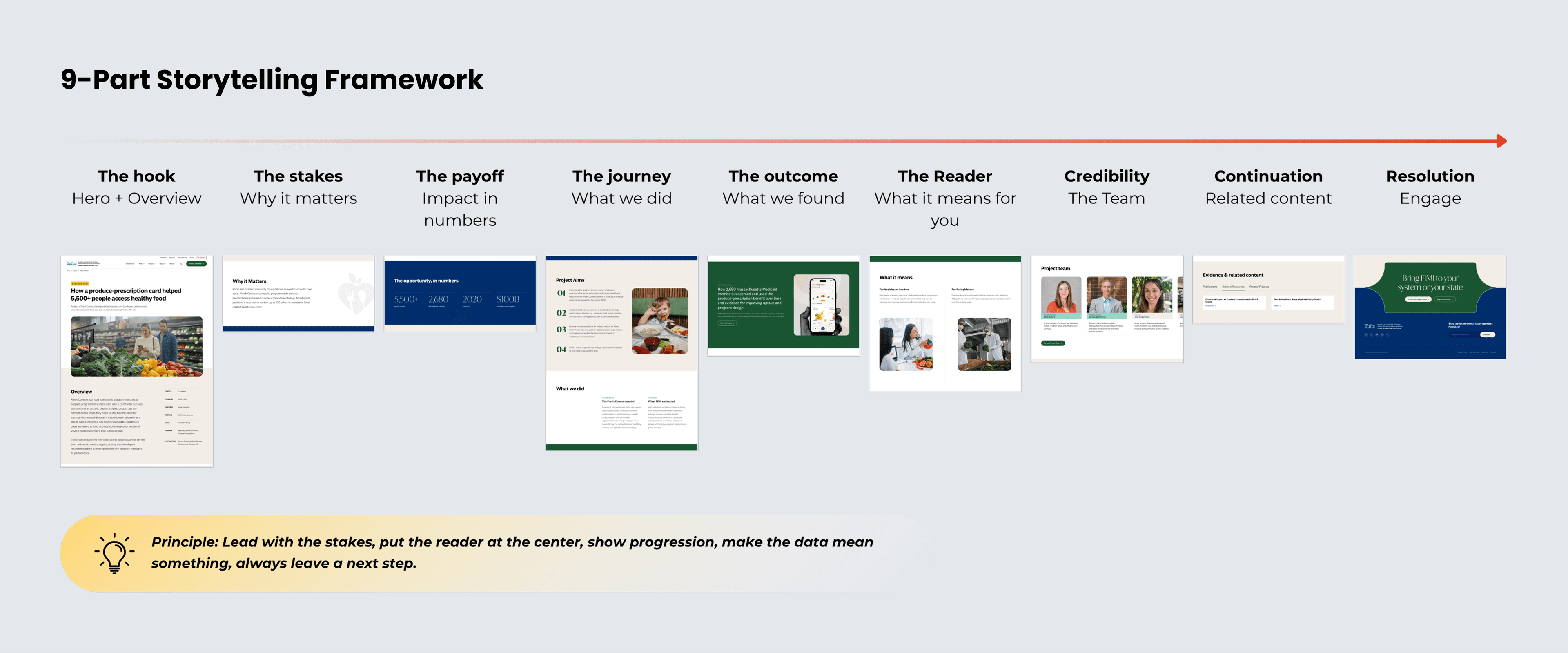
OSL translated that principle into a 9-part narrative framework, mapping each storytelling beat to a specific section of the page:
Implementation Details
OSL used FIMI's live Fresh Connect page, an existing analysis of produce-prescription cardholder utilization, to show, section by section, how the redesigned template would work in practice.
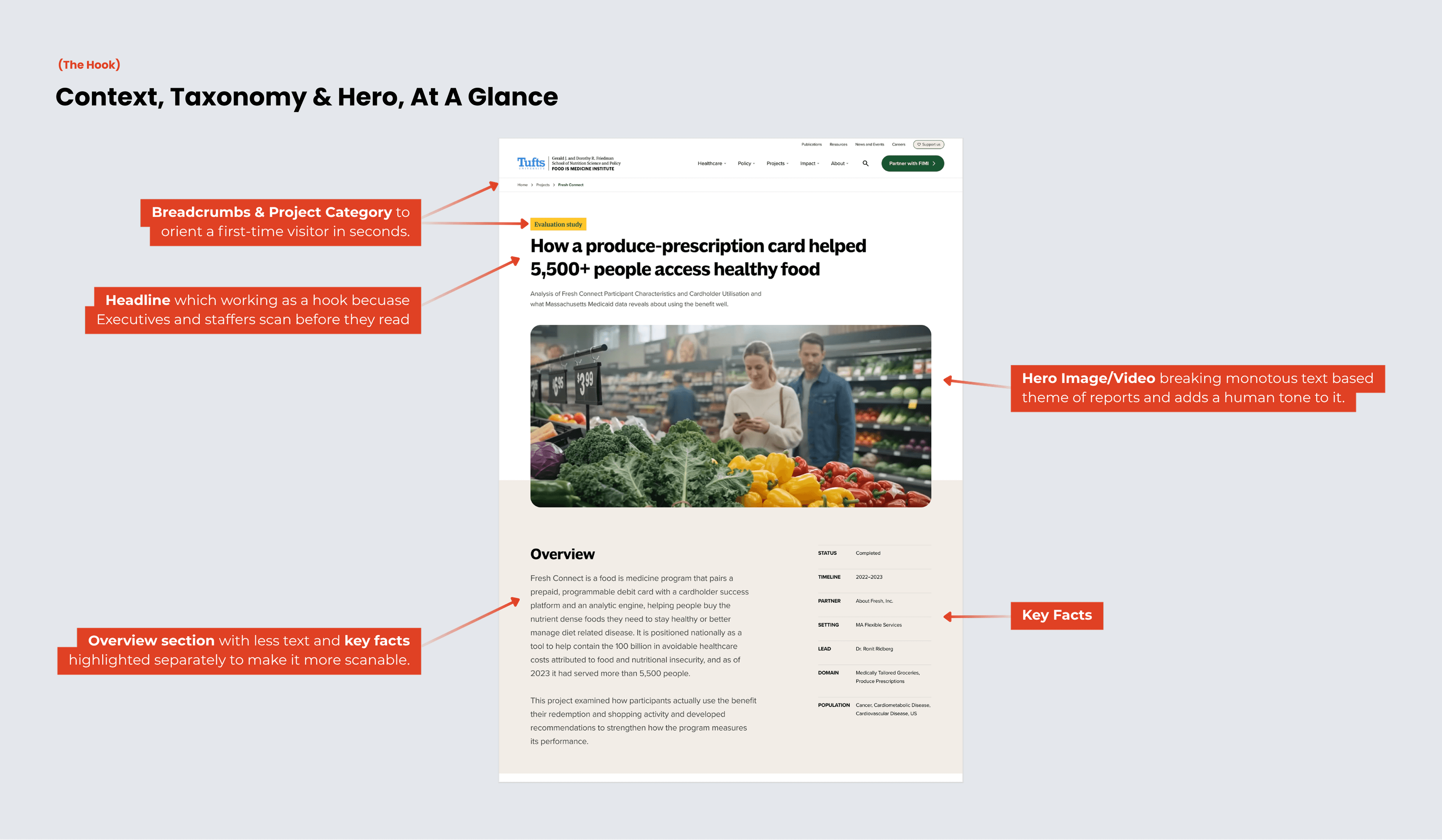
- The Hook, Hero + Overview: Breadcrumbs and a project-category tag orient a first-time visitor immediately. The headline, “How a produce-prescription card helped 5,500+ people access healthy food”, is written to work as a hook for readers who scan before they read. A hero image breaks up the page's academic tone, and the Overview section pulls key facts (status, timeline, partner, lead researcher, population) into a separate, scannable panel instead of burying them in prose.
- The Stakes, Why It Matters: The redesign names the problem before presenting numbers, reframing an internal research effort as a reason a health system or state should care, tying the work to cost and access.
- The Payoff, Impact in Numbers: The program's real figures more than 5,500 people served, 2,680 Massachusetts Medicaid members studied, and a $100 billion national opportunity in avoidable healthcare costs are pulled out of paragraph text into count-up stat cards.
- The Journey, What We Did: The page separates “the Fresh Connect model” from “what FIMI evaluated,” rewriting the program's four original research aims as plain-language outcomes, and adds an image/video section to break up the milestones layout.
- The Outcome, What We Found: The peer-reviewed finding is summarized in plain language against a prominent background, with a “Read the Study” CTA linking to the underlying citation and a supporting image previewing the findings.
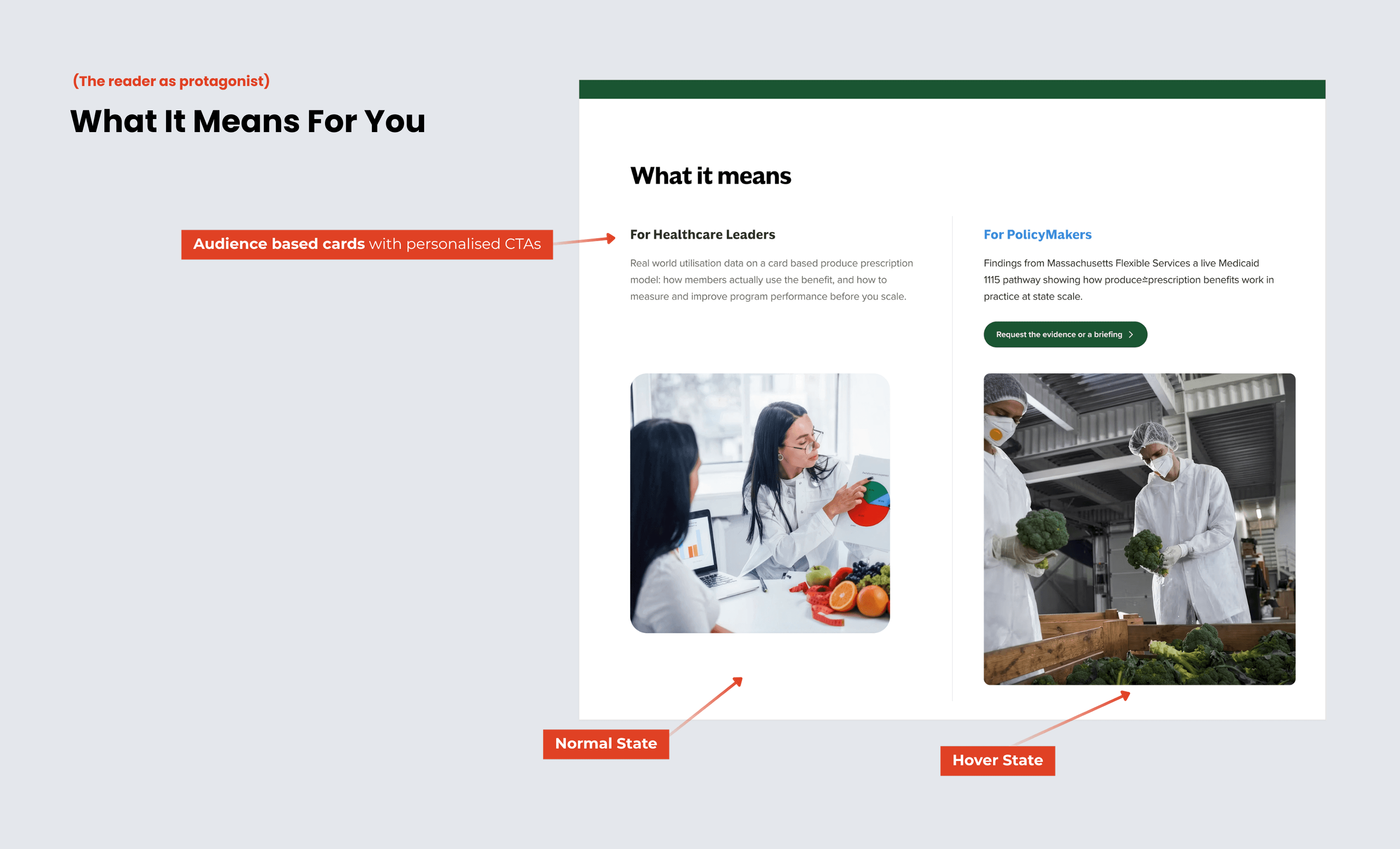
- The Reader, What It Means for You: Two audience-based cards, one for healthcare leaders, one for policymakers, each carry a distinct, personalized call to action, with defined normal and hover states, turning the reader into the page's protagonist.
- Credibility, The Team: A horizontal slider lists the project team as linked profile cards, with FIMI branding distinguishing principal investigators from supporting Tufts team members, authority the reader can see and follow.
- Continuation, Evidence & Related Content: A tab-based module surfaces related publications, resources, and projects by shared tags, with a 2x2 grid layout so more related content fits in a single viewport.
- Resolution, Engage: The final CTA section uses one of Tufts' own brand motifs to stay visually distinct while remaining on-brand, pairs audience-specific CTAs, demotes administrative details like funder and timeline below the fold, and closes with a newsletter signup.
Supporting deliverables
Standard components of OSL's Design & Hand-off phase, illustrated for FIMI's team using examples from OSL's broader design practice:
- Mid-fidelity wireframes and mobile-responsive page compositions, with attention to mobile optimization and component design
- ADA and GDPR compliance considerations, built on an atomic design system
- A usability testing plan, supported by tools such as Figma, Microsoft Clarity, userbrain.com, and maze.co
- Functional and business requirements documentation, including technical considerations and prioritized scope
- Governance materials, a digital style guide, component guide, and SEO best-practices documentation, to support the client's team after hand-off
Where This Stands
This engagement is a design pitch, not a completed build, so there are no live performance metrics to report yet. What FIMI's team walked away with:
- A complete before-and-after redesign of the Project Detail Page template, worked through using FIMI's live Fresh Connect page as the example, with an interactive Figma prototype for review
- A reusable 9-part narrative framework, Hook, Stakes, Payoff, Journey, Outcome, Reader, Credibility, Continuation, Resolution, designed to extend across FIMI's full library of project pages, not just Fresh Connect
- A competitive audit, brand and design vision, and three audience personas grounding the redesign in FIMI's actual readers rather than assumptions