CGS: Interactive Platform for Climate Pathways Platform

The Center for Global Sustainability (CGS) at the University of Maryland partnered with OpenSense Labs to build the Country Climate Ambition Platform, a dedicated digital space to present High Ambition Climate Pathway Research. The goal was to translate complex, country-specific climate data into an interactive, accessible, and scalable platform that supports global climate policy discussions under the Paris Agreement.

Client Background and Mission

Center for Global Sustainability (CGS) is a research institution focused on advancing global sustainability through data-driven insights.

The Center for Global Sustainability at the University of Maryland transforms how governments and individuals think about and implement ambitious climate action through top-notch research, global collaborations, and policy engagement.

Operating in a rapidly evolving global landscape shaped by shifting politics, advancing technology, and emerging opportunities, CGS adopts a diverse range of research approaches.

In a world where politics, technology, and understanding of new opportunities are evolving quickly, CGS uses a variety of research methods, including quantitative, computational, and qualitative, to highlight successful paths toward achieving collective climate, energy, and sustainability objectives.

Their work supports international climate policy processes by providing detailed assessments of country-level climate ambition and pathways aligned with the Paris Agreement.

Needs and Challenges

CGS requires a platform capable of handling complex climate research while remaining easy to understand and accessible for a global audience. Key challenges included:

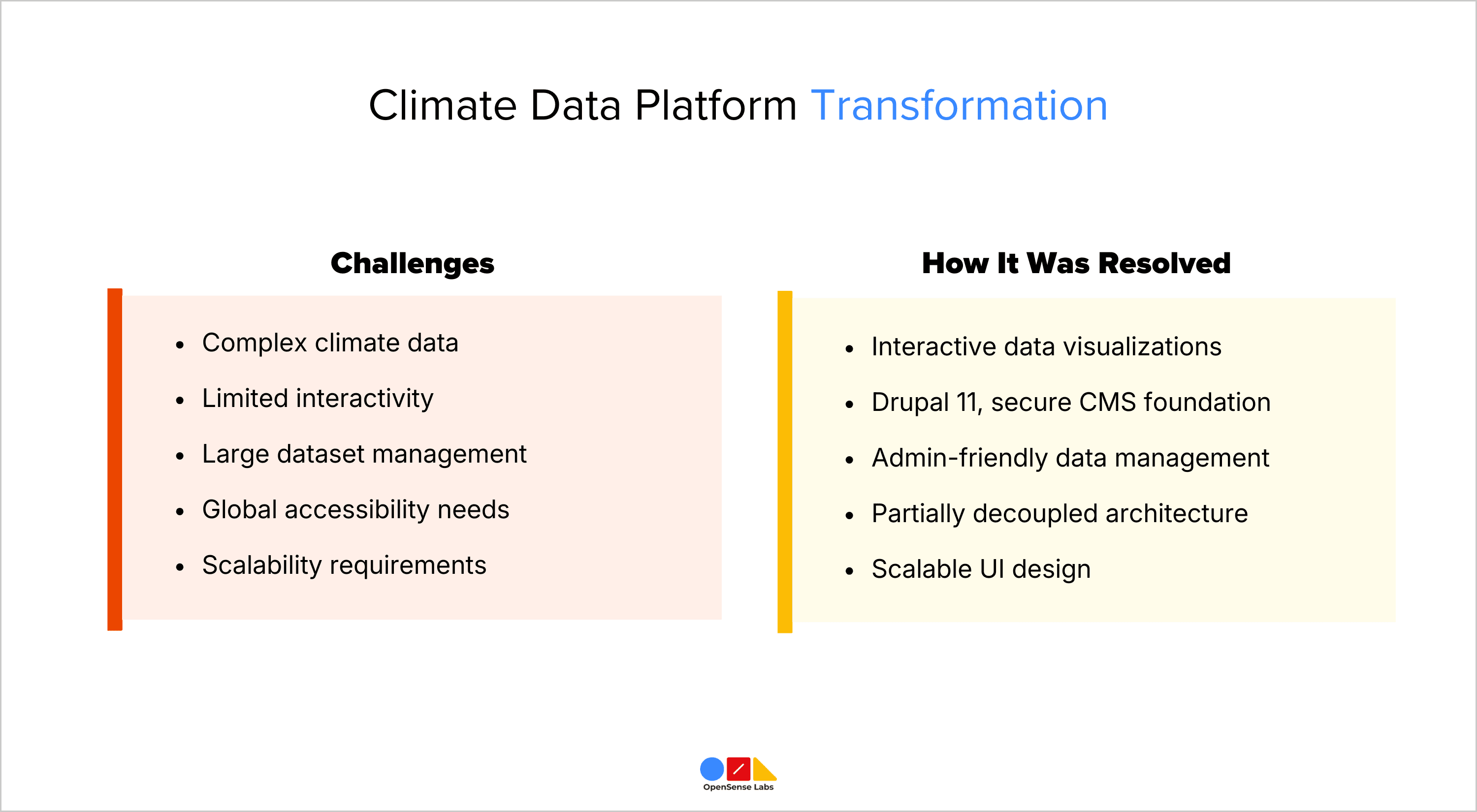
  1. Interactive platform: CGS requires a visually engaging, user-friendly website with dynamic interactive features to present its High Ambition country pathways research to a global audience.
  2. Complex data presentation: The platform needed to effectively communicate both global perspectives on 2035 climate targets under the Paris Agreement and detailed country-specific assessments through intuitive navigation and seamless user experience.
  3. Cross-platform compatibility: The site needed to be fully responsive, ensuring seamless performance across diverse devices and browsers for an international audience.
  4. Scalable UI architecture: CGS specified the use of atomic design methodologies implemented through Storybook, a scalable approach to UI development with living documentation that bridges design and development teams.
  5. Security and accessibility: As an academic institution serving a global audience, the platform needed to meet high standards for both security and accessibility.

If you are facing similar challenges in managing complex data, delivering intuitive user experiences, ensuring accessibility, etc. OpenSense Labs can help. Our experts specialize in transforming intricate requirements into high-performing, user-friendly solutions that are built to scale, easy to maintain, and optimized for global audiences.

Get Your Platform Assessed

Here is a more detailed examination of our strategy & implementations…

OpenSense Labs’ Approach

OpenSense Labs interacted closely with CGS to understand both their research goals and long-term data management needs. Multiple approaches to data presentation and platform architecture were considered before selecting a solution that balanced advanced visualization with editorial simplicity.

The focus was on enabling CGS to independently manage and evolve the platform while ensuring the research remained clear, credible, and impactful.

Strategy

The overarching strategy centered on:

  1. Structuring content to clearly communicate both global and country-specific insights.
  2. Designing intuitive navigation to support exploration of complex datasets.
  3. Aligning data visualization with CGS’s mission to inform climate ambition and policy processes.
  4. Ensuring the platform could scale as new research and datasets are introduced.

CGS Center for Global Sustainability Climate Data Platform Transformation OpenSense Labs

Implementation Details

Design

The design approach prioritized clarity, accessibility, and usability. Interfaces were crafted to help policymakers, researchers, and the public easily interpret complex climate data. Country-specific analyses were highlighted while maintaining a cohesive global narrative.

Development

The platform was developed as a Drupal 11 website with custom data management features and advanced visualizations using React and Recharts, implemented through a partially decoupled architecture with custom REST API endpoints.

Key implementations included:

  • Custom tabular data management interface for country datasets
  • Dynamic graph generation from complex datasets
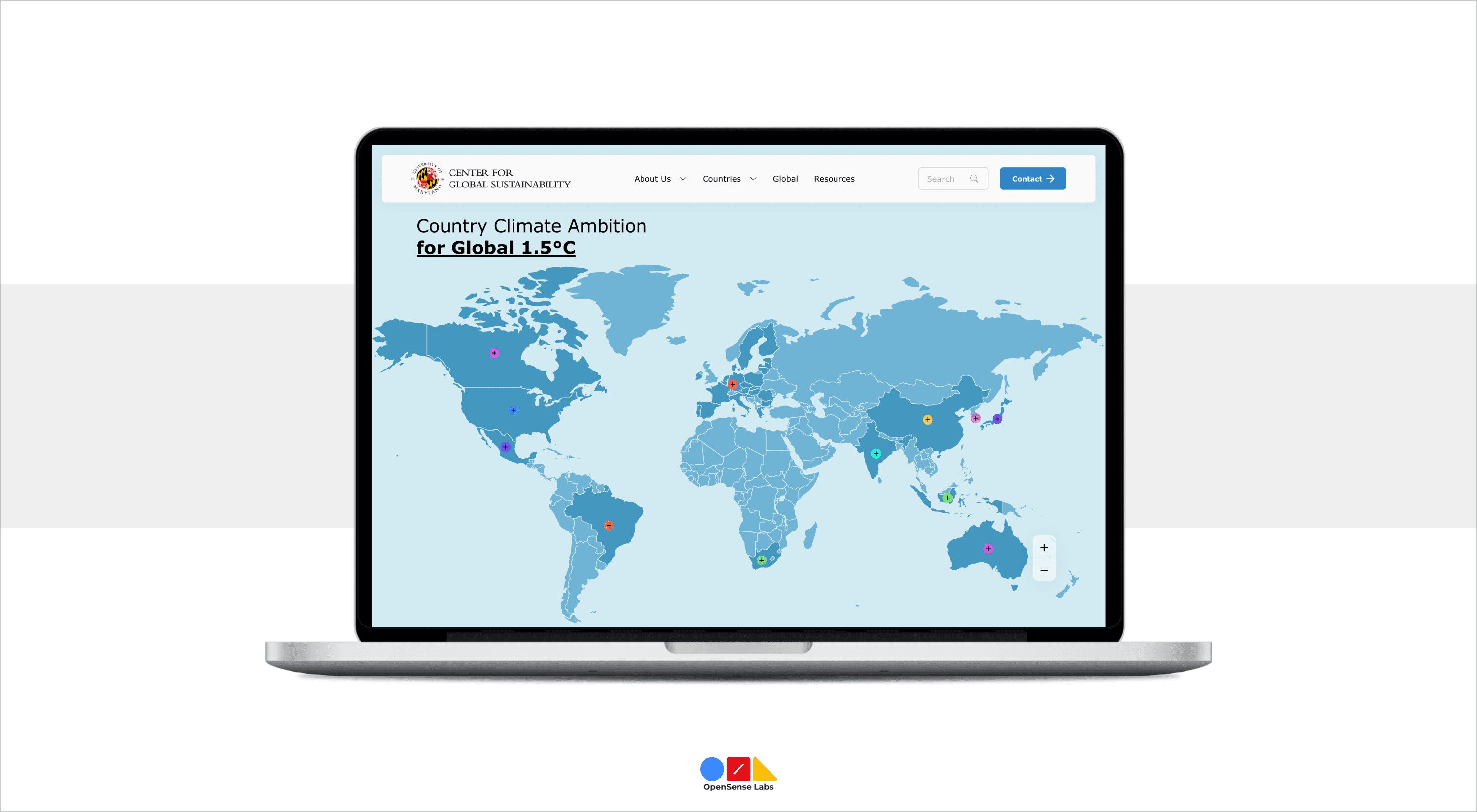
  • Decoupled React-based global map component on the homepage

The final platform delivers:

  • Interactive graphs that simplify complex climate pathways
  • A global map visualization offering an immediate worldwide overview
  • An intuitive admin interface allowing independent dataset management
  • A scalable UI architecture supporting long-term research growth

CGS Center for Global Sustainability Design and Implementations OpenSense Labs

The Results and Impact

The Country Climate Ambition Platform successfully launched at https://www.country-ambition.cgs.umd.edu, providing CGS with a dedicated, future-ready platform for its climate research.

The platform now serves as a comprehensive resource for country-specific climate analysis and supports the Paris Agreement’s NDC process with accessible, data-driven insights. Given below are the key outcomes and deliverables of the platform:

  • Fully functional Drupal 11 platform with custom data management.
  • Interactive visualizations for High Ambition pathways across countries.
  • Dynamic global map for at-a-glance climate insights.
  • A self-sufficient admin interface enables CGS to manage complex datasets independently.

Beyond project outcomes, the engagement also surfaced key learnings and best practices relevant to data-driven research platforms.

Also Check Out:

  1. CarbonCheck Website Revamp: Achieving 12% More Traffic & 40% Lower Costs
  2. Apply Once: A Decoupled Drupal 9 Education Portal
  3. A Trust-First Digital Platform for Forests4Farming (F4F)
  4. SPC FAME: Approach to Multi-Portal Data Migration and Visualization

Lessons Learned

Given below are the key takeaways from the project:

  1. UI-based dataset management is important for research teams: Providing a user-friendly interface for managing large datasets directly through Drupal's admin UI proved crucial. This approach empowers teams to maintain their data without ongoing developer support, making the platform sustainable long-term.
  2. Complex data visualization requires thoughtful architecture: Generating multilayer graphs from datasets with complex logic demanded careful planning of data structures and visualization components. The combination of Drupal's flexible content management with React's visualization capabilities (via Recharts) provided an effective solution.
  3. Decoupled architecture offers the best of both worlds: Integrating React-based map component with Drupal allowed us to leverage Drupal's content management strengths while delivering sophisticated interactive visualizations that would be difficult to achieve with traditional theming alone.

Best Practices for Future Projects

  • When dealing with data-heavy research projects, invest time upfront in understanding the data structure and updating workflows.
  • Tablefield module is an effective solution for managing tabular data when combined with custom frontend visualization.
  • For complex interactive components, consider a partially decoupled approach using custom endpoints rather than full decoupling, which maintains simplicity while enabling advanced functionality.
  • Recharts provides a reliable, React-friendly solution for data visualization needs.

Related case study

Blogs

Migrate To Your Search Engine Optimized Drupal Website

abc

Website migration not only sounds complex but puts at stake the very existence of your website. While SEO is one of the many factors involved, it is…

How to Plan Drupal Content Migration

3-opensenselabs-banner.jpg

Planning to migrate the content of your old website to a newer one? You might be migrating data from Drupal 7 to Drupal 9 or 10. Or, you might be…

PHP 8: Everything You Need to Know

Untitled%20design%20%289%29.jpg

Building modern web applications comes with the unspoken statute that they have to be versatile, scalable, flexible and easy to deploy amongst other…

Curious? We'd love to hear from you

Re-captcha
button-checkbox