


Headless CMS for Media and Publishing: Solving Content Delivery Bottlenecks at Scale



Media and publishing organizations are outgrowing the content management systems that once served them well. As audiences move across websites, apps, smart TVs, and syndication partners, a single monolithic CMS struggles to keep pace. This article examines why traditional architecture creates content delivery bottlenecks at scale, what a headless CMS for media and publishing solves, and why many enterprise teams are choosing hybrid headless architecture over a fully decoupled approach.
A media organization publishing to one website in 2015 faces a different reality in 2026. Content now needs to reach a website, a mobile app, partner syndication feeds, smart TV platforms, and increasingly, AI-driven search and answer engines. Each new channel adds pressure to a content management system that was never designed to serve more than one destination at a time.
This is where content delivery bottlenecks begin. Editorial teams duplicate work across properties. Developers spend cycles patching plugin conflicts instead of building new capability. A multisite rollout that should take weeks stretches into months.
A headless CMS for media and publishing resolves this issue by decoupling content management from content presentation. Content is created once and delivered everywhere through an API, rather than being rebuilt for every new channel. For organisations managing dozens of regional sites, multiple brands, or syndication partnerships, this architectural shift is becoming the baseline for staying competitive.
Where Traditional CMS Breaks Down at Scale?
A traditional CMS ties content directly to a single front end. This works well for one website with modest publishing volume but becomes a liability the moment a media organization needs to serve several channels or brands at once.
Three patterns tend to appear once an organization outgrows this model:
- Editorial Duplication: Without a shared content repository, teams re-enter the same story, headline, or image across multiple properties, introducing inconsistency and wasted effort.
- Developer Dependency: Every new landing page template, campaign microsite, or layout change requires a development sprint because content and presentation are built as a single system. A newsroom launching a new vertical or a publisher onboarding a syndication partner finds that even minor changes must go through IT.
- Technical Debt: Plugin ecosystems built for a single website rarely anticipate a modern martech stack. Connecting a CRM, personalization engine, or analytics platform requires workarounds that break up each upgrade, and maintenance costs climb steadily.
These pressures compound as a media business scales. What starts as a minor inconvenience on one site becomes a structural constraint across twenty. If you're still evaluating your CMS approach, our detailed comparison, Headless CMS vs. Traditional CMS: What's the Difference?, breaks down the key differences, benefits, and ideal use cases to help you choose the right architecture.
How a Headless CMS for Media and Publishing Solves Modern Content Challenges?
A headless CMS vs traditional CMS comparison comes down to one architectural decision: whether content management and content delivery are coupled or separated.
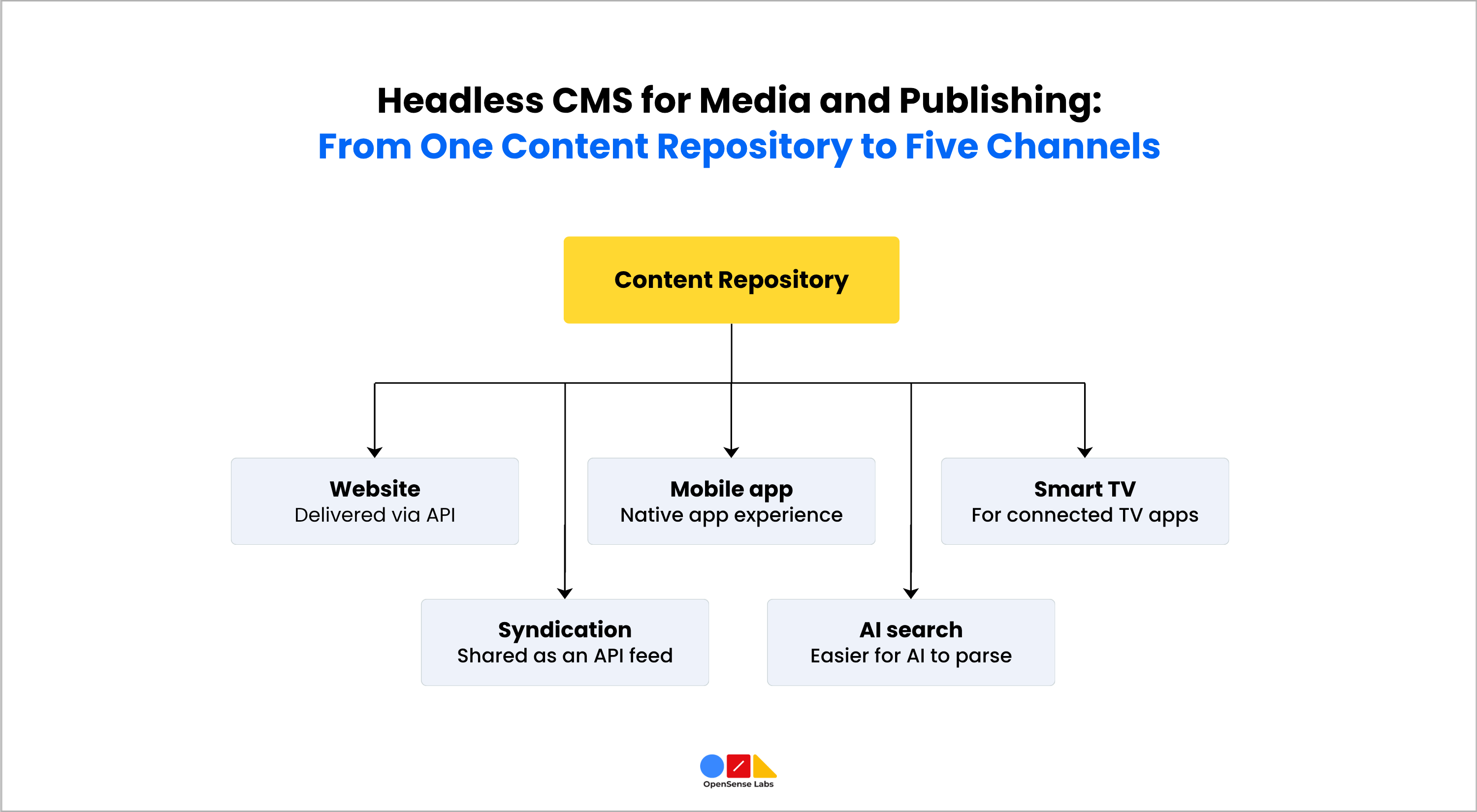
In a headless CMS for media and publishing setup, content is stored in a structured repository, independent of how it will eventually be displayed. Editors define content models, reusable templates that specify fields such as headline, body copy, author, images, and publication date. Developers then build APIs, most commonly REST or GraphQL, that any front end can query to retrieve that content.
This API-first CMS approach gives media organizations two practical advantages: content can be published once and delivered to a website, a mobile app, a partner feed, or a smart TV platform without duplicating the underlying work, and front-end teams gain the freedom to build each channel using whichever framework suits it best.
Structured content also improves discoverability. Clear content models with well-defined fields make it easier to tag, search, and reuse assets across a large content library, which matters considerably once an organization is managing thousands of articles, videos, and images.
Multisite and Syndication Governance
Multisite publishing is where the difference between platforms becomes most visible. Managing several regional sites, brands, or syndication partnerships from separate CMS instances reintroduces exactly the duplication problem organizations were trying to escape.
A shared-instance model resolves this by centralizing content and assets across properties. Brand guidelines, imagery, and reusable content components are managed once and reused everywhere, rather than maintained in parallel across duplicated libraries, and governance and publishing permissions apply consistently regardless of how many sites or regions are involved.
This matters for digital asset management as much as for editorial content. A centralized asset library means images, video, and metadata are stored, tagged, and retrieved from one place, rather than scattered across disconnected site instances. It also supports personalization at scale, since content delivered through a single API layer can be tailored by the audience, region, or device without maintaining separate content bases for each variation.
For syndication partnerships specifically, an API-first architecture simplifies the handoff considerably. A partner feed becomes another API consumer, rather than a manual export-and-import process that needs to be repeated every time content changes.
Evaluation Criteria for Media and Publishing Teams
Choosing an enterprise headless CMS for media and publishing companies is rarely a single-featured decision. Several inquiries assist in structuring the assessment:
- Who publishes day-to-day, and how technical are they?
If editorial teams need to work independently without raising a ticket for every layout change, marketers' usability and visual editing tools should carry real weight in the decision.
- How many sites, brands, or regions does this need to support, now and in three years?
Multisite architecture is far easier to plan for at the outset than to retrofit later.
- What does the current technology stack look like?
A CMS that integrates cleanly with existing analytics, CRM, and personalization tools reduces both implementation risk and ongoing maintenance.
- Does the organization need hybrid flexibility or full headless control?
Teams with strong in-house development resources may prefer full headless freedom, while teams that want to preserve editorial independence are usually better served by a hybrid approach.
- What does support look like after launch?
Ongoing governance, training, and platform support often determine whether a CMS migration delivers its promise over the following years.
Hybrid Headless vs Fully Headless: Why the Distinction Matters
Not every media organization needs a fully headless architecture, and the distinction is worth making explicit before any platform decision.
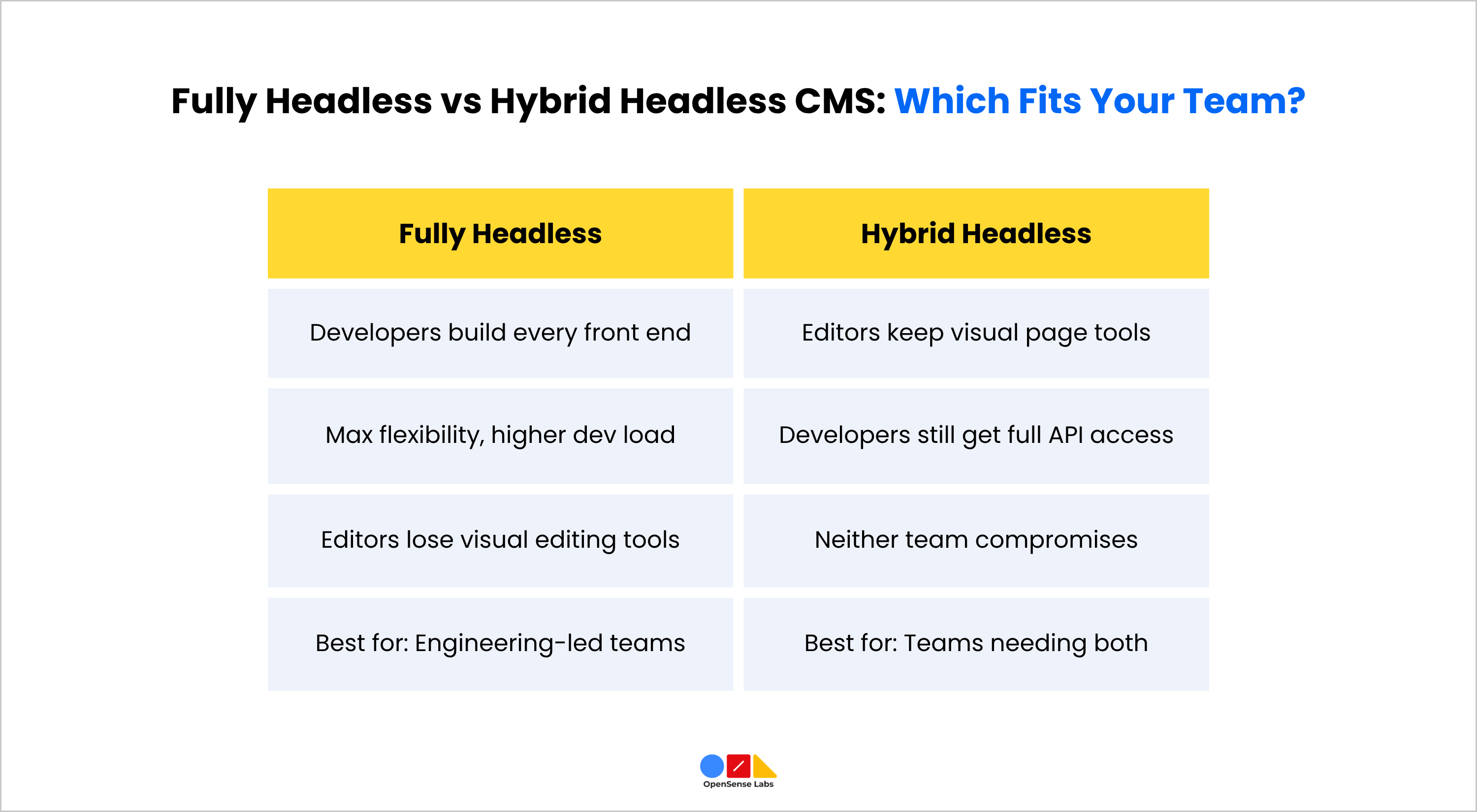
A fully headless CMS removes the built-in front end entirely:
- Every presentation layer, for every channel, must be built and maintained by developers.
- This gives maximum flexibility but shifts significant workload onto engineering teams.
- Editorial staff typically lose the visual, drag-and-drop tools they are used to.
A hybrid headless CMS keeps a built-in front end for teams that want it, while still exposing the same content through APIs for channels that need a custom build:
- Editors retain visual page management and live previews for the website.
- Developers get full API access to the same content for the mobile app, a partner feed, or an emerging channel.
- Neither group is forced to compromise.
For most enterprise media organizations, this hybrid model resolves the central tension that headless architecture otherwise creates. Editorial teams need to publish quickly without waiting on a development cycle, while development teams need clean, well-documented APIs to build without being boxed in by CMS templates. A hybrid architecture, such as headless Drupal, supports both requirements from a single content repository, rather than forcing a choice between developer flexibility and editorial independence.
Where the Field is Heading in 2026
Content operations are increasingly shaped by artificial intelligence, both in how content is produced and in how it is discovered. Media organizations are beginning to structure content not only for human readers across channels, but also for AI-driven search and answer engines, which parse structured, well-modelled content more effectively than unstructured page templates.
This adds a further argument for structured, API-first content. A content repository built around clear content models is easier to expose AI tooling for summarization, tagging, and discovery, without requiring a separate content restructuring project each time a new AI-driven channel emerges.
Composable architecture, where a CMS integrates cleanly with best-of-breed tools for personalization, analytics, and AI, is likely to remain in the dominant direction for enterprise media organizations throughout the rest of the decade.
Conclusion
Media and publishing organizations built around a single-website CMS are reaching the limits of that architecture as channels multiply. A headless CMS for media and publishing addresses the resulting content delivery of bottlenecks by separating content management from presentation, allowing the same content to reach every channel without duplication.
For most enterprise teams, the right answer is not a fully headless rebuild but a hybrid approach, one that preserves editorial independence while giving developers the API flexibility they need. Getting this right requires evaluating governance, existing technology investments, and long-term multisite requirements before committing to a platform.
OpenSense Labs helps media and publishing organizations design and implement CMS architecture built for this kind of scale. To discuss what this could look like for your organization.
Subscribe
Related Blogs
HIPAA-Compliant CMS for Healthcare: Architecture Guide

HIPAA-compliant CMS for healthcare projects succeeds or fails on architecture decisions made before development begins not…
Free Learning Content Management System: Best 10 List For 2025
In today's fast-changing education and training landscape, a free Learning Content Management System (LCMS) is a smart…
Headless CMS vs Traditional CMS: What's The Difference?
If you are looking for a new content management system, you may have come across the term ‘headless CMS.’ Today, businesses…