



Customer Service AI Bot Metrics: What to Track After Deployment



Deploying a customer service AI bot is only the first step. Proving that it works comes next, and this is the harder part.
Gartner reports that 91 percent of customer service leaders face pressure from executives to show measurable results from AI investment. Many teams still rely on dashboards built for an earlier generation of chatbots.
These dashboards track conversation volume, response speed, and containment. They do not show whether a customer's problem was actually solved.
A customer service AI bot can handle thousands of conversations each month and still leave customers unresolved. The metrics that worked for simple FAQ bots do not capture what a modern AI system needs to prove.
This article covers metrics that show genuine resolution, metrics that reveal hidden problems, and a review cadence that turns numbers into action.
What is the Containment Rate?
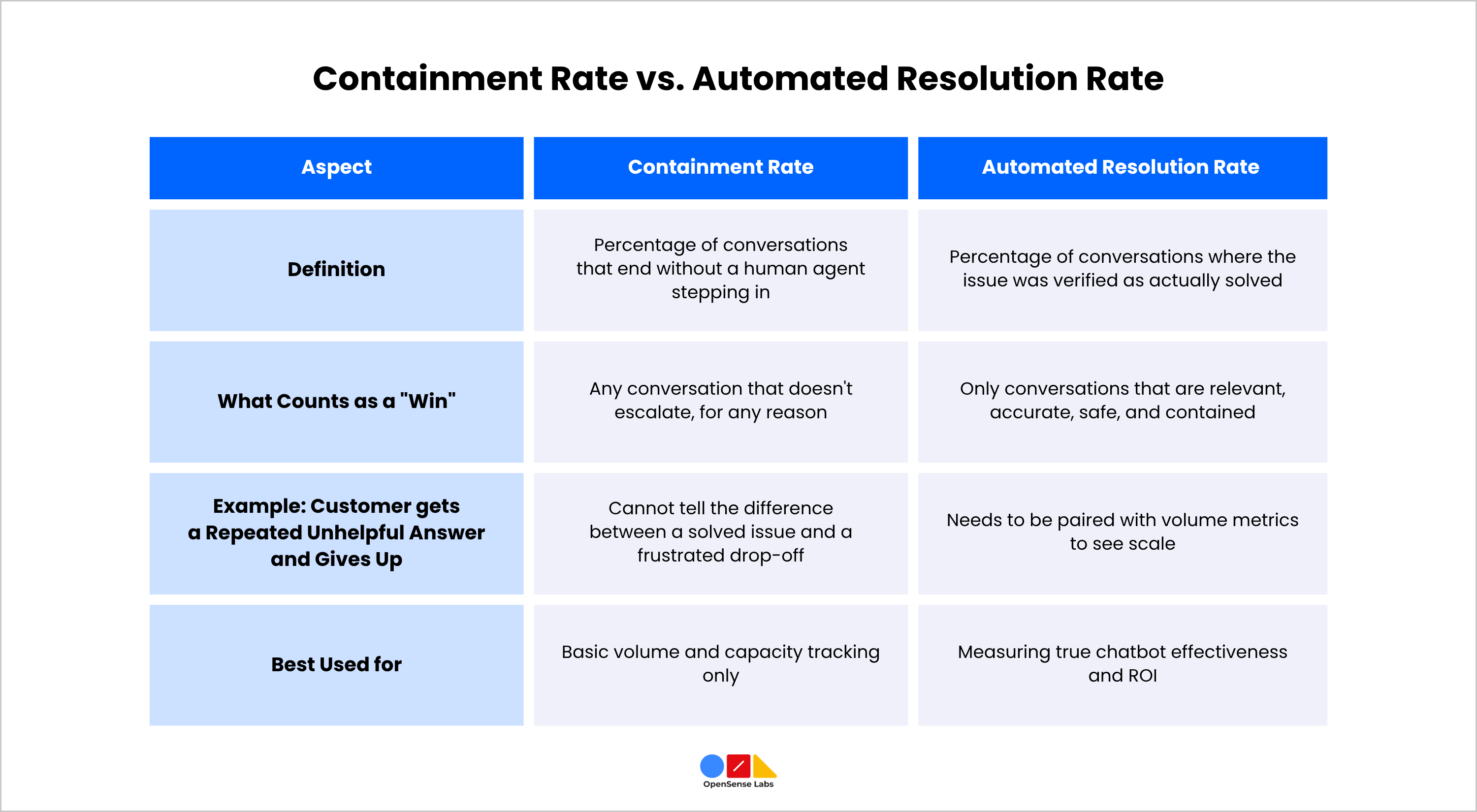
Containment rate measures the percentage of conversations that end without a human agent stepping in.
Formula: Containment Rate = (Conversations Contained ÷ Total Conversations) × 100
This means that if a customer does not escalate their issue beyond the AI, it indicates that the AI has effectively resolved their problem.
This trend is partly due to the growing prominence of AI agents in customer service. Gartner predicted in 2022 that by 2026, 10% of customer service interactions would be automated, a significant rise from the 1.6% that were automated at that time. Many companies aim to enhance this technology to the point where it can resolve numerous customer issues independently, making it crucial to measure the AI agent's success in doing so. However, it is becoming increasingly evident that the traditional metric used to assess this, the containment rate, is inadequate.
"Customer service leaders are optimistic about the future of chatbots, but they find it challenging to pinpoint actionable metrics, which hinders their ability to evolve and expand chatbot capabilities, ultimately affecting their return on investment." - Uma Challa
Senior Director Analyst
Throughout the industry, customer service leaders are raising concerns about the containment rate and are striving to create new metrics for evaluating AI agent performance.
Why is Containment Rate a Flawed Metric?
This assumption breaks down in practice. Here is what containment rate counts as a success:
- A customer leaves the conversation because the bot repeated the same unhelpful answer
- A customer closes the chat out of frustration, not resolution
- A customer abandons the flow after being routed through several menu options with no result
None of these outcomes are winning. But a standard containment dashboard records all of them as contained conversations.
Conversational AI consultants and vendors across the industry have raised the same concern. Several have said publicly that containment rate rewards silence, not success. A chatbot can post a high containment rate while quietly damaging the customer experience.
The containment rate still serves a purpose for tracking basic volume. The solution is to combine it with metrics that assess actual resolution, which will be discussed in the next section.
Core Customer Service AI Bot Metrics that Measure Real Resolution
Resolution-focused metrics answer a different question. They ask whether the customer's issue was actually solved, not just whether a human was avoided.
Automated Resolution Rate (AR%)
This metric only counts a conversation as resolved when it meets four conditions:
- The response is relevant to what the customer asked
- The response is accurate
- The response meets safety and compliance standards
- No human agent was required
Formula: AR% = Resolved Conversations ÷ Total Conversations
First Contact Resolution (FCR)
FCR measures the share of issues solved on the first attempt, with no follow-up contact needed.
Formula: FCR = (Issues Resolved on First Contact ÷ Total Issues) × 100
For a customer service AI bot, FCR should include both fully automated resolutions and AI-assisted ones. Set separate targets by topic. A password reset should resolve at a much higher rate than a billing dispute.
Escalation Rate
Escalation rate measures how often a conversation is handed to a human agent.
Formula: Escalation Rate = (Escalated Conversations ÷ Total Conversations) × 100
A low escalation rate is not automatically good. Some requests should always reach a human, particularly ones involving compliance, sensitive data, or emotional situations. Review escalation reasons by category rather than chasing a single target number.
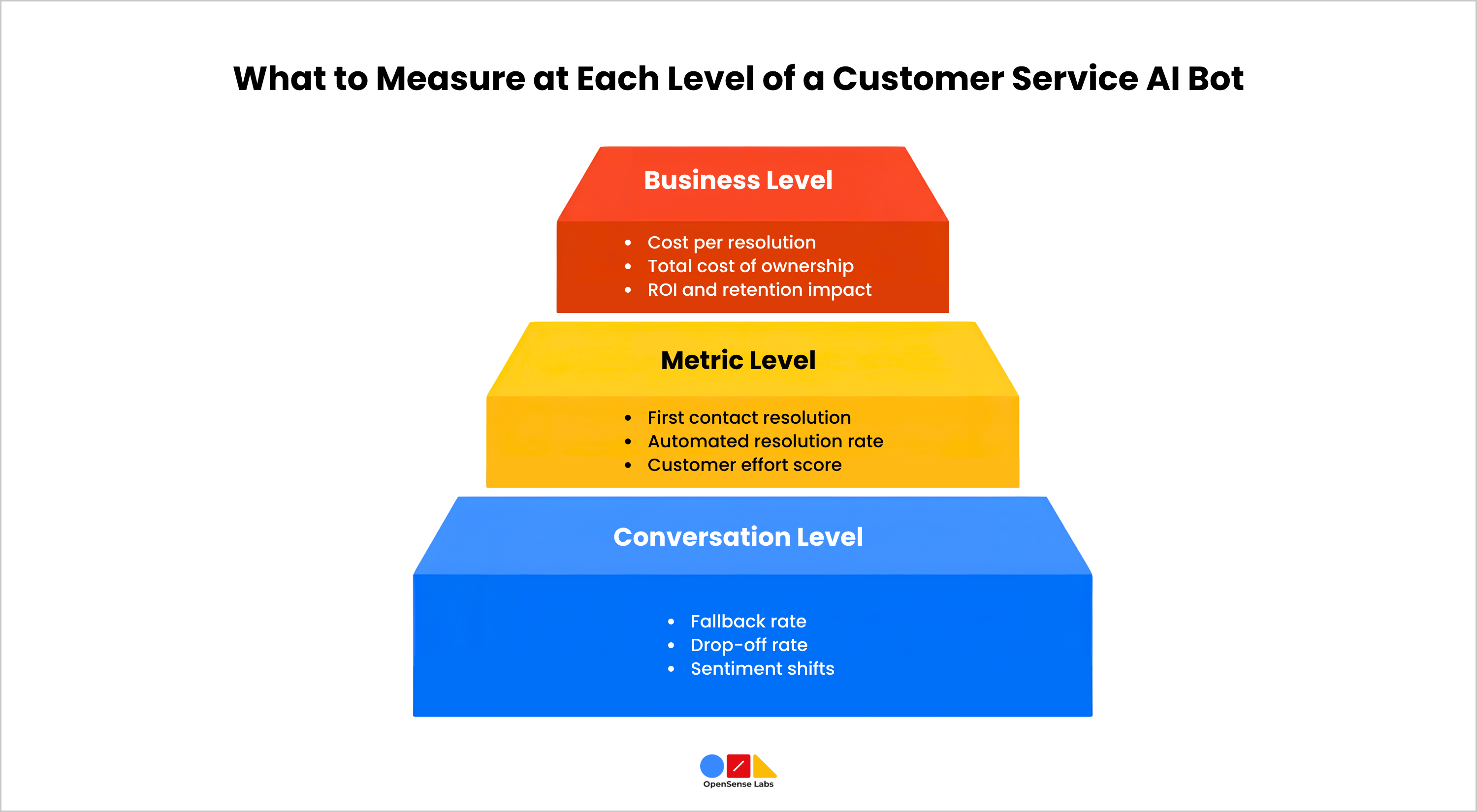
Experience Metrics: CSAT, CES and Sentiment Analysis
Resolution metrics show whether a problem was solved. Experience metrics show how the customer felt about the process.
Customer Satisfaction Score (CSAT)
CSAT is collected through a short survey after the conversation ends.
Formula: CSAT = (Positive Responses ÷ Total Survey Responses) × 100
CSAT has a known limitation. Many customers skip the survey, so the score only reflects the people who chose to respond.
Customer Effort Score (CES)
CES asks how easy it was for the customer to get their issue resolved, usually on a numbered scale.
A high-effort experience often means:
- The bot asked the customer to repeat information already provided
- The conversation required too many steps for a simple request
- The handoff to a human agent lost context along the way
Sentiment Analysis
Sentiment analysis uses natural language processing to read the tone of a conversation. It can flag frustration or confusion before a customer ever fills out a survey.
Reviewing sentiment shifts before and after an escalation point is particularly useful. A sharp negative shift right before a handoff usually points to a specific breakdown in the flow.
Cost and Efficiency Metrics: Cost Per Resolution, AHT, and TCO
Business leaders care about outcomes, but they also need to see the cost side of the equation.
Cost Per Resolution
This metric divides total operating cost by the number of successfully resolved requests.
Formula: Cost Per Resolution = Total Operational Cost ÷ Successfully Resolved Requests
Include these cost inputs for an accurate figure:
- Platform and infrastructure costs
- Implementation and ongoing maintenance
- Human review and escalation handling
- Rework needed after failed automation
Average Handle Time (AHT)
AHT still matters, but only when segmented by interaction type. Track it separately for:
- AI-only resolutions
- Human-only resolutions
- AI-assisted human resolutions
Without this split, AHT can mislead a team. If the bot filters out simple requests, the human queue is left with harder, more complex cases. Human AHT may rise even though the bot is performing well.
Total Cost of Ownership (TCO)
TCO captures the full running cost of the system, not just the licence fee. A low-cost bot can become expensive if it needs heavy integration work or pushes unresolved issues back to human agents.
Conversation-Level Diagnostics: Fallback Rate, Drop-Off and Repeat Contact
High-level metrics show what is happening. Diagnostic metrics show why.
Fallback Rate
Fallback rate tracks how often the bot fails to understand a query and returns a generic response.
Formula: Fallback Rate = (Conversations Triggering a Fallback ÷ Total Conversations) × 100
A fallback rate above 15 percent usually signals a gap in the knowledge base. Review the most common unanswered questions as a starting point.
Drop-off Analysis
Drop-off analysis identifies where in a conversation customers abandon the flow. Common causes include:
- Too many questions before the customer reaches an answer
- Confusing menu options
- A missing integration that stalls the conversation
Repeat Contact Rate
Repeat contact rate tracks how often a customer returns with the same unresolved issue within a set window, such as 24 or 48 hours.
This metric catches a blind spot that resolution metrics miss. A conversation can be marked as closed while the underlying problem stays unsolved.
How to Fix Declining Customer Service AI Bot Metrics
Identifying a problem metric only matters if it leads to a specific action. Each metric points to a different root cause and a different fix.
Low First Contact Resolution
- Review the intents with the lowest resolution rates and check if the knowledge source for those topics is outdated or incomplete
- Rebuild the flow for the three worst-performing intents rather than making small adjustments across all of them
- Set resolution targets by topic rather than one blanket number, since complex issues need a different bar than simple ones
High Fallback Rate
- Pull the list of unanswered queries and group them by theme
- Add missing documentation for the most frequent themes first
- Retrain the intent classifier once new documentation is in place, rather than only updating content
High Drop-Off Within a Conversation
- Map where in the flow customers most often abandon
- Reduce the number of questions asked before the customer reaches a useful answer
- Simplify menu options where customers repeatedly choose the wrong path
Rising Repeat Contact Rate
- Sample conversations marked as resolved that led to a repeat contact within the tracking window
- Check whether the original response was accurate but incomplete, rather than simply wrong
- Adjust the resolution criteria so a conversation only closes once the full request is addressed
Negative Sentiment Shift Before Escalation
- Review the exact point in the conversation where sentiment turns negative
- Check if the shift lines up with a specific request type or a specific handoff step
- Move the escalation trigger earlier for that request type, before frustration builds
Rising Cost Per Resolution
- Separate the cost increase by interaction type to see if it comes from more escalations or higher per-conversation cost
- Address the volume driver rather than the platform cost if escalation volume is the cause
- Revisit workflows with the highest rework rate, since repeated fixes to failed automation add up over time
Each fix works best when tested on a small segment first, then rolled out once it proves out. This makes clean baseline data essential, which is the reason for the review cadence below.
Setting a Review Cadence for Customer Service AI Bot Performance
Metrics only create value when someone reviews them on a set schedule and acts on what they find. A practical cadence looks like this:
- Daily: conversation volume, escalation spikes, technical errors
- Weekly: failed intents, workflow gaps, top escalation reasons
- Monthly: CSAT, CES, sentiment trends and repeat contact, broken down by topic
- Quarterly: cost per resolution, total cost of ownership, staffing impact and expansion plans
Each metric should map to a specific action. A low FCR points to a knowledge gap. A high fallback rate points to missing documentation. A negative sentiment shift points to a tone or escalation problem that needs a fix.
Measurement works best when it is part of the chatbot's design from the start, not added after launch. A bot built with accuracy, relevance, and safety checks at each response has resolution data available from day one, rather than needing a separate analytics layer bolted on later.
This is the approach behind OpenSense Labs' AI Chatbot builds. Every chatbot is developed with our framework in place, scoring responses for accuracy, fairness, and safety before they reach the customer. The metrics in this article are not an afterthought for these deployments. They are built into the architecture.
Subscribe
Related Blogs
Chatbot Human Handoff: Escalation Triggers, Context Transfer and Queue Design

A chatbot human handoff is easiest to fix before launch and hardest to fix once customers are waiting. This article gives…
AI Governance in Financial Services: A BFSI Leader's Framework

AI governance in financial services is converging fast, the EU AI Act, DORA, and the FCA now demand the same things:…
What Enterprise AI Readiness Assessment Actually Reveals?

Most vendor-led AI readiness assessment check the obvious things, data strategy, executive sponsorship, completed pilots,…